
Trustees authorize sale of land, modernization of dining services
HAMMOND, Ind. - The Purdue University board of trustees, meeting at Purdue Calumet, agreed Friday (Sept. 29) to sell 78 acres of land on the edge of West Lafayette.
|

The board also increased the Housing and Food Services budget to build a previously planned new dining facility near Wiley Hall and approved planning for a new outdoor plaza at Discovery Park and renovations to several floors of Young Hall.
The land to be sold extends west and north from the intersection of Salisbury Street and Kalberer Road on West Lafayette's north side. The land, purchased in 1951 from the estate of Lena Belle Brier, is mostly farmland that was recently annexed by West Lafayette. The university decided to sell after moving its Purdue farm research operations further west in Tippecanoe County.
The proposed transaction next will be submitted to Gov. Mitch Daniels, who will appoint appraisers to determine the land's value, which is currently held in trust for Purdue by the state of Indiana.
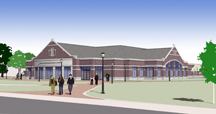
The board increased the budget for University Residences' food service master plan, established in 1999,from $48.2 million to $57.9 million to adjust for increases in projected construction costs. The master plan also has been modified to take advantage of the experiences gained from constructing the first three dining courts. Instead of renovating the food service facility in an existing residence hall, Purdue instead will build a freestanding, 500-seat, $19.8 million dining court just south of Wiley Hall, directly across Intramural Drive from the Recreational Sports Center.
The Wiley Dining Court will be similar to previously completed, award-winning dining courts at Earhart Hall, Windsor Halls and Ford Dining Court near Cary Quadrangle. It will include multiple themed food stations that offer an array of domestic and international food options, many prepared to order. The modern interior architecture and décor will combine stone, wood, burnished steel and frosted glass with contemporary fixtures and furniture.
"These diverse dining options are an important recruiting and retention tool not only for University Residences but for the university as a whole," said Barbara Frazee, executive director for University Residences. "The dining courts contribute significantly to the quality of life on campus in large part by ensuring that students experience social interaction, quality food and nutritious meals at a reasonable price."
Sarah Johnson, director of University Residences dining services, said the new concept has helped reduce the number of meals students skip by almost 10 percent over the past six years and more than tripled the amount of business from people who dine at the courts by choice and not contract. Operational costs have decreased and customer satisfaction has increased.
In the mid-1990s University Residences found that its 11 food service venues needed more than $50 million in renovation, students wanted a more modern dining experience and options, student workers were harder to recruit, and dining and housing plans needed to be coordinated. The resulting master plan aimed to increase customer satisfaction, decrease the institutional cafeteria atmosphere, increase operational efficiencies and use cost savings to pay for the improvements. Since 2002 University Residences has built three dining courts and two quick-service retail dining facilities. The plan has been recognized with multiple awards, including Best in Show in Food Management magazine's 2006 Best Concepts Awards.
A self-supporting operation, University Residences will fund all construction through fees paid by revenue from student board contracts and cash meal sales in the dining facilities. No tax dollars are involved.
"The national awards and statistical metrics show that we are achieving our goals," said John A. Sautter, vice president for housing and food services. "The Wiley Dining Court successfully completes our food service master plan and dovetails nicely with our housing plan."
In addition to being less expensive, Sautter said a freestanding facility also increases design flexibility and expands the likely life span of the dining hall.
Scholer Corp. of Lafayette designed the dining facility. Construction is scheduled to be completed during summer 2008, in time for a fall 2008 opening.
On the south side of campus, Discovery Park will receive a new look for its eastern gateway along Intramural Drive. The $2.4 million in improvements will include walkways, landscaping and a brick-paved plaza.
"The architecture at Discovery Park is award-winning, and we are extending the same innovation outdoors," said Alan Rebar, executive director of Discovery Park. "Well-thought-out landscape architecture helps ensure that people from different buildings in the park are encouraged to engage socially and professionally. That kind of interaction is at the heart of our philosophy of interdisciplinary discovery."
The board approved contracting Rundell Ernstberger Associates LLC, of Muncie, to provide architectural services.
The $4.56 million renovation to Young Hall will convert the top two floors of the residence hall into office space and conference rooms. The project will complete the building's fire suppression system. The elevators will receive a complete renovation that ensures compliance with the Americans with Disabilities Act.
"This project increases the utility and safety of a strategically placed building for many years to come," said Wayne Kjonaas, vice president for physical facilities. "The design will make the most efficient use of the existing space to use the vital renovation dollars as judiciously as possible."
The board approved contracting HCO Inc. of Indianapolis to provide architectural services.
The board also approved the naming of two new buildings in West Lafayette and a bridge in Fort Wayne. The Niswonger Aviation Technology Building was named to honor Scott Niswonger, who donated $3 million to construct the new aviation technology building and to renovate another historic classroom-office building where Amelia Earhart hangared her plane at the Purdue Airport. The building to be renovated has housed the Department of Aviation Technology for its more than 50-year history.
The trustees approved the naming of Bill and Sally Hanley Hall. The Hanleys contributed $3 million toward the building, which will be the home for the Human Development Institute. The institute will include centers and programs that promote research on families, aging and leadership under the umbrella of the College of Consumer and Family Sciences.
The Venderly Family Bridge was named in honor of Ron Venderly of Fort Wayne, who donated $1 million to build the spans across the St. Joseph River and another $1 million for athletic scholarships.
The board's Physical Facilities Committee on Thursday (Sept. 28) took the following actions:
• Approved financing and construction for the renovation of Wetherill Laboratory of Chemistry, Room 200, which is a 474-seat lecture hall. The $745,000 project will include refurbishing the walls, ceiling and lectern area, updating lighting fixtures and installing new audiovisual and wireless data connection systems. The committee approved using repair and rehabilitation funds to pay for the project. Construction bidding will take place in January and work will be done during summer 2007.
• Awarded the construction contract for the $600,000 electrical utilities improvements project at the Elliott Hall of Music to Hagerman Construction Corp. of Fort Wayne. Work is scheduled to begin immediately and be complete by spring.
• Approved planning, financing and construction of a fire sprinkler system on all 10 floors of the Mathematical Sciences Building. The committee approved contracting Applied Engineering Services of Indianapolis for architectural services. The committee approved using $700,000 in repair and rehabilitation funds for the project. Construction bidding will take place in early 2007 with 14-16 months of construction scheduled to begin in March.
• Approved planning for a $600,000 fire alarm and fire suppression system for the east wing of Owen Hall. The committee approved contracting R.E. Dimond and Associates Inc. of Indianapolis to provide architectural services.
• Approved financing and construction for upgrading and renovation of laboratory and research space in the Biochemistry Building. Four rooms will get new plumbing, electrical systems, fume hoods, lighting and an upgraded air-handling system. J.R. Kelly Company Inc. of Lafayette was awarded the construction contract for the $515,000 project, which will be paid for with repair and rehabilitation funds. Work is scheduled to begin immediately and be complete by April.
• Approved an agreement with Anderson University to lease 11,294 square feet in the Flagship Enterprise Center being built in Anderson. Beginning in fall 2007, the space will house classes for Purdue's Statewide Technology programs.
Writer: Jim Schenke, (765) 494-6262, jschenke@purdue.com
Sources: Alan Rebar, (765) 496-6625, rebar@purdue.edu
Barbara Frazee, (765) 494-1000, bjfrazee@purdue.edu
Sarah Johnson, (765) 494-4100, scj@purdue.edu
John Sautter, (765) 494-1022, jasautter@purdue.edu
Wayne Kjonaas, (765) 494-8000, wwkjonaas@purdue.edu
Larry Fusaro, university architect, (765) 494-8003, ljfusaroa
Purdue News Service: (765) 494-2096; purduenews@purdue.edu
Related Web sites:
Speech: President Jischke's comments to the board of trustees
Related news releases:
Advanced manufacturing funding included in Purdue's budget request
Trustees honor deans, professors; OK appointments, academic changes
To the News Service home page