
Civil engineering inventor, entrepreneur honored at two events

|
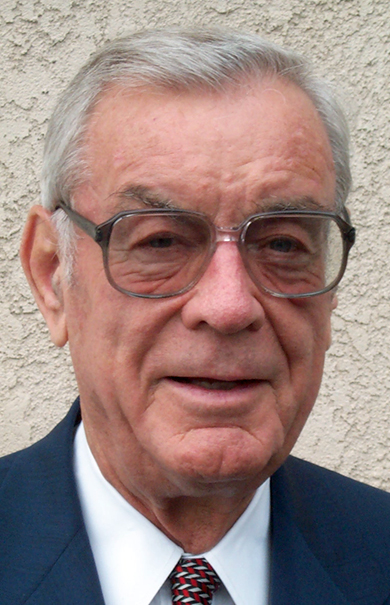
Charles Pankow, a South Bend, Ind., native and a 1947 graduate in civil engineering who received an honorary engineering doctorate from Purdue in 1983, will receive the national Chi Epsilon organization's highest individual honor. In addition, Purdue's Civil Engineering Student Advisory Council will name a student lounge in the Civil Engineering Building in Pankow's honor.
"We heard about the students' desire to have a lounge and saw this as a real need," said Purdue alumnus Robert Law, the chief estimator for Charles Pankow Builders Ltd. in Pasadena, Calif. "We were also impressed with the fund raising and the work the students were willing to do in order to have an area in the Civil Engineering Building renovated for a lounge."
The national Chi Epsilon Award will be presented during a private ceremony in Stewart Center. This award has been given to just 58 of the more than 100,000 members in the organization, which was established in 1922.
At 4:30 p.m. Purdue will dedicate the Charles Pankow Student Lounge on the second floor of the Civil Engineering Building. This event is open to the public.
More than 10 members of Pankow's family and company are expected to attend both events. Pankow (pronounced PAN-ko) died in 2004. His brother, James, earned a bachelor's degree in liberal arts and a master's degree in engineering law from Purdue in 1947 and 1950, respectively. Law earned a bachelor's degree in interdisciplinary engineering and a master's degree in civil engineering from Purdue in 1973 and 1974, respectively. He serves on the School of Civil Engineering Industry Advisory Council.
"Charles Pankow's contributions in the field of civil engineering are well known by students and professionals in the field," Purdue Provost Sally Mason said. "We are proud of what he accomplished. He is one of just four individuals from Purdue to receive the national Chi Epsilon Award."
The three other Purdue alumni who have received the National Chi Epsilon Award are:
• Stephen D. Bechtel Jr., who earned a bachelor's degree in civil engineering in 1946 and an honorary doctorate in engineering in 1972. He serves as chairman emeritus of Bechtel Group Inc. in San Francisco, one of the nation's largest engineering and construction companies.
• Ralph E. Fadum, a former Purdue professor of civil engineering who received an honorary doctorate degree in engineering from Purdue in 1963. He was dean emeritus of North Carolina State University's College of Engineering. He died in 2000.
• Solomon Cady Hollister, a former Purdue professor of civil engineering and a dean of engineering and professor emeritus in civil and environmental engineering at Cornell University. During his career, Hollister was a designer of Hoover Dam in Nevada. He died in 1982.
Chi Epsilon is the national honor society for civil engineers. Its award is in recognition of individual accomplishments in the field of civil engineering. Only two members receive the National Chi Epsilon Award during a two-year period.
Pankow founded his own construction company, Charles Pankow Inc., in the garage of his Altadena, Calif., home in 1963. The company builds commercial office buildings, multifamily housing, mixed-use developments, hotels, hospitals and parking structures.
In conjunction with the National Institute of Standards, CERF and the University of Washington, Pankow Builders successfully developed a precast concrete hybrid resisting moment frame. This system is highly resistant to earthquakes, sustaining significantly less damage to a building's structure than traditional systems.
"I studied a lot about the work Charles Pankow did in civil engineering," said David DeLong, a graduate student in civil engineering from Dayton, Ohio, and president of Chi Epsilon's Purdue chapter. "For example, he invented the process for manufacturing hollow concrete piles, which are used in building constructions in earthquake areas. This invention changed the way some structures are built and contributed to the safety and security for many people living in areas where earthquakes are a danger."
In 1974 Pankow received the American Concrete Institute's Roger H. Corbetta Award for his innovative construction methods and for developing economical uses for concrete.
Pankow's son, Richard, said his father was quietly loyal to Purdue, even while he lived in California.
"Not only has he made contributions to Purdue, his company has hired numerous graduates from Purdue. I know it was a very pleasant Saturday around the house when Purdue beat Notre Dame in football," Richard Pankow said.
"Education was also very, very important to Dad. When we were in high school, he talked not in terms of whether we would go to college, but only where we would go. I think this weekend is a perfect blend of his values.
"I know he would be proud to have been so honored in this way by his alma mater and pleased that this gift has helped make possible this student lounge at this fine university."
The Charles J. Pankow Foundation provided half of the funding for the $30,000 student lounge. The foundation is a non-profit public benefit charitable corporation with the mission of providing the public with improved quality, efficiency and value of buildings by advancing innovation in design and construction.
An 11-member Civil Engineering Student Advisory Council developed and planned the 500-square-foot lounge. The area provides full Internet access, three office spaces for student organizations, five round tables, several sofas and chairs, and three workstations.
"This is the first time the students will have a dedicated space in the Civil Engineering Building to serve as a place to meet," said Abigail Moyer, council president and a senior in civil engineering from Bellefontaine, Ohio. "The whole process of creating this space was a learning experience for us because we had to find out how to raise money and develop plans to create this space."
Other contributors to the lounge include several civil engineering alumni, the School of Civil Engineering, the Civil Engineering Student Advisory Council and several civil engineering faculty.
Purdue's School of Civil Engineering is one of 13 academic engineering programs. The Purdue College of Engineering has nearly 6,200 undergraduate students and is one of the largest in the nation. U.S.News and World Report regularly ranks the college in the top 10 programs nationwide, with the School of Civil Engineering's undergraduate and graduate recently ranked No. 7 and No. 8, respectively.
Writer: Cynthia Sequin, (765) 494-4192, csequin@purdue.edu
Sources: Robert Law, (626) 304-1190
Abigail Moyer, amoyer@purdue.edu
David DeLong, ddelong@purdue.edu
Purdue News Service: (765) 494-2096; purduenews@purdue.edu
To the News Service home page