
March 2, 2006
Bush administration official tapped for Purdue conference
WEST LAFAYETTE, Ind. – A top Bush administration official working to reduce the health-care industry's reliance on paper and advance the benefits of information technology will be the keynote speaker for a March conference at Purdue University.

|
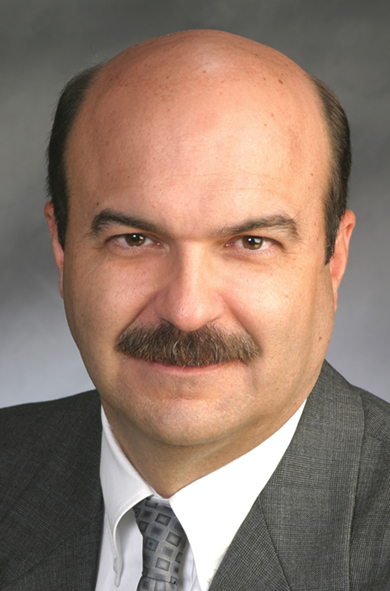
Dr. John Loonsk, director of the office of interoperability and standards in the Office of the National Coordinator for Health Information Technology, will headline the Purdue conference, Delivering on Health Care, on March 20-22 in Stewart Center.
Purdue's Regenstrief Center for Healthcare Engineering and Homeland Security Institute at Discovery Park, as well as the Center for Education and Research in Information Assurance and Security (CERIAS), are sponsoring the three-day event.
"The goal to make the health-care industry paperless in 10 years represents an important advancement in health-care delivery," said Steven Witz, director of the Regenstrief Center for Healthcare Engineering.
"With support from the Regenstrief Foundation, we are working with new applications for information systems and other operations improvements to make the health-care industry more efficient while upholding the quality of care that the industry is known for in this country."
Loonsk (pronounced Loon-SK), whose talk is titled "The U.S. Government's Healthcare Information Technology Strategy: A Progress Report and a Look Ahead," is scheduled to speak at 11 a.m. March 21 in Stewart Center's Fowler Hall.
The three-day event, which is a part of the fourth annual e-Enterprise Conference and the seventh annual CERIAS Symposium, is free and open to the public.
"The application of advanced information technology to health care will almost certainly lead to better access to medical services, greater cost efficiencies, and improved quality of diagnoses and patient care," said Eugene Spafford, executive director of CERIAS.
"But there are numerous challenges in how best to fit the right technologies into existing and future health-care enterprises. Furthermore, the introduction of increased online access to confidential health-care information will create new opportunities for its unauthorized or inappropriate use."
The Purdue event also will include panel discussions on bird flu, nursing, privacy issues, telemedicine and federal and state solutions to help control the rising costs of health care. In addition, Regenstrief, CERIAS and Homeland Institute researchers will highlight updates on reports and projects completed or still under way at Purdue. Poster sessions also are planned.
To register, go online. For more information about the CERIAS event, go online.
The Regenstrief (pronounced REE-gen-streef) Center, which was launched within Purdue's e-Enterprise Center at Discovery Park in January 2005, is working to design, implement and sustain interdisciplinary solutions to transform the nation's health-care delivery system.
Loonsk, who received medical training at the State University of New York at Buffalo after graduating from Johns Hopkins University, was appointed to the federal post in January. He reports to Dr. David Brailer, who reports to U.S. Health and Human Services Secretary Michael O. Leavitt.
Loonsk is working with Brailer to bring together the many fragmented segments of the health-care industry, including doctors, hospitals, health plans, payers and the health-related agencies of the federal government.
Through greater use of electronic health records and electronic prescription-ordering systems, the federal government estimates taxpayers could save up to $160 billion annually, according to a study released by the nonprofit organization Rand Corp. last September.
Most of those savings would come from improved patient care by eliminating redundant tests when doctors don't have access to paper-based information, the Rand study indicated.
Fewer than 5 percent of physicians and hospitals currently use electronic health records and related systems, mainly because of the costs. Costs to equip hospitals with the necessary equipment to go completely paperless have been estimated as high as $276 billion over 10 years, according to the Office of the National Coordinator for Health Information Technology.
"Dr. Loonsk's comments about his work to create the Public Health Information Network will provide important insights for RCHE and CERIAS researchers," CERIAS' Spafford said.
Before joining the Bush administration, Loonsk was associate director of informatics at the Centers for Disease Control. There, he helped create the National Electronic Disease Surveillance System, leading to the Public Health Information Network.
In 2003, he also rolled out BioSense, a program within the CDC designed to pick up signals of potential health emergencies as close to the onset as possible.
His first foray into medical informatics came in 1975 when he worked on a project to develop a computer system to categorize liver diseases. Medical informatics is the application of information technology to health-care industry practices, research and learning, particularly in segments of the industry that must manage large amounts of data within their operations.
Loonsk also implemented the nation's first mandatory course in medical informatics at SUNY-Buffalo and oversaw the development of electronic learning at the University of North Carolina in Chapel Hill.
Bush created the federal health information technology coordinator position nearly two years ago, pledging to provide most Americans with electronic health records within the next decade.
Brailer has said his goal is to have every doctor using a computer to record and read patients' medical records, to order tests, write prescriptions and view images, such as X-rays or CT scans. The real challenge, he added, is creating connections among all hospitals so if a person is in an emergency room in a different city, those medical records will be readily available.
During a stop in Cleveland in early February, President Bush said the medical industry is behind the times, using paper and pen for many records and prescriptions when computerized records could reduce cost and errors.
"Most industries in America have used information technology to make their businesses more cost-effective, more efficient and more productive. And the truth of the matter is, health care hasn't," Bush said during a forum at the Cleveland Clinic in Ohio. "We've got fantastic new pharmaceuticals that help save lives, but we've got docs still writing records by hand."
The Regenstrief Center and the Homeland Security Institute are a part of the e-Enterprise Center at Discovery Park, Purdue's $300 million hub for interdisciplinary research and home to 10 established research centers focusing on endeavors ranging from biosciences and manufacturing to oncological sciences and health-care engineering.
Some initial areas of research at the Regenstrief Center include improving the safety and efficiency of patient care; providing more efficient deployment of physicians, nurses and other health-care personnel; and better coordinating inpatient and outpatient treatment.
Writer: Phillip Fiorini, (765) 496-3133, pfiorini@purdue.edu
Sources: Steve Witz, (765) 496-8303, switz@purdue.edu
Eugene Spafford, (765) 494-7825, spaf@cerias.purdue.edu
Purdue News Service: (765) 494-2096; purduenews@purdue.edu
To the News Service home page