
November 18, 2005
Purdue University plant geneticist named fellow of AAAS
WEST LAFAYETTE, Ind. - Research that developed new grain varieties able to withstand parasitic weeds and drought and have improved the livelihood of people in developing countries has earned a Purdue University plant geneticist a fellowship in the world's largest general scientific society.

|
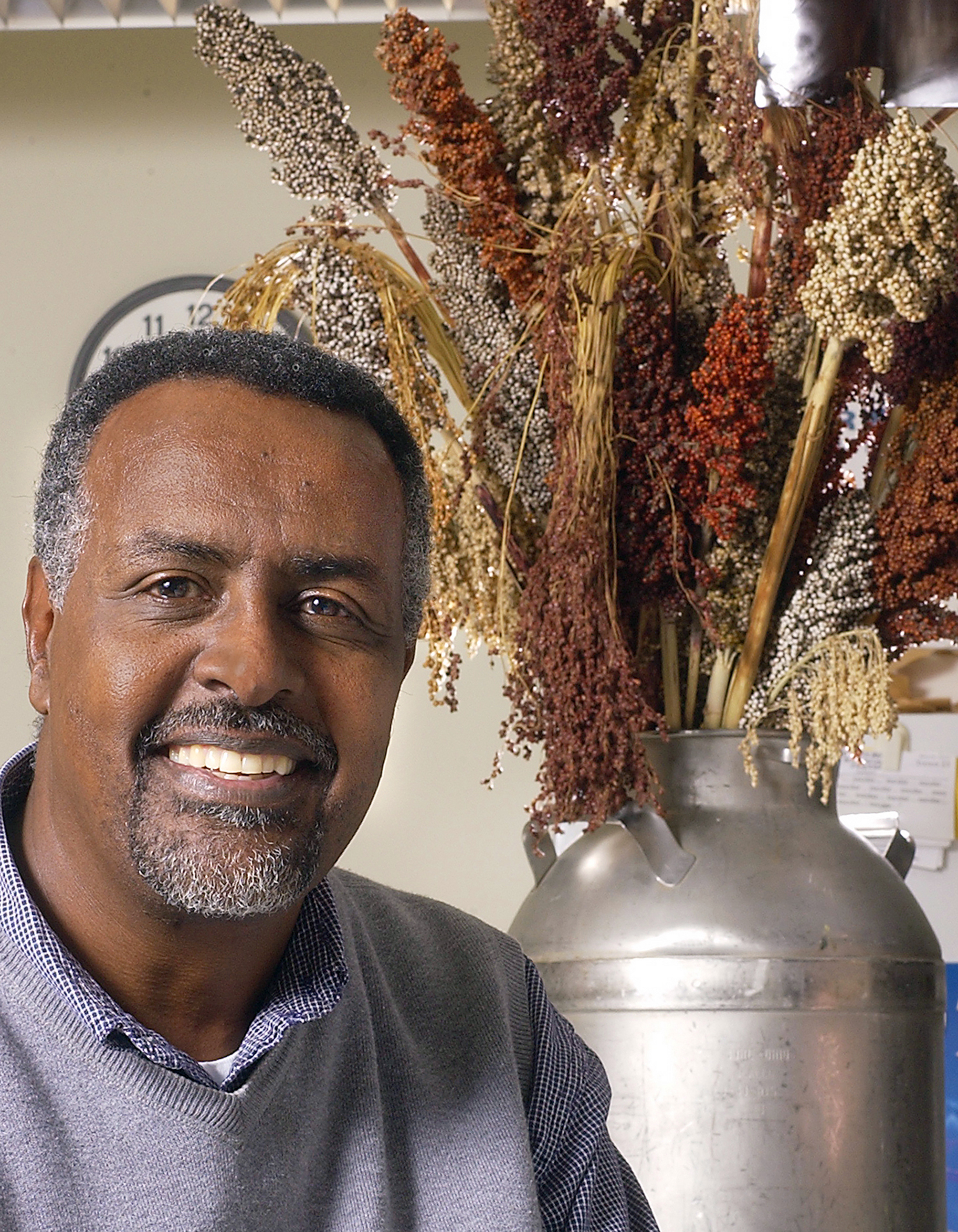
Gebisa Ejeta was recognized for his "significant contributions to the study of the biology of host-parasite interaction in crop plants and for enhancing the well-being of people in developing countries through the genetic improvement of crops," according to the American Association for the Advancement of Science (AAAS). Ejeta was one of only 16 new fellows chosen this year from the society's Agriculture, Food and Renewable Resources Section.
An Ethiopian native, Ejeta has been instrumental in developing higher quality sorghums that are resistant to drought and the parasitic weed striga. These sorghums have been officially released for broad commercial cultivation in five African countries. Sorghum is a grain widely used for both human and livestock consumption in African countries where striga, drought and poor soil often make crop growth almost impossible.
In Ethiopia more than 100,000 farmers have adopted the striga-resistant sorghum varieties. In the Sudan one of the drought-resistant hybrids is grown on more than a million acres and is providing an estimated annual benefit of $70 million.
To further the development and deployment of these resistant sorghum plants, Ejeta also established the Integrated Striga Management project to use resistant sorghum plants, along with fertilizer and water conservation, to improve production. Another objective of the program is to create markets for sorghum in order to provide incentives for farmers to use integrated management. The U.S. Agency for International Development's Office of Foreign Disaster Assistance provides support for this project.
"Because damage caused by parasitic weeds is more severe on crops already under stress, we reasoned that an integrated management package including host plant resistance, soil fertility enhancement and a water conservation measure will encourage a synergistic response that is greater than the sum of its components," said Ejeta, a professor of plant breeding and genetics in Purdue's Department of Agronomy.
Agronomy department head Craig Beyrouty said that Ejeta's work is invaluable.
"His sorghum breeding and development in Africa is truly remarkable," Beyrouty said. "The Integrated Striga Management program is having tremendous impact on feeding the hungry and allowing more farmers to become self-reliant."
Ejeta and his Purdue collaborators developed 11 types of sorghum resistant to the striga weed. In 2001 they launched an integrated management pilot program in four regions of Ethiopia. Since then the program has been used in two other African countries, Eritrea and Tanzania.
The management system resulted in as much as five times the yield normally found in the affected areas, even in areas so severely infested with striga that farmers were realizing almost no crop production. Areas that used the integrated management strategy became almost striga-free.
The system is beginning to result in new markets for the grain through the organization of farmers' seed-growing cooperatives. A Tanzanian brewery and an Ethiopian cookie factory are interested in using sorghum produced by local farmers for their products if uniform quality and quantity standards can be met. The Tanzanian government also has agreed to buy sorghum for its National Strategic Food Reserve.
Ejeta earned his bachelor's degree at Alemaya University in Ethiopia and his master's degree and doctorate at Purdue. He joined the Purdue faculty in 1984.
The AAAS will present Ejeta with an official certificate and a gold and blue rosette pin on Feb. 18 during the society's 2006 annual meeting in St. Louis. The organization was founded in 1848 and began its fellows program in 1874. It includes 262 affiliated societies and academies of science and publishes the largest paid-circulation, peer-reviewed general science journal in the world, Science.
Writer: Susan A. Steeves, (765)496-7481, ssteeves@purdue.edu
Source: Ejeta Gebisa, (765) 494-4320, gejeta@purdue.edu
Ag Communications: (765) 494-2722;
Beth Forbes, forbes@purdue.edu
Agriculture News Page
PHOTO CAPTION:
Gebisa Ejeta, a Purdue plant geneticist, has developed strains of the grain sorghum that have changed the lives of many farmers in Africa. The sorghum varieties are resistant to drought and a parasitic weed called striga. (Purdue Agricultural Communication photo/Tom Campbell)
A publication-quality photo is available at https://www.purdue.edu/uns/images/+2005/gebisa-aaas.jpg
To the News Service home page