
| RELATED INFO |
| • Purdue Cancer Center |
| • Elanco |
| • Indiana Elks cancer research support |
| • Purdue Campaign News Page |
| • Purdue Home Page |
October 12, 2005
Cancer research careers will get head start from gifts to Purdue
WEST LAFAYETTE, Ind. – Early-career scientists as well as those with innovative new ideas in cancer research will get a boost from several gifts to Purdue University's Cancer Center, including one from the Indiana Elks and another from a retired Purdue professor.
|
Donations totaling $4.6 million supporting various efforts in the fight against cancer were announced Wednesday (Oct. 12) during a luncheon at the Burton D. Morgan Center for Entrepreneurship in Discovery Park. Purdue President Martin C. Jischke said the gifts were an important contribution to the university's efforts to help eradicate the disease, which strikes more than 28,000 Indiana residents each year.
"The National Institutes of Health have called upon the nation's researchers to eliminate cancer as a threat by 2015, and a critical part of our contribution will be attracting the best minds to join Purdue's research team," Jischke said. "These funds will allow us to improve the initial financial packages we can offer to incoming faculty so they can get a running start on their efforts and will also help us expand our existing research efforts."
A $2.7 million cumulative gift from the Indiana Elks and a $1.4 million combined gift and pledge from professor emeritus James E. Robbers and his wife, Diann, make up the majority of the funds. The remaining gifts include $250,000 from Charles Jordan, executive director of Elanco, a division of Eli Lilly and Co. that was formerly known as the Lilly Research Labs; $250,000 from an anonymous donor; and just over $100,000 from the family of James R. Lowe, who was former legal counsel to the Purdue Research Foundation.
The announcements are part of a two-week celebration leading up to Purdue's Saturday (Oct. 15) Homecoming. Events focus on ways Purdue is improving education and helping the state of Indiana as part of the university's strategic plan and $1.5 billion fund-raising campaign.
Cancer Center director Richard F. Borch said the funds will benefit researchers at a critical moment in their research careers when financial assistance is often scarce.
"In medical research it is always difficult, even for the most promising young scientists, to begin from nothing, especially when the equipment needed for work in this field is so expensive," said Borch, who also is the Lilly Distinguished Professor of Medicinal Chemistry and Molecular Pharmacology in Purdue's College of Pharmacy, Nursing and Health Sciences. "These gifts are all from individuals and groups who recognize the importance of jump-starting the careers of our young researchers. Together the funds will augment our ability to supply our new faculty with lab gear that will help them make a difference in the fight against cancer."
James E. "Jim" Robbers, who retired from the Department of Medicinal Chemistry and Molecular Pharmacology in 1997, said he and his wife wished to repay the university community with the same sort of opportunity that was extended to him at the outset of his own career. In the late 1960s, shortly after coming to Purdue, he received a small grant that helped him establish his laboratory to perform cancer research.
The Robbers, who now live in Mukilteo, Wash., have given more than $1.4 million to Purdue in cash and deferred gifts, with the majority going to the Cancer Center. They set up the Jim and Diann Robbers Cancer Research Grant for New Investigators to help junior scientists establish their careers. The Cancer Center Executive Committee chooses the recipients for the $20,000 awards, which are made every two years.
The grant was originally established in 1998 and is supported by cash gifts from the Robbers. It became an endowed fund in 2003, established with proceeds from the sale of the Robbers home in West Lafayette. In early 2005 the couple made a pledge to increase the size of the endowment to allow it become self-supporting through the income generated from the endowment.
James Robbers joined the Purdue faculty in 1966 and taught courses in medicinal chemistry and pharmacognosy, immunology and chemotherapy, natural products and drugs from nature. His area of research included the chemistry, genetics and physiology of fungal metabolites as well as the isolation and identification of carcinogenic mycotoxins.
The Indiana Elks have been contributing to Purdue's Cancer Center for several decades. The organization's contributions, which have recently passed the $2.7 million mark, support Innovative Grants, designed to assist researchers in pursuing innovative ideas that might not otherwise receive funding.
"Innovative Grants are used to provide incentive to researchers to think in new and different ways about the problem of cancer," Borch said. "The hope is that the researchers will be able to compile enough data with these projects to move their proposals onto peer-reviewed funding. Typically, peer-reviewed funding is difficult to obtain for ideas with no data."
Joseph A. Erp, who since 1995 has been president of Indiana Elks Charities Inc., said his organization was proud to be associated with the Innovative Grants, proposals for which are peer-reviewed by Purdue faculty.
"Elks lodges across the country support many good causes, but our state is the only one I know of whose major project is cancer research," Erp said. "We are pleased that our efforts will help researchers at a time when they need it most."
The $250,000 anonymous gift was made to support an endowed postdoctoral position in cancer research, providing approximately $20,000 every two years.
James R. Lowe was legal counsel to Purdue Research Foundation in the 1950s and '60s. After he died of cancer, his widow, Betty Lowe, gave $104,655 in appreciated stocks, which were then sold to establish the James R. Lowe Lung Cancer Research Fund. Proceeds from the endowed fund generate money for lung cancer research. The first disbursement was spent this summer to purchase a new line of lung cancer cells that will be used to conduct drug research. This is the first fund in the history of the cancer center designated to support the search for a cure for a specific disease.
The Purdue Cancer Center is one of just seven National Cancer Institute-designated basic-research facilities in the United States. The center attempts to help cancer patients by identifying new molecular targets and designing future agents and drugs for effectively detecting and treating cancer. The center also is affiliated with the Oncological Sciences Center, one of four newly created centers in Purdue's Discovery Park.
Writer: Chad Boutin, (765) 494-2081, cboutin@purdue.edu
Sources: Richard F. Borch, (765) 494-1403, borch@purdue.edu
Stephanie Mannon-Grabow, Cancer Center development director, (765) 496-6374, smannon@purdue.edu
Purdue News Service: (765) 494-2096; purduenews@purdue.edu
Note to Journalists: Broadcast-quality video also is available by contacting Jesica Webb, Purdue News Service, at (765) 494-2079, jwebb@purdue.edu.
PHOTO CAPTION:
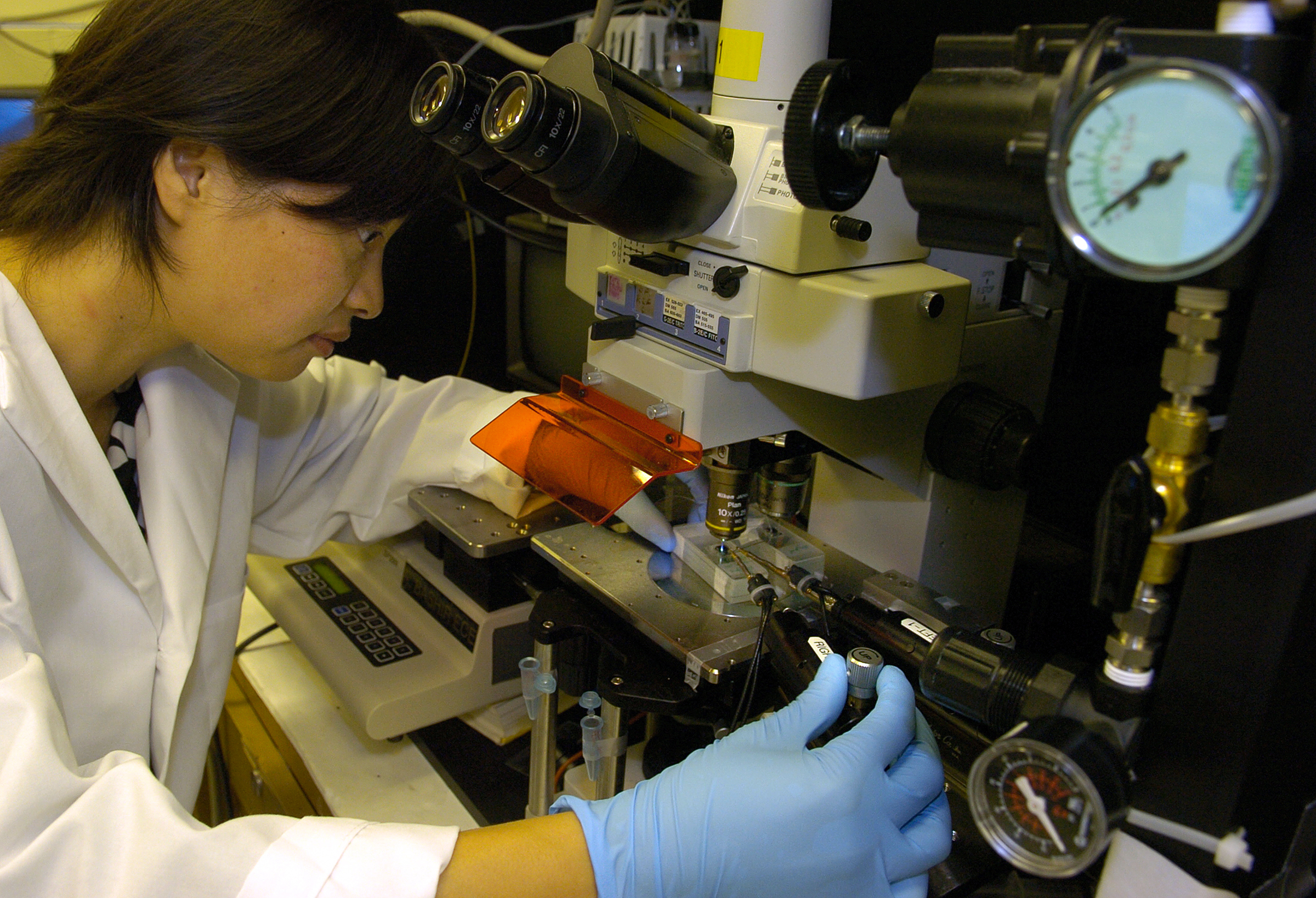
Liju Yang, a postdoctoral research associate in Purdue's School of Electrical and Computer Engineering, uses a microscope to see bacterial cells placed into a microchip containing an antibody that captures the bacteria. The technology, developed in the lab of professor Rashid Bashir, offers promise for creating devices called "biochips" that can also detect proteins indicative of diseases such as cancer. Such devices can provide a means to perform early detection of cancer from body fluids. (Purdue News Service photo/Dave Umberger)
A publication-quality photo is available at https://www.purdue.edu/uns/uns/images/+2005/bashirlab-mic.jpg

To the News Service home page