
October 5, 2005
Purdue's Discovery Park opens 2 new high-tech research centers
WEST LAFAYETTE, Ind. – The doors of the Bindley Bioscience Center and Birck Nanotechnology Center, two new interdisciplinary facilities in Purdue University's Discovery Park, are now officially open.
|
As of its dedication Saturday (Oct. 8), the Birck Center, considered among the best university facilities of its kind in the nation for nanotechnology research, joins the Bindley Center, a state-of-the-art, flexible research facility for biological research, dedicated last Saturday (Oct. 1). The two buildings, physically joined by a covered walkway, are designed to encourage collaborations among scientists.
"These buildings, like the rest of Discovery Park, are meant to be a place where collaboration among specialists will be the hallmark of great achievement," said Purdue President Martin C. Jischke. "The age of interdisciplinary science is upon us, and researchers need places where they can step outside their fields and attain goals they could not reach on their own. Thanks to the vision of William Bindley, Michael Birck and everyone who has worked to create these centers, our scientists and engineers now have a space to come together, meet and create."
The Birck Center has been operating since Discovery Park was formed in 2001, but researchers have been using existing laboratories and equipment in campus facilities. Alan H. Rebar, interim executive director of Discovery Park, said the center has already been successful in attracting funding and top faculty.
"We have two national centers located within the center, one funded by the National Science Foundation and the other funded by NASA," Rebar said.
The building was completed in September after construction began in 2003. It will take about a year for scientists and engineers to move equipment into the new center's specialized laboratories.
Scientists are simultaneously moving their equipment into the Bindley Bioscience Center, which provides 18,000 square feet that can be configured for individual projects as needed. The six large lab spaces are designed to provide exactly what a project needs, and then be custom-reconfigured for the next project.
"The inside of this building was designed with the same organizing principle as a theater," said Charles R. Buck, the center's director of operations. "It has a stripped-down interior that can provide small or large space for a project – the equipment and benches can be moved in accordance with what a researcher needs. Even the utilities drop down from the ceiling."
Bindley is connected to the east side of the Birck Center via a second-floor walkway.
"We've co-designed the buildings to make it easier for people in both centers to work together," said Richard Schwartz, co-director of the Birck Center and a professor of electrical and computer engineering. "We did this partly because we think that some of the really early payoffs in nanotechnology will be in the nano-bio area, which will involve both engineering and biological sciences."
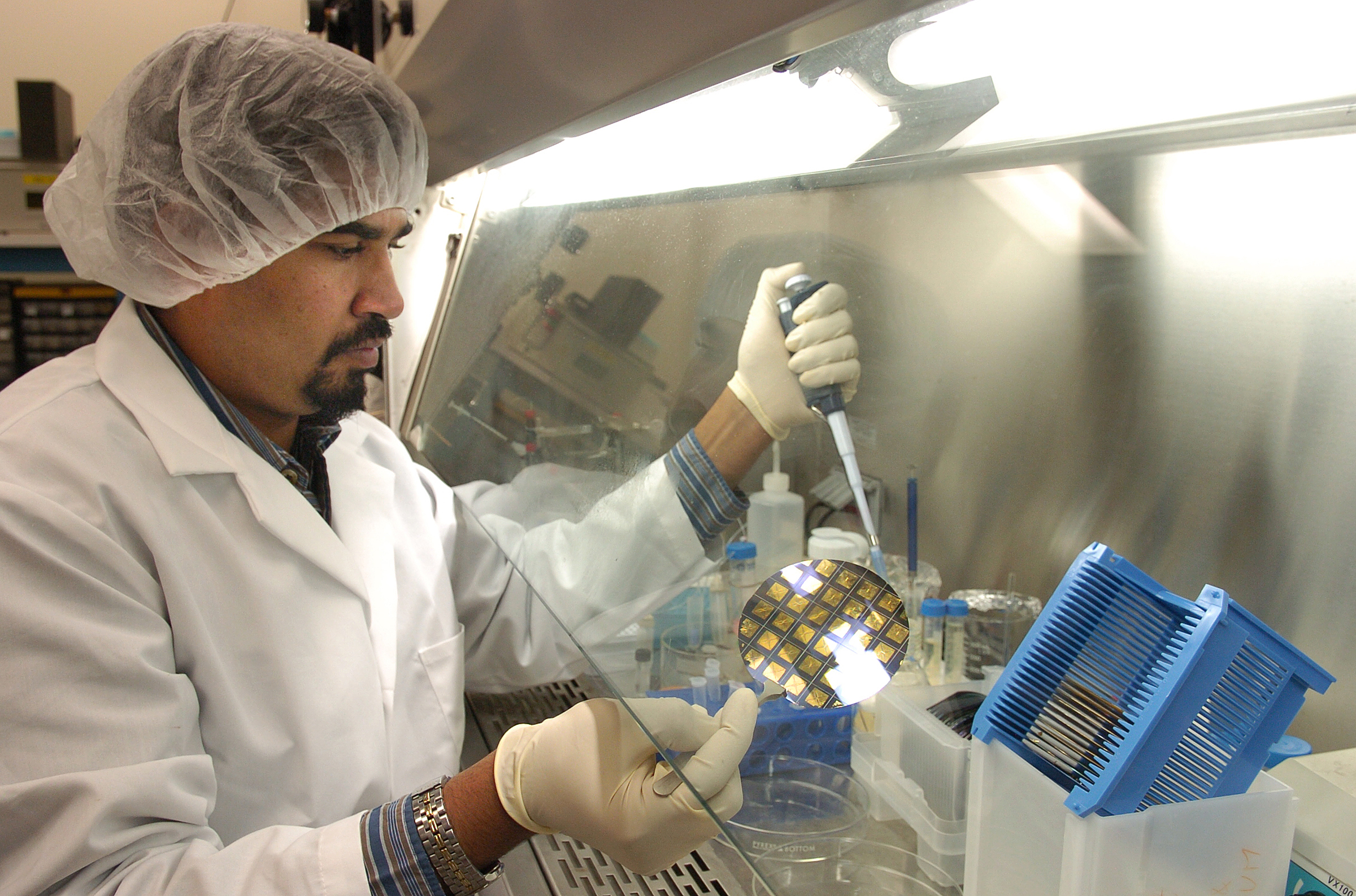
One example of such work is research led by Rashid Bashir, a professor of electrical and computer engineering, aimed at creating devices called "biochip" detectors that combine proteins and other biological molecules with electronic components.
The Birck Nanotechnology Center also possesses modern equipment and a design that will assist scientists. Two labs in the Birck building have floors consisting of thick concrete slabs that float on air-filled shock absorbers for ultra-fine vibration control. The rooms also are surrounded by heavily insulated walls like those of walk-in freezers. Vibration and temperature must be carefully controlled because researchers will be working on the scale of individual atoms. The slightest jarring or expansion from heat would foul up experiments.
"You can keep the air in here stable to plus or minus one-tenth of a degree Celsius," said George Adams, the center's research development manager and an adjunct associate professor of electrical and computer engineering. "We call them the high-accuracy rooms. In these labs we will use scanning probe microscopy and other techniques to examine the structure of materials nearly on an atom-by-atom basis. In order to study specimens on such tiny scales, you have to be able to hold them extremely still and you also have to control the temperature.
"If I pick up a pencil and hold it in my hand, the warmth from my fingers makes it about a thousand atoms longer because of expansion, so if you want to look at a particular atom, it moves out of your field of view."
Another sophisticated feature of the building is its large suite of "clean rooms," 25,000 square feet of space containing a series of labs that are rated progressively higher based on the number of particles in each cubic foot of air.
"It is an awesome building," Schwartz said. "The center is definitely a draw to Purdue. It is helping us recruit top faculty and students in nanotechnology areas."
The Birck Center is named for Michael and Katherine (Kay) Birck of Hinsdale, Ill. The Bircks donated $30 million for the building. He is a Purdue alumnus, a member of the Purdue Board of Trustees and chairman of Tellabs Inc. Kay Birck, a Terre Haute, Ind. native, recently retired as head of nursing at Women's Healthcare of Hinsdale.
Purdue alumni Donald and Carol Scifres also donated $10 million to the center, and alumni William B. and Mary Jane Elmore provided $2 million toward the center's William and Mary Jane Elmore Advanced Wireless Concept Validation Laboratory.
William E. Bindley was born in Terre Haute, Ind., and received his bachelor's degree from Purdue in 1962. In 1968 he founded Bindley Western Industries, a pharmaceutical distributor that became a Fortune 200 company traded on the New York Stock Exchange. In February of 2001 Bindley Western merged with Cardinal Health to create the largest health-care distributor and services provider in the world. Following the merger, Bindley retired as Bindley Western's chairman and CEO and served as a member of the board of directors of Cardinal Health until 2003.
In 2001 Bindley organized Bindley Capital Partners LLC, a private equity and investment firm headquartered in Indianapolis. He also served as chairman of Priority Healthcare Corp., a provider of biopharmaceuticals and chronic disease therapies with revenues of more than $2 billion, which he founded in 1992. In July it was announced that Priority will be acquired by Express Scripts Inc.
Bindley resides in Naples, Fla., with his wife, Mary Ann.
The dedications are part of a two-week celebration leading up to Purdue's Oct. 15 Homecoming. Events focus on ways Purdue is improving education and helping the state of Indiana as part of the university's strategic plan and $1.5 billion fund-raising campaign.
Writers: Chad Boutin, (765) 494-2081, cboutin@purdue.edu;
Emil Venere, (765) 494-4709, venere@purdue.edu
Sources: Martin C. Jischke, (765) 494-9708
Charles Buck, (765) 494-2208, cbuck@purdue.edu
Alan Rebar, (765) 496-6625, rebar@purdue.edu
George B. Adams, (765) 494-2698, gba@purdue.edu
Richard Schwartz, (765)494-0619, schwartz@purdue.edu
Purdue News Service: (765) 494-2096; purduenews@purdue.edu
Related Web site:
Bindley Bioscience Center dedication
PHOTO CAPTION:
Samir Iqbal, a doctoral student in the School of Electrical and Computer Engineering, works under a laboratory hood to transfer a small amount of DNA solution to electronic chips. DNA attaches to gold molecules on such "biochips" in a technology that offers promise for creating devices for detecting bacteria and other substances by combining proteins, DNA and other biological molecules with electronic components. Such chips might be used to detect cancer cells and cancer-related proteins.(Purdue News Service photo/David Umberger)
A publication-quality photograph is available at https://www.purdue.edu/uns/uns/images/+2005/bashir-lab-chip.jpg

To the News Service home page