
September 30, 2005
Asian lady beetles back in force this year
WEST LAFAYETTE, Ind. - Homeowners may soon join farmers in their dislike of soybean aphids, thanks to Asian lady beetles.
|

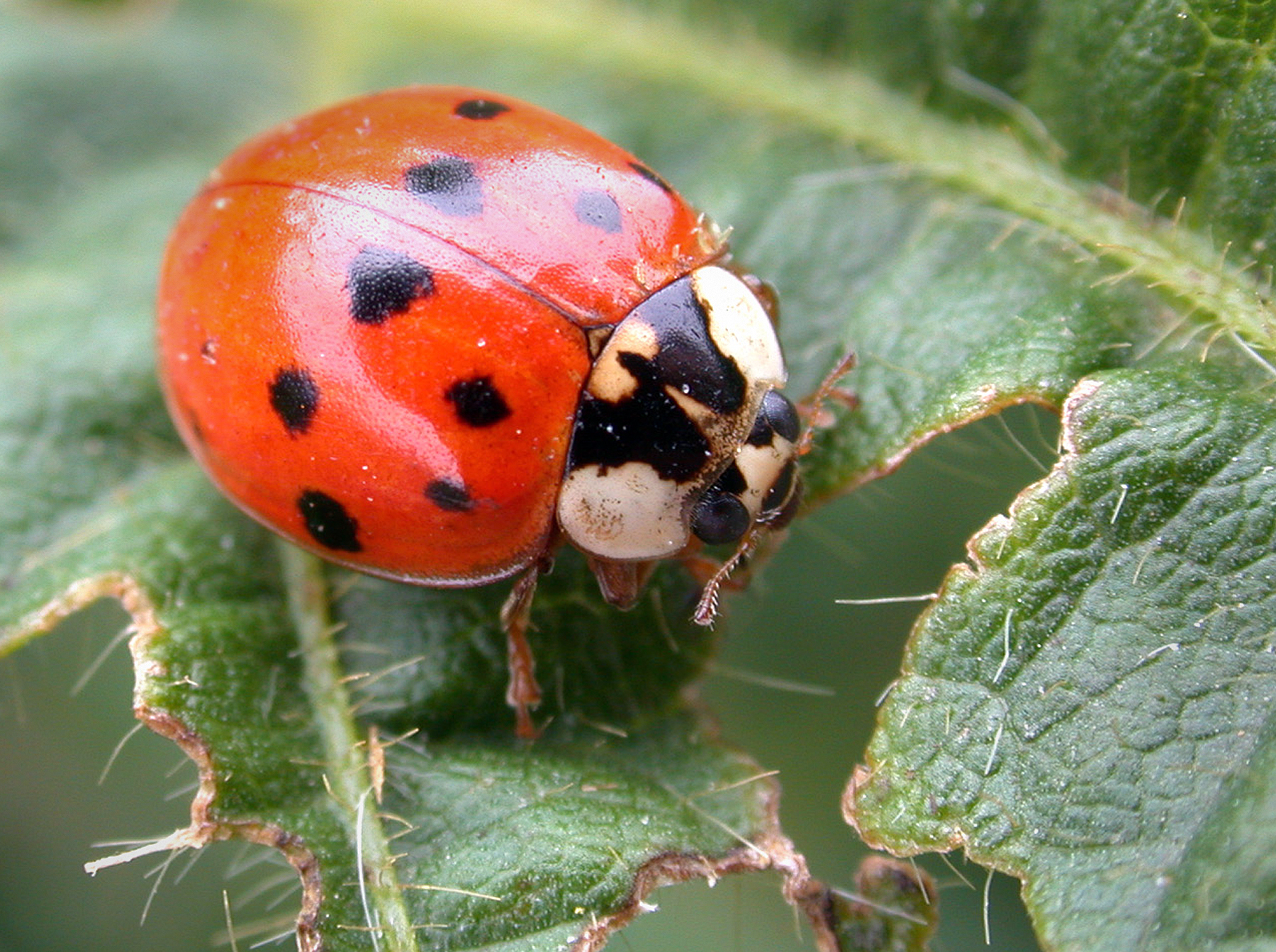
A Purdue University entomologist said the higher populations of soybean aphids this summer will probably lead to higher Asian lady beetle populations this fall. Asian lady beetles are the orange-colored ladybugs that invade homes every autumn.
"Beginning in the latter part of October, the Asian lady beetle has a peculiar behavior of wanting to congregate in large groups inside buildings," said Tim Gibb. "This becomes particularly troublesome if the building they've chosen happens to be your home."
And if the increased numbers weren't insult enough, Gibb thinks the lady beetles will try to enter homes one to two weeks earlier this year.
"This year we're seeing crops dry down much more quickly than they do normally, and I think that's going to accelerate the speed at which these pests move toward homes," Gibb said.
That means that this year, beetle prevention treatments should be in place by the second week of October.
"Homeowners should seal up any broken windows, sills, door sweeps that don't close properly, or any small crack or crevice through which the beetles can find entrance to the home," Gibb said.
This is especially important in two-story, light colored homes near soybean fields or woods because the beetles are attracted to tall light colored buildings. They also seem to prefer the south and west facing sides of homes.
"There are some chemicals that can be used as a barrier treatment to kill the Asian lady beetles as they come to the homes. Synthetic pyrethroids are probably the best materials to use. Be sure to apply the chemicals according to the label. Look for directions for a perimeter treatment against occasional invading pests," Gibb said.
If the beetles do make it inside the house, they can cause problems and the only efficient way to dispose of them is by vacuuming them up.
"If they do land on you, especially if you're perspiring even slightly, these things tend to nip for whatever reason," he said. The bites don't seem to have any lasting effect, but they are a nuisance.
Also, when the lady beetles congregate in large numbers they excrete a foul smelling material that can stain clothing, and medical studies have shown that they can trigger asthma problems.
If there's any good news it's that some areas of the state may be spared a large beetle infestation.
Gibb said in places where farmers sprayed their fields for aphids the populations of Asian lady beetles should be more manageable.
"We had a lot of soybean fields sprayed for aphids, which is not only going to kill the aphid, but it's also going to kill the Asian lady beetles. So it's really difficult to predict whether there's going to more Asian lady beetles or fewer. I suspect there's still going to be more, even though farmers did spray," he said.
Control recommendations for Asian lady beetles are available from Purdue Extension through a local Extension educator, the toll-free hotline (888) EXT-INFO, and at the Department of Entomology web site.
Writer: Kay Hagen, (765) 494-6682, kjh@purdue.edu
Source: Tim Gibb (765) 494- 4570, gibb@purdue.edu
Ag Communications: (765) 494-2722;
Beth Forbes, forbes@purdue.edu
Agriculture News Page
Related Web sites:
Purdue Entomology Asian Lady Beetle fact sheet
PHOTO CAPTION:
Asian lady beetles, such as this one, appear every October and make their way into homes. This year entomologist think the beetles will move into homes one to two weeks earlier. (Purdue Department of Entomology photo/John Obermeyer)
A publication-quality photo is available at https://www.purdue.edu/uns/images/+2004/gibb-lady.jpg
To the News Service home page