
July 5, 2005
Purdue team to compete in world's longest solar vehicle race
WEST LAFAYETTE, Ind. – A team of Purdue University students will compete in the world's longest solar car event this month in a vehicle they designed and built from scratch.
|
The Purdue Solar Racing team is the only group from Indiana to compete in this year's North American Solar Challenge, a collegiate competition for solar-powered cars. The 2,500-mile event begins July 17 in Austin, Texas, and ends July 27 in Calgary, Alberta.
"Building this car is a two-year project. The suspension, rims, body, shape and electronic systems you see on the car were made and designed by us," said Stephen Foulkes, president of Purdue Solar Racing, a student organization founded to build and race solar cars and to promote environmentally friendly technologies. "It's incredibility lightweight and strong. It weighs 350 pounds, and we configured another 200 pounds for the driver for a total weight of 550 pounds."
|
Foulkes, a 2005 graduate of the School of Electrical and Computer Engineering from St. Charles, Ill., is one of about 15 students on the team from the areas of mechanical, electrical and computer, aeronautics and astronautics, and civil engineering, as well as various engineering technology, management and marketing academic programs at Purdue.
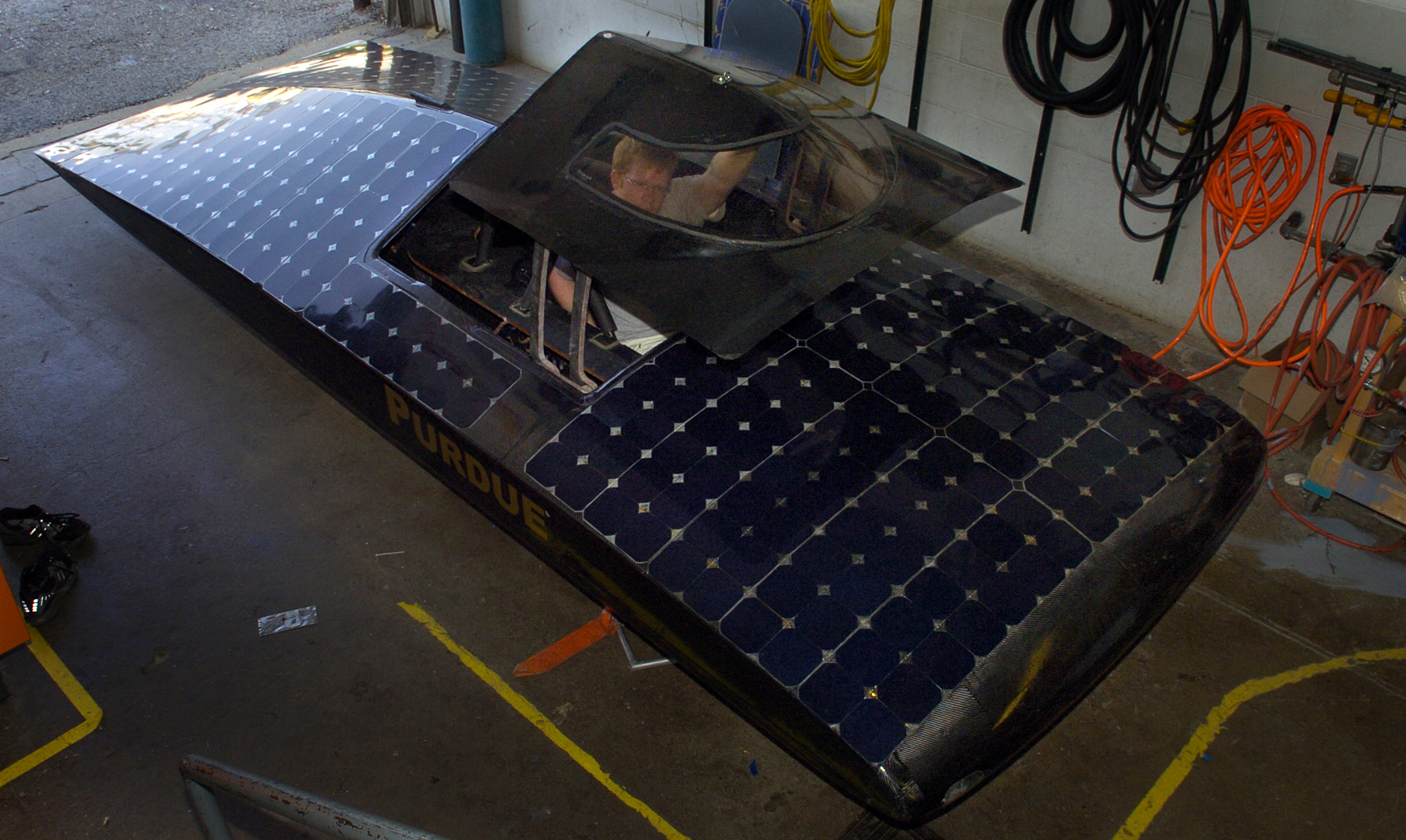
About 37 companies and organizations sponsor the solar car, called S.P.O.T. II (Solar Powered Overland Transportation). The vehicle resembles an airplane wing – sleek with a blended canopy and windshield – and is the sixth solar-powered prototype Purdue students have built in the past 12 years. The 16-by-6 foot solar car and chassis is made almost entirely of carbon fiber, which is in a honeycomb structure and in the specially designed material covering the honeycomb.
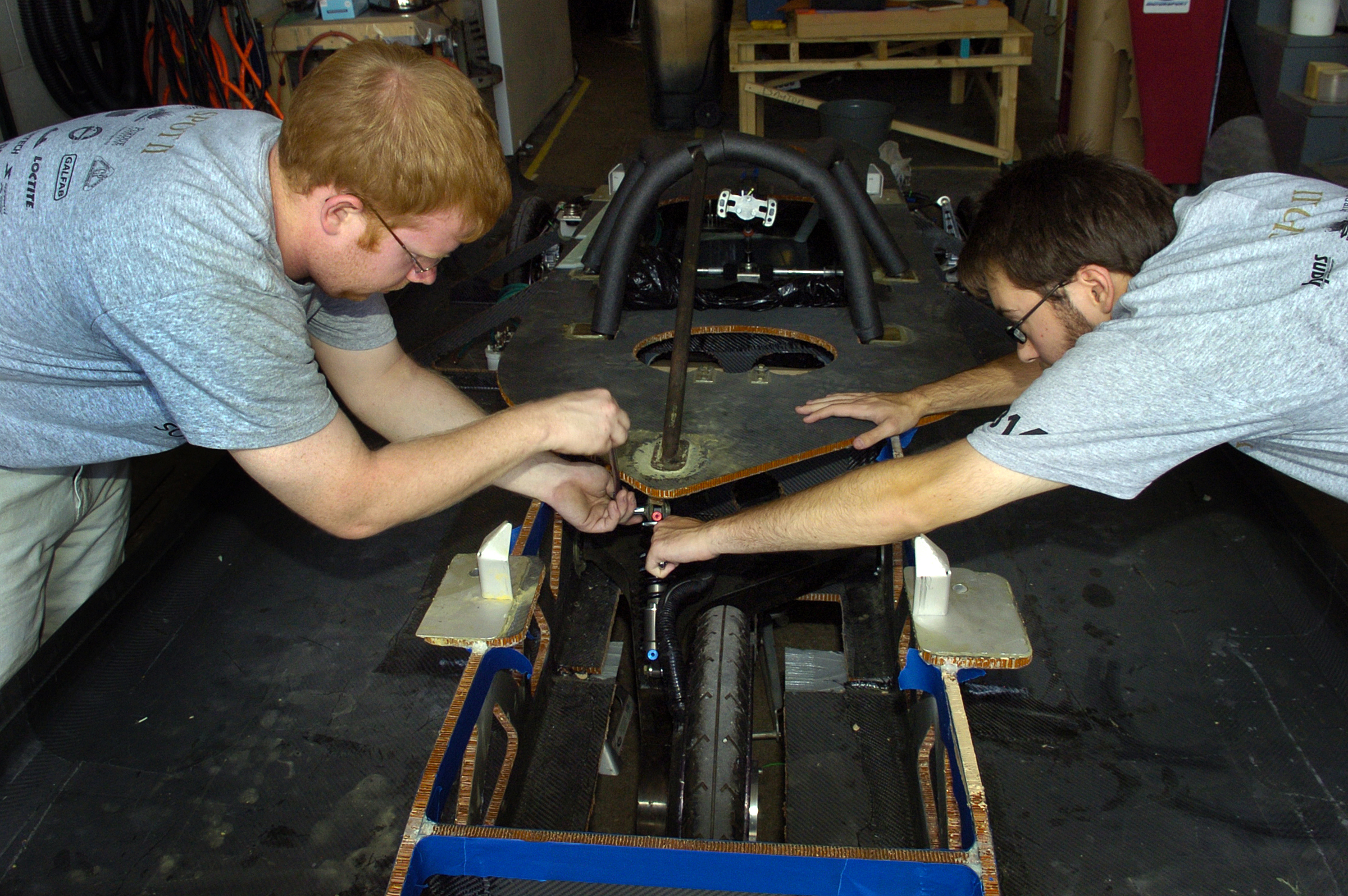
"Carbon fiber is the same material used in many Indy and Formula 1 cars, and the honeycomb is very light but adds durability," said team secretary Warren Santner, a 2005 graduate of the School of Electrical and Computer Engineering from Munster, Ind. "We had custom molds made of a high-density tooling polymer, and the carbon fiber starts as a fabric that we place in the mold. We added epoxy to the fabric to make it stiff."
The solar car cost $150,000 to build. The car has 420 solar cells on 30 black panels to provide about 1,200 watts of power. To provide back up power and to ensure a constant speed during cloudy conditions, the car has 15 lithium batteries. The car rides on three 16-inch moped tires and has a 10 horsepower electric motor connected to the rear wheel.
"Each solar cell is monitored with a circuit board, and there is an overall circuit board that tells it what to do," said team electrical director Randal Tippmann, a 2005 graduate of the School of Electrical and Computer Engineering from Fort Wayne, Ind. "The car's top speed is about 60 miles per hour, and the cruising speed is about 45 miles per hour."
Despite its light dimensions, safety was a key factor in the solar car's design.
"We have two safety bars in front of the driver, a six-point racing harness, and we have a head and neck helmet like those used in NASCAR racing," said Matt Romanotto, a senior in aeronautics and astronautics from of Fort Wayne, Ind. "The car is not air conditioned, and so we don't get too tired during the race, we will rotate drivers about every three hours."
A list of team members, sponsors and other information about the Purdue solar car is available online.
"The Purdue Solar Racing project has been an excellent learning opportunity," said Galen King, associate professor of mechanical engineering at Purdue and adviser to Purdue Solar Racing. "One important aspect is the entrepreneurial experience they had. The students went out and met with sponsors to raise the funds and collect material contributions for this project."
In addition to its corporate sponsors, the team also has received financial support from the university, including the facilities and equipment used at Purdue.
The North American Solar Challenge is sponsored by the U.S. Department of Energy. There are 28 solar cars from other universities, including the University of Michigan, Yale University, Illinois State University, Massachusetts Institute of Technology, Iowa State University and Stanford University that will compete in the race. The winning team will go to the World Solar Challenge 2005 in Australia later this year.
Writers: Cynthia Sequin, (765) 494-4192, csequin@purdue.edu, Emil Venere, (765) 494-4709, venere@purdue.edu
Sources: Galen King, (765) 494-46518, kinggb@purdue.edu
Stephen Foulkes, (630) 546-7532
Warren Santner, (219) 218-1411
Randal Tippmann, (765) 532-4042
Matt Romanotto, (260) 403-5277
Purdue News Service: (765) 494-2096; purduenews@purdue.edu
PHOTO CAPTION:
Stephen Foulkes, a graduate of Purdue's School of Electrical and Computer Engineering from St. Charles, Ill., demonstrates the shield of a solar car designed and built by Purdue students. The car will compete in the 2005 North American Solar Challenge, a 2,500-mile race from Austin, Texas, to Calgary, Alberta. The race, which will be run from July 17-27 is the world's longest solar car competition. Foulkes, who is president of the Purdue Solar Racing team, is one of about 15 students on the team representing the areas of mechanical, electrical and computer, aeronautics and astronautics, and civil engineering. The race is sponsored by the U.S. Department of Energy and promotes the development of solar-powered vehicles. (Purdue News Service photo/Dave Umberger)
A publication-quality photo is available at https://www.purdue.edu/uns/images/+2005/king-solarcar.jpg
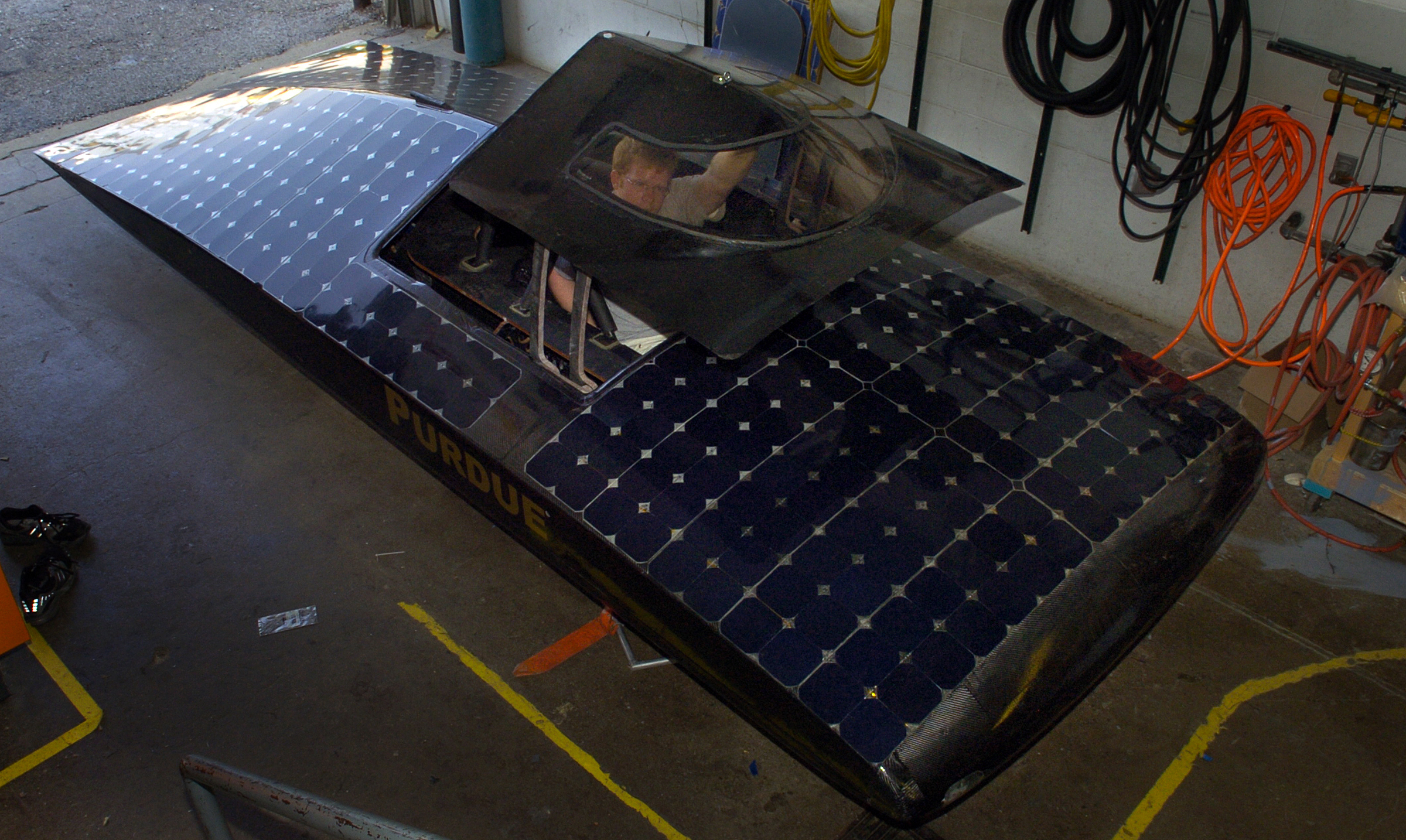
PHOTO CAPTION:
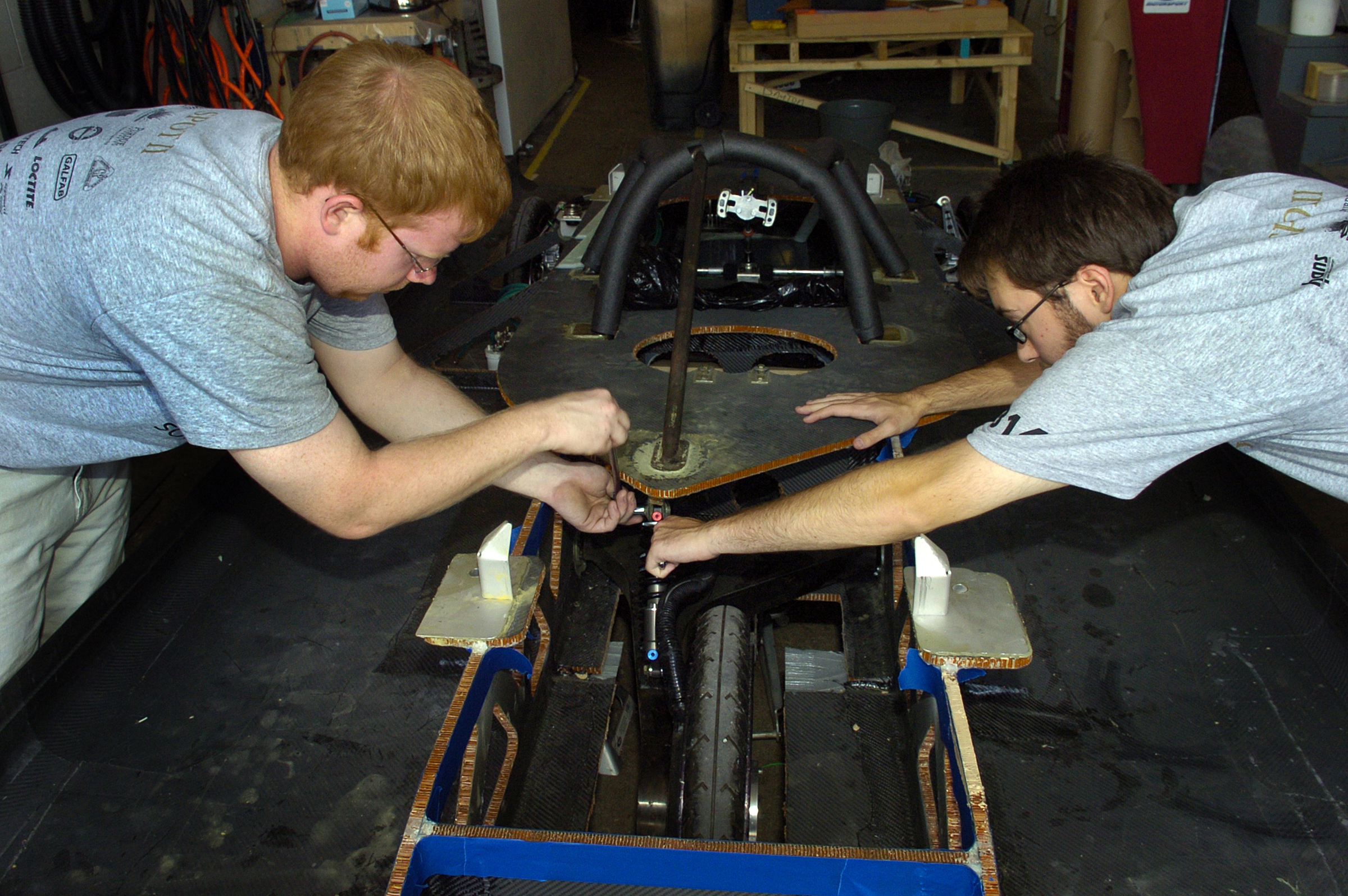
From left, Purdue engineering graduates Stephen Foulkes, of St. Charles, Ill., and Randal Tippman, of Fort Wayne, Ind., make adjustments on a solar car designed and built by Purdue students. Foulkes, who is president of the Purdue Solar Racing team, and Tippman, who is the team's electrical director, are two of about 15 students on the team that represents the areas of mechanical, electrical and computer, aeronautics and astronautics, and civil engineering. The car will compete in the 2005 North American Solar Challenge, a 2,500-mile race from Austin, Texas, to Calgary, Alberta. he race, which will be run from July 17-27 is the world's longest solar car competition. The race is sponsored by the U.S. Department of Energy and promotes the development of solar-powered vehicles. (Purdue News Service photo/Dave Umberger)
A publication-quality photo is available at https://www.purdue.edu/uns/images/+2005/king-solarcar2.jpg
To the News Service home page