2004 Honorary Degree
2004 Honorary Degree

|
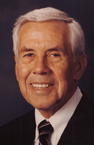
Richard G. Lugar
Doctor Of AgricultureRichard G. Lugar has distinguished himself as a highly successful politician.
He is currently in his 28th year as a member of the U.S. Senate, representing Indiana, and living in Washington, D.C. Born and raised in Indianapolis, Lugar graduated first in his class from Shortridge High School and Denison University, where he was co-president of student government with his future wife, Charlene. In 1954, he went on to Pembroke College, Oxford University, as a Rhodes Scholar, where he received honors degrees in politics, philosophy and economics. Lugar is an unwavering advocate of U.S. leadership in the world, strong national security, free-trade, and economic growth. This fifth generation Hoosier is the longest serving U.S. senator in Indiana history. He is the chairman of the Foreign Relations Committee and a member and former chairman of the Agriculture, Nutrition and Forestry Committee. He was first elected to the U.S. Senate in 1976 and won a fifth term in 2000, his third consecutive victory by a two-thirds majority. He holds all Indiana statewide election records. Lugar manages his family's 604-acre Marion County corn, soybean, and tree farm. Before entering public life, he helped manage, with his brother Tom, the family's food machinery manufacturing business in Indianapolis. As the two-term mayor of Indianapolis (1968-75), he envisioned the unification of the city and surrounding Marion County into one government. Unigov, as Lugar's plan was called, set the city on the path for uninterrupted economic growth. Lugar has been a leader in reducing the threat of nuclear, chemical, and biological weapons. In 1991, he forged a bipartisan partnership with then-Senate Armed Services Chairman Sam Nunn, to destroy weapons of mass destruction in the former Soviet Union. To date, the Nunn-Lugar program has deactivated nearly 6,000 nuclear warheads that were once aimed at the United States. As chairman of the Agriculture Committee, Lugar built bipartisan support for 1996 federal farm program reforms, ending 1930s-era federal production controls. He has promoted broader risk management options for farmers, research advancements, increased export opportunities, and higher net farm income.
|