Purdue News
Purdue News

|
|
July 22, 2004 Can you read this? Purdue institute helps more people answer 'Yes!'WEST LAFAYETTE, Ind. – While Indiana children are at play on their summer vacations, 400 of their teachers are going back to school. The teachers, from K-6 classrooms across the state, will be at Purdue University learning how to better teach their students to read and write.
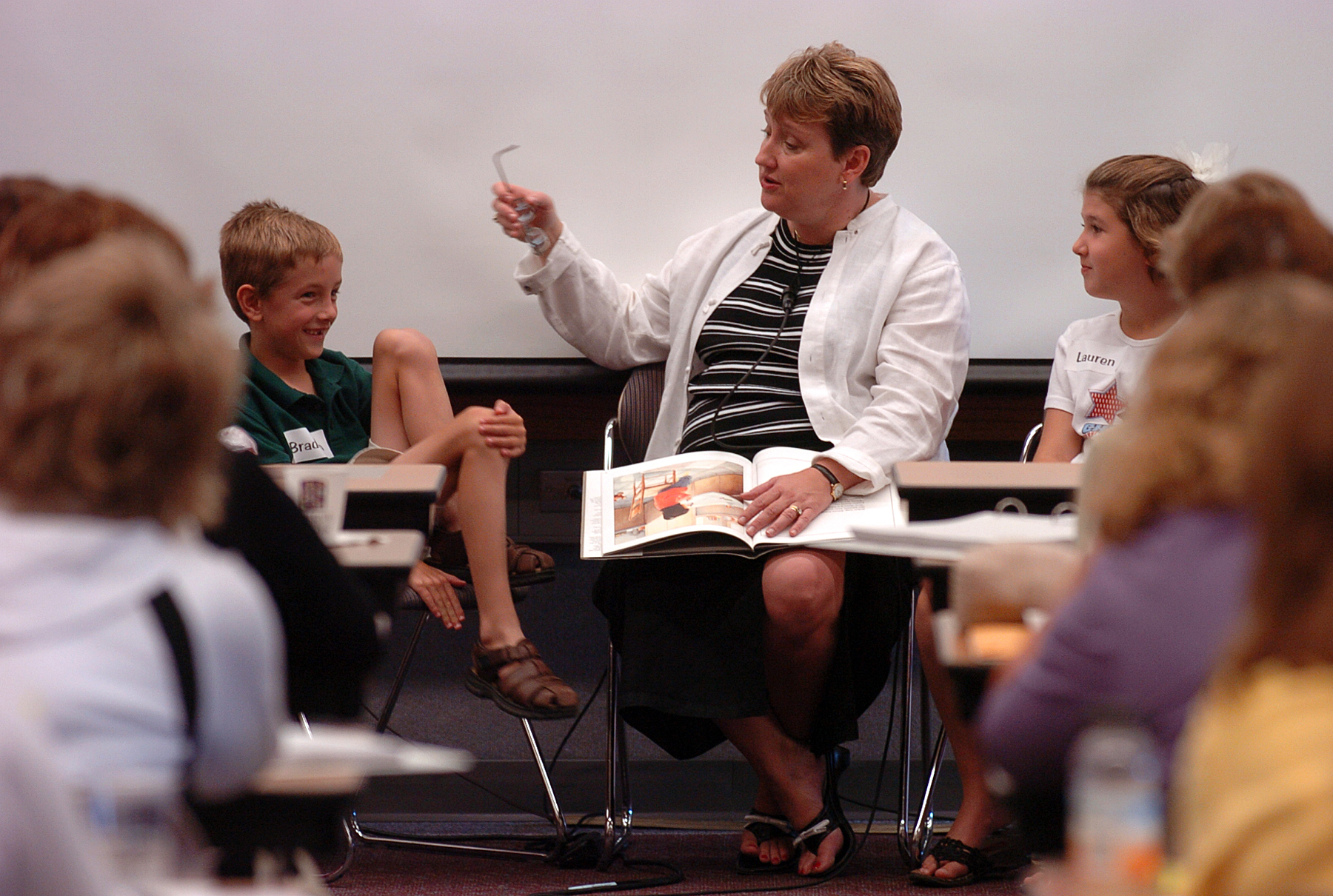
To support that early education, Purdue's School of Education will host 400 Indiana elementary school teachers to better prepare them to teach students what one Purdue professor calls the most fundamental building block of education. The Purdue Literacy Network Project's fourth annual Summer Literacy Institute will take place Tuesday through Thursday (July 27-29). At the institute, teachers of kindergarteners through sixth-graders will learn about new research and methods for literacy education and how to incorporate these tools into their classrooms. "Illiteracy is the problem no one wants to talk about, but it is one of the most important we have," said Maribeth Schmitt, Purdue Literacy Network Project director and a professor of literacy education. "Literacy is a key to the future of the state, and economic development is contingent on a population with the skills necessary to fill new kinds of technical jobs. Without effective, early literacy education, people will fight to catch up the rest of their lives." Schmitt said there is extensive evidence that many societal problems are linked to illiteracy rates: incarceration, high school drop-out rates, drug and alcohol abuse and unemployment. For example: • Literacy rates among prison inmates are difficult to determine, but most estimates are that between 50 percent and 60 percent of inmates nationwide are functionally illiterate. • According to a study by the federal government, almost 20 percent of inmates are completely illiterate, compared to just 4 percent of the general population. • Another government study shows that high schoolers with literacy problems are more likely to drop out, hurting their employment chances for the rest of their lives. • According to the National Institute for Literacy, 20 percent of American adults do not have the literacy skills necessary to earn a living wage. "It is obvious that literacy affects so much more than children's immediate success in school," Schmitt said. "If we cannot provide children with the necessary tools at an early age, they will pay the price for it the rest of their lives. However, teachers can make a difference, and not only does improved early instruction keep children from falling behind, but it also prepares them for other fields, such as math, science and social studies." The institute has a strong emphasis on early, high quality instruction, she said. "Literacy is the building block of education," Schmitt said. "That is why it is so important that we reach children early. The longer before they have a firm grasp of reading and writing, the further they will fall below their peers in other subject areas. If you don't provide literacy skills early, children never catch up. This institute will make a difference in children's lives because their teachers spent the extra time learning new skills." One focus of the institute is Reading Recovery, an early-intervention program that provides individual instruction to first-graders who are having difficulty developing literacy skills. Since Schmitt introduced the program at Purdue, 1,300 teachers have been trained and 47,000 Indiana students have been given a leg up in the world of the written word. Literacy Collaborative, a classroom instructional framework, also will have special sessions for literacy coordinators who work with their colleagues to strengthen literacy as a school. Director and trainer Sarah Mahurt, who brought Literacy Collaborative to Purdue, will coordinate those sessions. The content focus of this year's institute is reading comprehension. Katrena Leininger, director of the Professional Development Initiative for the Purdue Literacy Network Project, said the idea of comprehension is evolving beyond being able to answer simple questions about a story after reading it. "Comprehension is becoming more about the thinking involved in reading," she said. "Teachers want to help children visualize the characters and the action of a story while they are reading it, like an adult reader. That is when they will truly be able to enjoy reading and experience it the way authors hope." Besides instructional sessions, educators in attendance will hear from keynote speakers Ellin Oliver Keene and Susan Zimmerman, who co-wrote the book "Mosaic of Thought: Teaching Comprehension in a Readers' Workshop." Zimmerman also has written "Seven Keys to Comprehension: How to Help your Kids Read It and Get It," "Writing to Heal the Soul" and "Grief Dancers." "These two speakers are very well-known in the literacy world," Leininger said. "From their large and small group sessions with them, teachers will not only gain theoretical ideas, but also will learn about effective, proven practices they can use in their schools to improve children's education throughout Indiana." The Summer Literacy Institute is funded by the Purdue Literacy Network Project, which receives support for the institute from North Central Health Services Foundation, State Farm Insurance, Vectren Corp. and Purdue Employees Federal Credit Union. The Purdue Literacy Network Project supports professional development by creating a comprehensive program for elementary students to ensure that all children are given the opportunity to become readers and writers early in their schooling. Reading Recovery, the Literacy Collaborative and the Professional Development Initiative are overseen by the Purdue Literacy Network Project. Writer: Matt Holsapple, (765) 494-2073, mholsapple@purdue.edu Sources: Maribeth C. Schmitt, (765) 494-5683, mschmitt@purdue.edu Katrina L. Leininger, (765) 494-2356, georgekl@purdue.edu Purdue News Service: (765) 494-2096; purduenews@purdue.edu Note to Journalists: Journalists are invited to attend and photograph any session during the institute. Interviews with teachers from journalists' local areas can be arranged. For more information or a schedule, contact Matt Holsapple at (765) 494-2073, mholsapple@purdue.edu PHOTO CAPTION:
|