Purdue News
Purdue News

|
Paralysis team making strides on many frontsFrom Perspective Richard Borgens remembers when he first knew he would dedicate his career to helping paralysis victims.
"I was invited to a meeting of the National Paraplegia Foundation of Chicago," he says. "It was 1976, and I was fresh out of Purdue’s Ph.D. program in biophysics. I had just won one of two national fellowships from the foundation, and they were going to present me with the award at their annual banquet. It didn’t sound too thrilling – I thought I was going to walk into a room full of old people standing around in suits, but instead I saw something I’ll never forget." Borgens walked into the meeting hall and saw that around every table were people in wheelchairs. Most of the crowd was younger than he was. "Most everybody in the 200-person audience was suffering from paralysis, often the result of an accident that had happened when they were teen-agers," he says. "And I do mean suffering – you could see the pain and longing in their eyes, even from the other side of the room. Every one of them pulled my heart in a different direction."
Being pulled in different directions was nothing new to Borgens, who had elected to finish college only after a short stint as an Army medic diverted him from a successful career in the 1960s as a rock ’n’ roll songwriter. Borgens returned to Purdue and set up shop as a researcher with an eye on human applications for his work. Where he had once healed souls with electric guitars, he set about healing damaged animal spines with electrical fields – stimulating nerves to regenerate with tiny battery-powered devices implanted near the backbones. Though the technique was far from a cure for paralysis, it drew national acclaim for his lab and attracted scores of letters every month from paralysis victims volunteering to become human guinea pigs. Building and expanding on this work has brought other advances: three different approaches to treating paralysis. Two techniques are currently undergoing human trials. And one is currently in the final stages of licensing to a medical supply company. "We’ve come a long way in the two decades since then," says Borgens, who now directs the Center for Paralysis Research in Purdue’s School of Veterinary Medicine. "But what keeps our lab going is the knowledge that, in many ways, paralysis victims are still no better off than they were at the end of World War II with respect to treatments that can improve their quality of life."
"Improving quality of life" is a phrase Borgens wishes more people would think of when it comes to the 10,000 to 12,000 people who suffer spinal cord injury each year. The spinal cord is one of the few organs that, when damaged, the body is not able to repair. Injury leaves many victims without the use of their limbs or sensation in their bodies. In extreme cases, a damaged or severed spinal cord can mean a victim will require lifelong assistance with everyday tasks that healthy people take for granted – even breathing. "It’s a cliché in movies to hear a doctor talking about a paralytic, saying, ‘He’ll never walk again,’ as if that’s the only important consequence of spinal cord damage," Borgens says. "But many paralytics have told me that, while they’d love to walk again, it’s the independence that they miss the most." For that reason, though Borgens’ team at the Center for Paralysis Research still has a long road ahead to find a complete cure for paralysis and nerve damage, he says there are many steps along the way that will help improve quality of life. And for every one of those steps, there is a different approach. "No single remedy will likely do the trick for every victim," he says. "There are different kinds of injury, and patients react to treatments in different ways. For that reason, our team keeps its fingers in lots of research pies." Oscillating field stimulators When tissue grows in living things, it is an organism’s naturally occurring electrical field that plays a large role in getting it started. This electrical field both stimulates and directs tissue development; from the moment an embryo begins to form, such a field encourages the rapidly multiplying young cells to form head and tail in the right directions. "Many adult cells can do this same thing, but in the case of the spinal cord, nature needs a little help," Borgens says. "Spinal cords don’t heal naturally. But we realized that electrical fields play a major role in how the body mounts its successful efforts at healing. We figured out that if you placed an artificial field close to an animal’s injured spine, the neurons in the cord would begin to regenerate." Borgens’ team developed small battery-powered devices called oscillating field stimulators and, for one study, implanted them near the injured spines of 13 dogs. "People often ask why we do so much research on man’s best friend," Borgens says. "It turns out there are similarities between human and canine spinal injuries that make dogs excellent subjects, but there’s another reason. Dogs with long bodies and short legs are prone to such injuries. Dachshunds, Welsh corgis and basset hounds can suffer them later in life just by jumping off a couch. We love trying to help them." If the devices are implanted within 18 days of injury and left undisturbed for 14 weeks, most of the dogs’ conditions improve. In the most recent trial, seven of the 13 dogs were walking again within six months. "To give you an example, a cocker spaniel from Indianapolis named Diamonds was injured in an accident, suffering a disc herniation that left the dog completely paraplegic," Borgens says. "After receiving an implant, Diamonds was cured – you could never tell she had been injured." The devices have been under development for years, and the team is optimistic that they will be helping man as well as man’s best friend in the future. "We are in the process of running human trials on these oscillating field stimulators," says John Cirillo, the engineering technician at the center who builds and improves the devices. "If we find that they are safe for humans, within a few years we could have a tool for mending recent spinal damage." PEG Another treatment uses a substance found in, of all places, cosmetics and engine coolants. A liquid polymer called PEG – short for polyethylene glycol – has the ability to break the chain reaction of spinal cord damage if it is applied quickly enough. "I read an article about some researchers who had managed to sever an earthworm into two pieces, then fuse the pieces back together again with PEG," Borgens says. "As earthworms have giant single nerve fibers, I wondered if PEG could be used in spinal cords as well." Spinal cords seem anomalous when compared to the rest of the body. Although broken skin or bone sets about healing itself immediately after an injury, damaged spinal cells seem bent on suicide. "When a cell in the spine ruptures, it releases chemicals into the surrounding tissue that signal other spinal cells to die," Borgens says. "This causes a chain reaction of cell death. Within a few hours after the initial injury, far more cells have died than were hurt in the first place." PEG may give the body the tools it needs to repair damaged cells immediately, which also keeps them from causing a mass suicide among their neighbors. If the polymer is injected into the bloodstream soon after an injury, the body concentrates it around the damaged cells, forming a seal over regions of damaged cell membranes. "The best thing about PEG is that you simply inject it, and the victim’s body somehow knows where to put it," Borgens says. "After the damage has been halted, the PEG passes harmlessly out of the body like any other waste product." Initial tests have shown that up to 75 percent of dogs treated with PEG within one to two weeks after injury regained significant mobility, and two months after injury a few were running and playing as though their injuries had never occurred. Sam, a paraplegic beagle treated with PEG, was walking perfectly six weeks later. "While more proof of its capabilities need to be demonstrated, we’d like to see PEG eventually become a standard part of a paramedic’s kit," Borgens says. "Having PEG available at every accident scene could prevent much of the permanent damage from occurring in victims." 4-Aminopyridine Probably closer to market than PEG is another substance called 4-aminopyridine, or 4-AP, that also goes straight to damaged tissue. In 4-AP’s case, the goal is not to isolate damaged cells, but to plug holes in signal transmission fibers. "To get a message from your brain to your muscles, an electrical signal must travel down fibers in your spine, a lot like a telegram through a cable," Borgens says. "When damaged, these fibers develop holes through which chemicals leak out – one of which is potassium, an electrolyte essential for enabling the signals to travel." Without potassium, the fibers cannot conduct the signals effectively and fall silent. Two scientists Borgens recruited for the center, Andrew Blight and James Toombs, were the primary researchers behind developing 4-AP, which was in part intended to keep the potassium where it was needed. "Andrew came here with the idea for making the drug already percolating in his head," Borgens says. "Toombs is the surgeon who wanted to try it in paraplegic dogs." Though Purdue-patented 4-AP can stanch the fibers’ potassium leaks, treatment does not come without side effects, and Borgens says that even if it reaches market it will probably not be risk-free. "Clinical trials indicate that 4-AP may be better suited to treating multiple sclerosis in any case," Borgens says. "But we like to think we invented the wheel when we came up with 4-AP. Now, we’d like to go on to building Indy car tires." Borgens, who receives funding from Mari Hulman George (whose family owns the Indy 500), is hopeful that the next generation of drugs will have wider applications. "These other, higher-performance drugs, all of which are in varying stages of development, could be used not only to treat injuries, but also paralyzing diseases such as muscular dystrophy, multiple sclerosis, and Parkinson’s disease," he says. "We’re researching about 10 compounds aimed at slowing the diseases’ progress and returning bodily function." With all these different projects going on, Borgens says it would be impossible to get anything accomplished without the dedication of his co-workers, many of whom have years of experience and graduate degrees in their own right. "Everyone here has a very different set of skills they bring to the table, and the center wouldn’t have its reputation without the group’s contributions," Borgens says. "You could easily write a long article on John Cirillo’s work developing oscillating field stimulator technology over the years, or on Riyi Shi, who came to us after finishing his M.D. in China and now enlightens us on what happens at the molecular level to a damaged spine when PEG or 4-AP is applied. On anyone here, really – all 25 of these talented, but dissimilar, people fit together because they share a common goal." The center also collaborates with the Indiana University Medical Center on developing clinical applications from animals to humans, recently concluding clinical trials of the field stimulators. It is ultimately in the clinic rather than the laboratory that Borgens’ team hopes to make its mark. "To these veterinarians, clinical success with living, breathing creatures, often people’s companions, is not theoretical work," Borgens says. "For that reason, Purdue’s Veterinary School is a great place for us to do spinal cord research, because our work can be carried out just as it would be in a human hospital and will have an impact on health."
Story by Chad Boutin, Purdue News Service Photographs by David Umberger and courtesy of University of North Texas
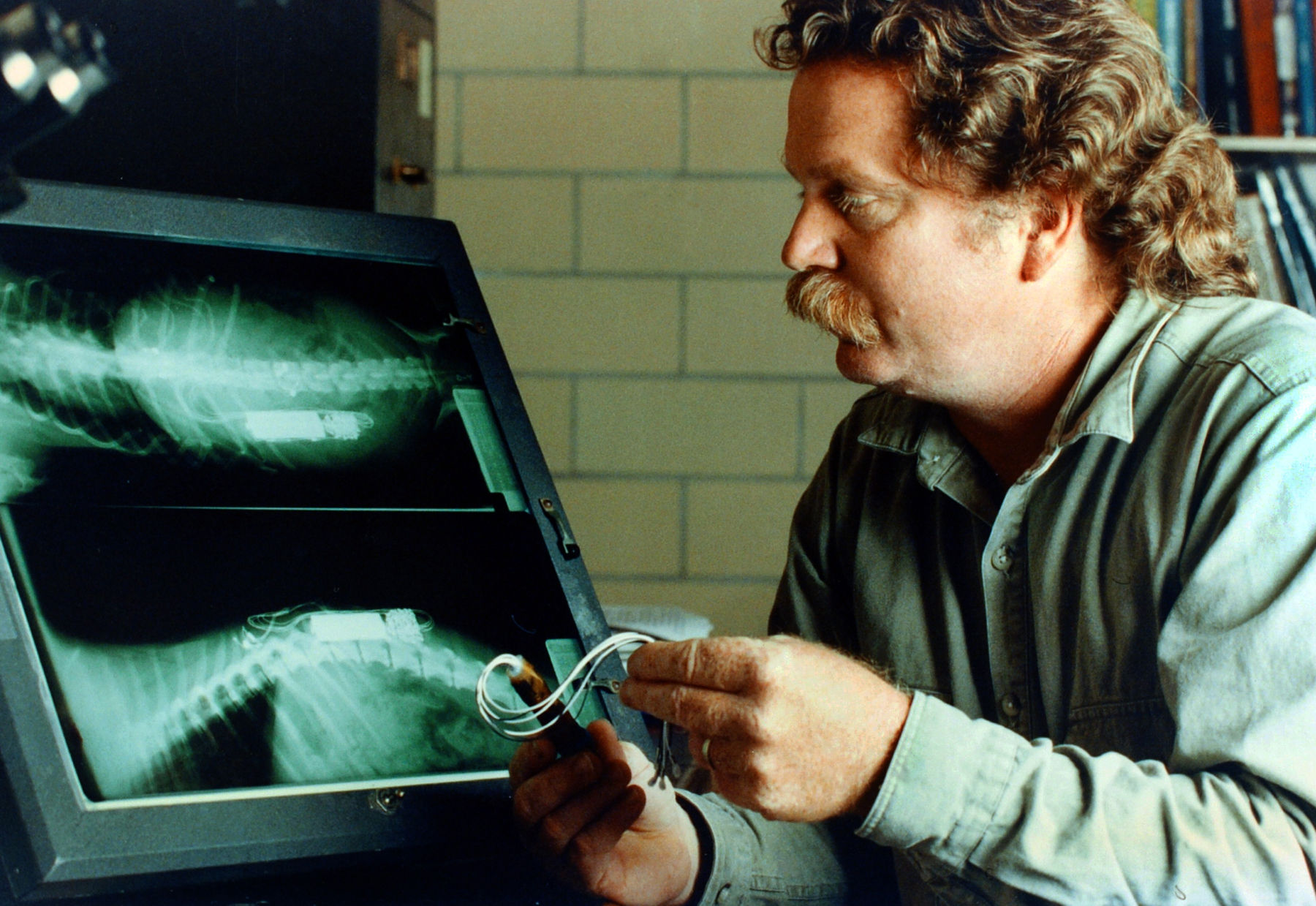
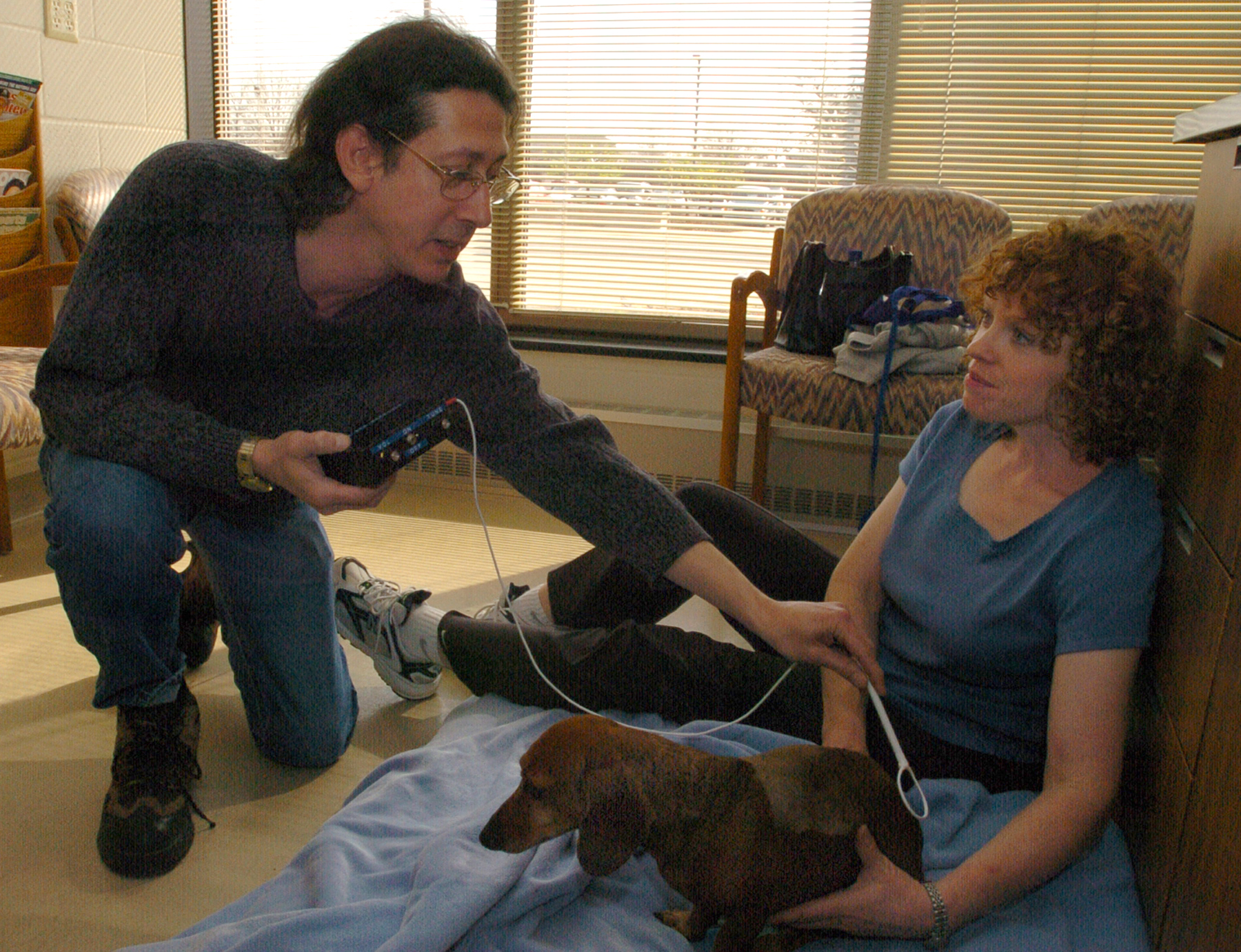
Cutline #1: Richard Borgens examines X-rays of a patient that has just had an oscillating field stimulator implanted near the spine. The outline of the device is visible in both X-ray images. Cutline #2: Engineering technician John Cirillo checks on the progress of Morton, a 7-year-old male Dachshund recently implanted with an oscillating field stimulator. Holding Morton is his owner, Suzie Fieber, of Oregon, who brought Morton to the Center for Paralysis Research for treatment after he injured his back jumping down from a couch. Cutline #3: Richard Borgens relaxes at home, playing one of his many stringed instruments. Black-and-white images of his colorful Texas family adorn the walls.
|