Purdue News
Purdue News

|
|
April 23, 2004 Emerald ash borer confirmed in Indiana, one area quarantinedWEST LAFAYETTE, Ind. - The emerald ash borer, an exotic species of beetle that destroys ash trees, has made its way into Indiana and officials are taking steps to contain it.
Tom Eickholtz, a Purdue University Cooperative Extension Service educator in Steuben County, found signs of the insect on Monday (4/19). On Wednesday (4/21) the Indiana Department of Natural Resources (IDNR) and an emerald ash borer specialist from the U.S. Department of Agriculture's Systematic Entomology Laboratory confirmed that Eickholtz' find was the ash boring pest.
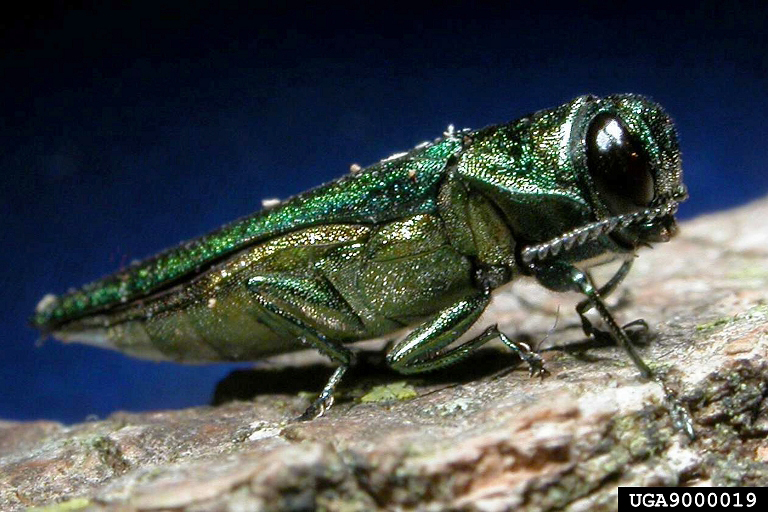
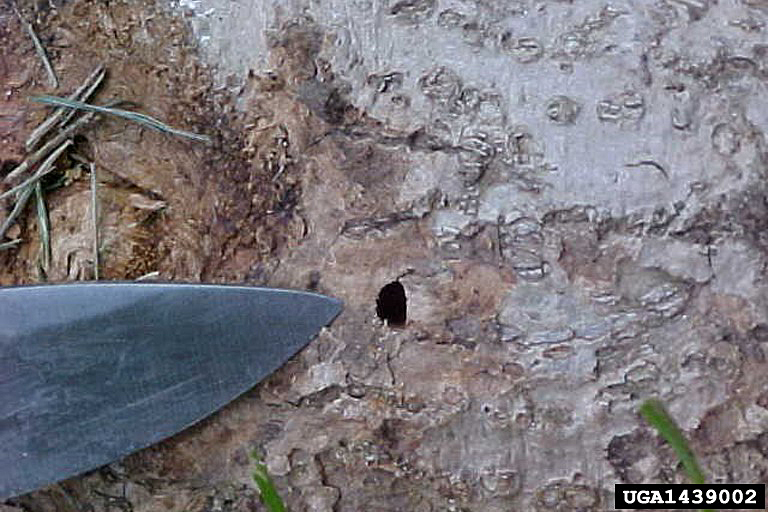
As a result of the confirmed discovery, the IDNR has issued a quarantine for Jamestown Township in Steuben County. Dr. Robert Waltz, state entomologist, said the quarantine forbids transportation of ash trees and most ash tree products out of the township. This includes nursery stock, logs or untreated lumber with the bark attached, and any composted or uncomposted ash chips or bark chips that are one inch or larger. The IDNR will spend the next few days surveying the area around the Yogi Bear Jellystone campground on Barton Lake where the infected tree was found. Barton Lake is about 40 miles north of Fort Wayne, Ind. Waltz said the survey will determine how many ash trees are in the surrounding area and the extent of the infestation. These steps are in preparation for the removal of all ash trees within a half-mile radius of the infestation. "As research gets further along, we think there will be other ways to stop emerald ash borer," said Jodie Ellis, the exotic insects education coordinator at Purdue. "But right now, cutting down these trees is what needs to happen to eradicate this pest." Homeowners can assist Purdue Extension and the IDNR in slowing the spread of the emerald ash borer. "This infestation likely happened because humans moved infested ash products," Ellis said. "More than likely it occurred when firewood or nursery stock was moved." That's why it's important that Hoosiers don't bring firewood from Michigan or Ohio - two states with emerald ash borer infestations - into Indiana. Ellis said it's also best to debark all firewood before traveling, and that campers should be sure to burn all the wood they brought with them. Residents also should keep their ash trees healthy by providing adequate water - about one inch per week. The adult emerald ash borer is slender and a bright, metallic, coppery-green color. It is about one-third of an inch long, making it difficult to spot in tree leaves. The larval, or immature, form of the pest destroys live ash trees by eating the vascular tissue that supplies nutrients to the tree, Ellis said. The tree starves to death three years after the vascular tissue is destroyed. It's difficult to diagnose emerald ash borer damage because of the prevalence of other ash-boring pests in Indiana. One of the main ways to distinguish emerald ash borers from native species is the characteristic D-shaped exit holes in the main trunk and the rate at which ash borers kill trees. Other symptoms include vertical splits in the bark and increased woodpecker activity. Cliff Sadof, a Purdue Extension entomologist, said the beetle has already killed more than 6 million trees ash trees in Michigan since it was found in July 2002. Indiana has approximately 150 million ash trees. Residents who see evidence of emerald ash borers should contact Ellis at (765) 494-0822 or the Indiana Department of Natural Resources Invasive Species Hotline at (866) 663-9684. "We knew it was coming and hoped it wouldn't be here quite this soon," Ellis said. "But we had advance warning that it was approaching. This is a great example of the benefits of cooperation between IDNR and Purdue in the matter of exotic insects. It's very encouraging. "Tom Eickholtz and Gary Moughler, the IDNR entomologist who first visited the site, performed a great service for Indiana in making this find. Now that we know it's here, we can take steps to eradicate it." Additional information and photos of the emerald ash borer are available at Purdue's emerald ash borer Web site. Writer: Kay Hagen, (765) 494-6682, kjh@purdue.edu Sources: Jodie Ellis, (765) 494-0822, ellisj@purdue.edu Robert Waltz, (317) 232-4120, bwaltz@dnr.state.in.us Cliff Sadof, (765) 494-5983, cliff_sadof@entm.purdue.edu Ag Communications: (765) 494-2722; Beth Forbes, bforbes@aes.purdue.edu Related Web site: PHOTO CAPTION: A publication-quality photo is available at https://www.purdue.edu/uns/images/ashborer.adult.jpeg PHOTO CAPTION: A publication-quality photo is available at https://www.purdue.edu/uns/images/ashborer.damage.jpeg
|