Purdue News
Purdue News

|
|
April 21, 2004 Student teams present big design plans for rerouting U.S. 231WEST LAFAYETTE, Ind. – Six interdisciplinary teams of Purdue University students on Tuesday (4/27) will present to local and state officials "an optimum physical design" for rerouting a two-mile stretch of U.S. 231 and a comprehensive plan for utilizing surrounding land.
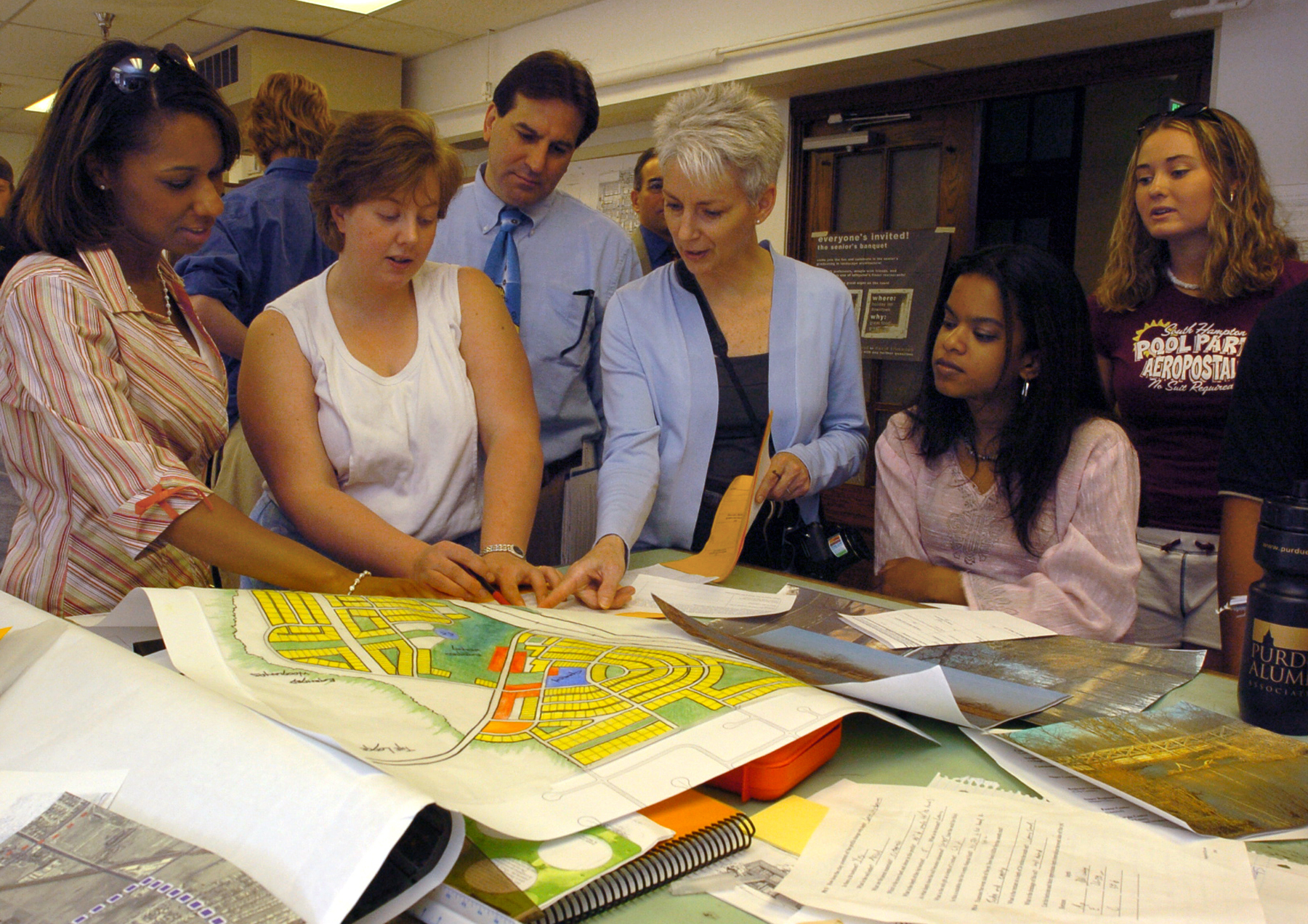
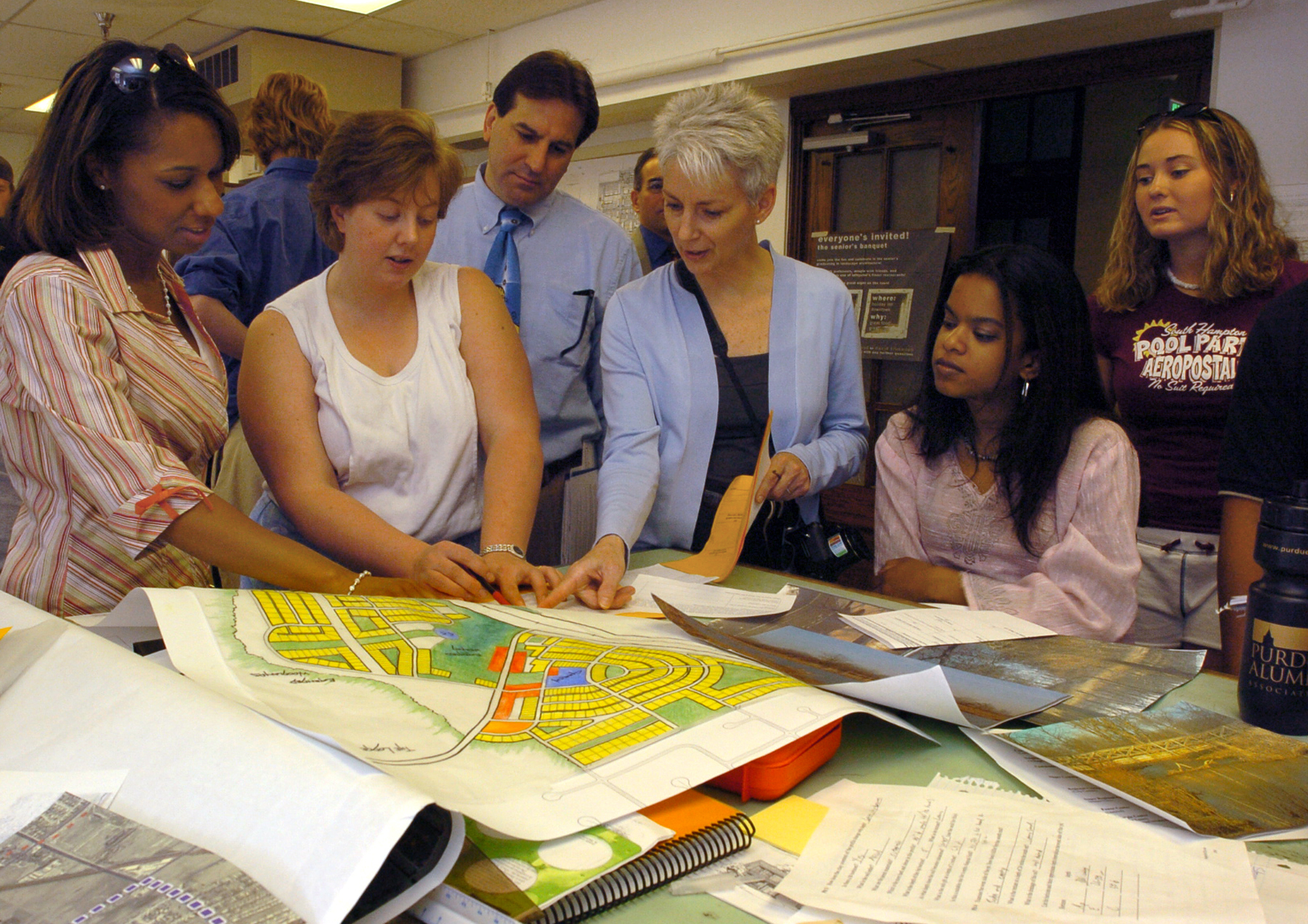
Representatives from the Area Plan Commission, Indiana Department of Transportation, Purdue and the U.S. 231 Community Advisory Committee will review the design during presentations at 5-6 p.m. and 7-8 p.m. in Stewart Center, Room 218D. University officials, deans and faculty members are scheduled to attend, and the sessions are open to the public. There will be a 6 p.m. reception between the two presentations. Students and professors from three departments – forestry and natural resources, horticulture and landscape architecture, and hospitality and tourism management – have created 4-by-8 foot posters covering not only the exact route of the new two-mile stretch of highway but also the social, economic and environmental issues involved with the project. Mick La Lopa, associate professor of hospitality and tourism management, said the semester-long assignment for the students was to develop proposals to deal with the highway rerouting in the broadest, most comprehensive way. "The goal is to develop a sustainable community that takes into account land use and the region's ecology, as well as diversity of housing, open spaces and commercial development," La Lopa said. The second phase of the proposed U.S. 231 relocation, which will extend from near the Purdue soccer complex at Cherry Lane and McCormick Road to U.S. 52 and serve as a new entrance to the university, is scheduled to be completed in 2010. Sherry Meng, a senior in hospitality and tourism management from Indianapolis, and Katie McWhorter, a freshman HTM major from Zionsville, Ind., are doing an independent study in event management. Their task is to coordinate the efforts of the 160 students, host the poster session at the presentation and get word of the presentation out to the public. "It's a challenge coordinating students from different disciplines, with different schedules with a solid real-world deadline to be critiqued by the decision makers and those affected by the decisions made," Meng said. "Event management is a huge field, and I'm checking this out for myself as a career option." Kim L. Wilson, associate professor of horticulture and landscape architecture, said the project was divided by department, and students from the three departments were on each of the six teams. "The HTM students looked at the existing demographics, finding out who lives in the area now," Wilson said. "Forestry students surveyed the local residents to determine future development needs and looked at habitats, particularly in the development of a comprehensive open space network that takes into account wetlands and drainage patterns in the area. The landscape architecture students are charged with making sure the highway is not a barrier, but rather a seam. "Our goal is cutting-edge neighborhood design principles and new approaches to community development – preventing sprawl and creating livable communities." Wilson said that formerly she taught this junior-level landscape architecture class using the traditional classroom and textbook approach. "Would I use this interdisciplinary approach again?" she asks. "Yes, I would, because my students are experiencing what I term 'deep learning.' They're seeing their profession in the context of other professions and also in terms of zoning laws and the sometimes competing points of view of various stakeholders – homeowners, government decision makers and developers, and other business people." Wilson said her students also are learning not only how to communicate with those in other disciplines but also are seeing all that is required to put together a successful project, skills the students will use throughout their careers. "Philosophically, disciplines need to work together in teams to solve complex environmental projects. If we truly believe that, we should begin this process in higher education." Shorna Broussard, assistant professor of forestry and natural resources, is the third faculty member whose students are part of the project. "One very critical component of the project is incorporating citizens into planning decisions at the local level and also emphasizing the importance of open space and natural resources in the planning process," she said. The forestry and natural resources students are enrolled in a course titled "Human Dimensions of Natural Resources" in which they explore the various roles of humans in the environment. They are applying that expertise in this project. Several teams surveyed local residents to determine their preferences for residential and commercial development and land uses associated with 231. "We stressed the importance of the plans being informed by the community," Broussard said. Project faulty spent nearly a year planning the course prior to this semester. The project was funded by the Purdue University Libraries as well as a Service Learning Faculty Development Grant through the Center for Instructional Excellence. Christian Reiner, an evaluation specialist in the Center for Instructional Excellence guided the student evaluation and assessment; Vickie Killion, pharmacy librarian, led the information literacy piece; and Amy Ross-Davis, a doctoral student and graduate teaching assistant aided in many aspects of project management and implementation. Writer: Mike Lillich, (765) 494-2077, mlillich@purdue.edu Sources: Mick La Lopa, (765) 494-6218, lalopam@purdue.edu Sherry Meng, (765) 497-2400, smeng@purdue.edu Katie McWhorter, (765) 495-1280 Kim L. Wilson, (765) 494-1308, willson@hort.purdue.edu Shorna R. Broussard, (765) 494-3603, srb@fnr.purdue.edu Purdue News Service: (765) 494-2096; purduenews@purdue.edu Note to Journalists: Student teams creating proposals for rerouting U.S. 231 will be making their presentations on Tuesday (4/27) from 5-6 p.m. and 7-8 p.m. in Stewart Center, Room 218D. Reporters can interview individual professors, students, INDOT and county officials during a reception that starts at 6 p.m. Large posters of the teams' work will be available in Stewart Center, 218A-C. PHOTO CAPTION: A publication-quality photo is available at https://www.purdue.edu/uns/images/+2004/lalopa-hiwayteams.jpg
|