Purdue News
Purdue News

|
|
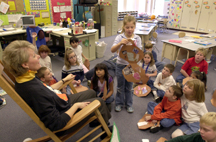
November 16, 2001 Economics joins three Rs in elementary educationWEST LAFAYETTE, Ind. – Second-grader Brooke Richardson is studying reading, writing, spelling, arithmetic – and economics.
Through the help of a state-supported program based at Purdue University, Indiana teachers are learning how to fold basic economic concepts into their daily curriculum. The Indiana Council for Economics Education oversees 13 economics education centers, which in turn, offer workshops and programming for teachers interested in economics. The movement to integrate economics into the daily classroom routine has snowballed, as economic education advocates share with other teachers what has worked for them. Callie Marksbary, second grade teacher at Vinton Elementary in Lafayette, Ind., is one such economics education advocate. An award-winning teacher, she says she believes that basic economic concepts are as important as the three Rs. "I am very passionate about economics," Marksbary says. "It is a life skill that they will use every day of their lives. I want my students to make good decisions." Marksbary, who has been teaching for 28 years, recently had the students plan an imaginary trip, during which they discovered the economic concept of opportunity cost. Each student had to leave an item behind so they could fit their favorite item of choice in their suitcase. Later in the year, Marksbary will join with fifth grade teacher Mary Sturgeon to operate a student-run cookie factory. The students will do their own marketing and product development. They will then bake the cookies and sell them. The money earned will pay for a field trip and the remainder will be donated to a charity. During the process, income records will be kept and taxes will be estimated. "It's like a mini economy," Marksbary says. "They learn that tax dollars pay for the fire department, police protection, trash collection, etc." Besides providing training and curriculum materials for teachers, the ICEE sponsors several innovative programs promoting economics. One such program is the Indiana Stock Market Simulation. Teams of Indiana students from grades four through 12 invest a hypothetical $100,000 in stock via the Internet. During the process, the students learn about the sources and uses of capital, along with the potential risks and rewards associated with managing personal finances. The ICEE provides training and curriculum for teachers interested in the simulation, and supplies awards for teams who accumulate the most capital. Another popular ICEE-sponsored program is a calendar contest. Students in grades one through eight create posters illustrating one of six economic concepts, such as producer and consumer. The top three entries, along with winners from four other states, appear in a 15-month calendar published by the Federal Reserve Bank of Chicago. High school students put their economics education to use by competing in the Economics Challenge Competition each spring. State winners advance to a Midwest and possible national competition. The ICEE also provides tangible support to teachers by conducting graduate-credit workshops featuring business, labor and agricultural leaders. Beverly Brewer, ICEE associate director, says the workshops enable teachers to learn new economic concepts and develop curriculum units to use with their students. "Thanks to many generous contributors, the ICEE offers tuition scholarships to those attending the workshops, which over the years have become the flagship program of the ICEE," Brewer says. The ICEE also oversees the implementation of the EconomicsAmerica School Grant Program in Indiana, which provides the monetary means to implement new curriculum ideas. The ICEE even supplies sets of posters for classroom display. Each poster defines and explains one of 22 economic concepts. The poster teaching guides also include a bibliography of children's literature that can be used to teach economics. Toward the end of the year, the ICEE holds an awards banquet where teachers throughout the state are honored for excellence in economic education. "These prestigious awards are coveted by teachers across Indiana," Brewer says. "And with good reason – they definitely reward excellence in education." Marksbary says her real reward is having the ICEE as a low cost, but highly valuable, resource. "The ICEE has been wonderful for teachers in the state of Indiana," Marksbary says. "They will even come into the classroom to help teachers. I cannot speak highly enough about them." Writer: Marydell Forbes, (765) 496-7704, mforbes@purdue.edu Sources: Beverly Brewer, (765) 494-8545, brewerb@mgmt.purdue.edu Callie Marksbary, (765) 771-6140, cmarksbary@lsc.k12.in.us Purdue News Service: (765) 494-2096; purduenews@purdue.edu PHOTO CAPTION: A publication-quality photograph is available at ftp://ftp.purdue.edu/pub/uns/brewer.icee.jpeg.
|