 Purdue News
Purdue News

|
Center for Families supports a complex,
Families. What they have in common the world around is that they are the
place where people learn who they are and how to be that way, says author
Jean Illsley Clarke in "Self-Esteem: A Family Affair." |
|
An essential building block of civilization, the family is changing and becoming more and more complicated.
Witness these characteristics of the modern family:
* Single parents raise nearly one-third of the children in the United
States.
* More than half of the mothers of infants are employed. And, in a recent
national survey, 62 percent of employed parents with children under age
13 said they experienced problems finding quality child care.
* As the population ages, many workers are caring not only for young
children, but for aging parents - and are beginning to become concerned
about their own retirement years.
* The proportion of marriages that end in divorce rose steadily through
the 1980s, and now half of all new marriages are expected to end in
divorce. Remarriages and other unions are resulting in "blended"
families that can be quite complex.
* In Indiana alone, more than 47,000 families were receiving welfare
assistance in 1997.
The numbers are more than just statistics for Shelley MacDermid, director of the Purdue Center for Families. Likewise for other researchers in the Department of Child Development and Family Studies and the School of Consumer and Family Sciences.
The numbers represent real people who want and need advice, assistance, information.
"The scientific study of families and their concerns is becoming more, not less, important," MacDermid says.
Families are not the cozy "Mom at home, Dad at work, two kids at school" ideal that MacDermid says has always had a large element of myth in it. In fact, families are multifaceted when it comes to finances, working arrangements and home life.
"We truly focus on family well-being," MacDermid says. "Our priorities are promoting the use of rigorous research about families, making that research accessible, and nurturing the collaboration of groups that work to benefit families."
Providing the latest research about families to human service professionals, extension educators, employers and legislators, MacDermid says, means families will get the most help possible to have the best qualiy of life they can.
Founded in 1994, the Center for Families has undertaken more than 25 projects thus far - and many more are planned.
"Today, it seems there are `family values' experts in every arena," MacDermid says. "Scholars in schools such as ours are needed to provide thorough, thoughtful research. We need to arbitrate the national discussion, to train professionals and citizens to understand family-related data in the context of current and past trends, and to insist on high-quality evidence and reasoned debate."
To get the word out about what's best for families, the Center for Families has organized seminars for legislators, such as the recent Family Impact Seminar, to help encourage family-friendly policies and laws.
"It is so important to provide policy-makers with educational information about topics such as quality in child care and evidence of the impact of full-day kindergarten," MacDermid says. "We are not there to lobby, but to provide background. This information can have a major impact on the decisions legislators make."
Susan Kontos, professor of child development and family studies and a speaker at the Family Impact Seminar, says that while abundant research shows the importance of child care quality, the questions really are, What does quality look like in early care and education? and Do we recognize quality when we see it?
The ratio of children to adults, the experience and education of teachers and caregivers, the size of the group of children, and the sensitivity and attentiveness of the caregivers all are indicators of quality, Kontos says.
MacDermid says educational events such as the Family Impact Seminar point out to government agencies that what they do affects individuals and families.
"States with rigorous licensing standards for child care have been shown to have greater proportions of high-quality care," Kontos says.
The Center for Families also has formed a partnership with employers who are interested in work-family issues - the Midwestern Work-Family Association.
As director of that partnership, MacDermid has helped organize workshops and individual training programs for various employers.
"Our workshops explore different ways employers can support workers and their families while meeting business goals," she says. "We look at flexible work arrangements, and we encourage employers to offer information to employees. Some of these things cost very little but help employees feel better about their work."
An upcoming workshop for members of the association will focus on elder care.
"Many companies have an aging work force," MacDermid says. "The workers have parents to care for, but they also wonder about their own retirement years."
While it's an unscientific assessment, MacDermid says, many child- and elder-care referral services are reporting that their calls are close to 50 percent for elder care now as opposed to mostly related to child care.
Trends and challenges to families are what drive research by MacDermid and her colleagues.
Researchers explore child care for infants and toddlers, the pluses and minuses of full-day kindergarten, the effects of family life on working men and women, and the effects of work on marriages and family life.
One recent study has shown that working parents can choose to reduce their workload yet still climb the ladder to success.
Other studies focus on single-parent families to determine what programs can be of help to the parents and children. Work continues on developing programs to help families living in poverty make better decisions so they can live healthier, more prosperous lives.
"We need to provide information and programs to human service professionals so they can do a better job dealing with families in crisis," MacDermid says.
Preventing child abuse, helping moms and dads be better parents, providing financial counseling to help families get back on their feet after a crisis - educational information is sometimes what's needed most, MacDermid says, and the Center for Families can help with that.
The Center for Families has several goals and objectives, she says, but as its names implies, all are focused on the family - the quality of life of parents and children of all ages.
Story by Julie Rosa
Photographs by David Umberger and Tom Campbell
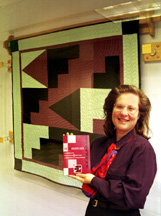
PHOTO CAPTION:
Shelley MacDermid, director of the Center for Families, says the center
draws strength from its many elements - much like the quilt of the center's
logo is stronger because the pieces are stitched together.
Purdue News Service: (765) 494-2096; e-mail, purduenews@purdue.edu
 To the Purdue News and Photos Page
