Purdue News
Purdue NewsFebruary 7, 1998
|
More than 600 people turned out to watch the three-team competition in Elliott Hall of Music.
The Society of Manufacturing Engineers placed first ahead of machines built by the student chapters of the Society of Women Engineers and Society of Physics Students, and the American Society of Mechanical Engineers. The winning team will vie for the national title against teams from across the country in the National Rube Goldberg Machine Contest on April 4 at Purdue.
The contest honors the late cartoonist Rube Goldberg, who specialized in drawing whimsical, complicated machines to perform very simple everyday tasks. The machines were judged based on the completion of the task, creativity, number of steps involved, and Rube Goldberg spirit.
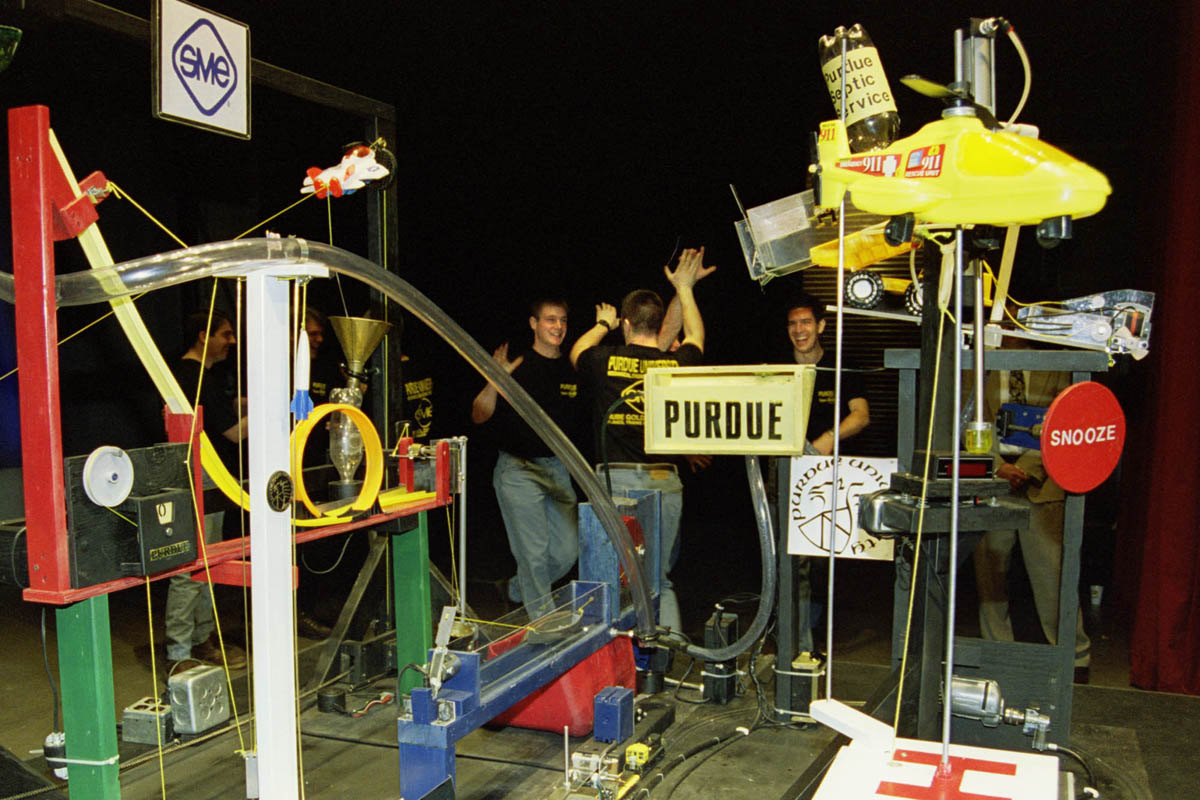
In keeping with this year's task, the winning machine was activated when one of its members pressed a large red "snooze" button. Various elements of transportation were employed throughout, including a toy airplane simulating flight, a tanker truck, canoe, rocket, a "Hot Wheel" car complete with loop-the-loop orange track, a model train and a toy helicopter.
Other machines used items such as children's wooden blocks, dominoes, golf balls, action figures and "Red Hots" cinnamon candies, used to represent Newton's Apples falling from a tree.
Members of the winning team, all from Indiana, are: Mickey Wilson, a senior from Greenwood; Chris Tucker, a senior from Mentone; Rick Tomich, a senior from Hebron; Wes Kitchen, a junior from Martinsville; Jack Lehner, a senior from Dyer; Alan Morrison, a junior from North Vernon; and John Fenter, a senior from Indianapolis.
The winners spent more then 500 hours and about $100 putting their machine together, according to team spokesman Wilson. Here's their award-winning method of turning off an alarm clock:
Pressing the snooze button actuates an electromagnet, which drops a large ball bearing down a clear rubber hose. The bearing lands on a lever that flips a switch that activates the motor responsible for pulling a chain drive connected to an airplane -- simulating flight. At the peak of the plane's flight, a ball bearing bomb is released and lands in a golden funnel. The bearing is directed by a short length of clear rubber hose tubing and then drops out of sight.
At this point the bearing completes a circuit that activates a small bilge pump that fills a sewage tanker truck from a septic tank below. When the tanker is full, the weight of the fluid tips the platform the truck is on, depressing a switch. This activates a motor that raises the bed on the tanker. When the bed of the tanker is raised completely, a mouse trap is tripped, pulling the pin that holds the sewage in the tanker. The sewage drains from the tanker filling a reservoir. Once the reservoir is filled, the fluid is siphoned out over a waterwheel.
|
Wilson says the most difficult engineering aspect of the machine involved the dump truck, because it took three micro-switches working simultaneously to dump the water.
Second place went to a team from the Society of Women Engineers and the Society of Physics Students for their machine that simulated various team members' childhood dreams.
Third placed was awarded to the Society of Mechanical Engineers for a machine that reflected the student experience of being late for class. It featured several hand-made replicas of landmarks unique to Purdue's West Lafayette campus.
The winning team received a check for $150 and an 18-cubic-foot refrigerator from corporate sponsor General Electric.
Source: Chad Goze, contest chairman, (765) 743-2461; e-mail, goze@purdue.edu
Writer: Sharon Bowker, (765) 494-2077; e-mail, sharon_bowker@purdue.edu
Purdue News Service: (765) 494-2096; e-mail, purduenews@purdue.edu
PHOTO CAPTIONS:
(Photo 1)--Senior Wes Kitchen of Martinsville, Ind., (left), congratulates senior Mickey Wilson
of Greenwood, Ind., following the first successful run-through of their Rube Goldberg
Machine at Purdue University on Saturday (2/7). Teammate Alan Morrison, a junior
from North Vernon, Ind., looks on. The team from the Society of Manufacturing Engineers
won the 16th annual contest with a machine called "Planes, Trains and Automobiles."
It successfully turned off an alarm clock in 26 steps. The team now will vie for
the national title against teams from across the country in the National Rube Goldberg Contest
on April 4 at Purdue. (Purdue News Service Photo by Dave Umberger)
Color photo, electronic transmission, and Web and ftp download available. Photo ID:
Rube98.reax
Download here.
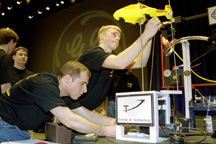
(Photo 2)--Jack Lehner, a senior from Dyer, Ind., and John Fenter, a senior from Indianapolis,
reset their machine for its second run-through at the 16th annual Rube Goldberg Machine
Contest at Purdue University on Saturday (2/7). Their team, sponsored by the Society of Manufacturing Engineers, defeated two other entries in the contest with its "Planes,
Trains and Automobiles" machine and will represent Purdue in the national contest
held at Purdue on April 4. The contest honors the late cartoonist Rube Goldberg,
who specialized in drawing whimsical, complicated machines to perform simple everyday
tasks. (Purdue News Service Photo by Dave Umberger)
Color photo, electronic transmission, and Web and ftp download available. Photo ID:
Rube98.reset
Download here.
 To the Purdue News and Photos Page