Imagine that a new lifesaving medication is invented, but its unusual structure makes it difficult to manufacture. Catalysis expert and chemist Christopher Uyeda aims to head off this problem by designing new reactions and catalysts that enable advanced chemistry. A reaction he designed is currently part of Pfizer’s process for manufacturing Paxlovid, the first-in-line treatment for COVID-19.
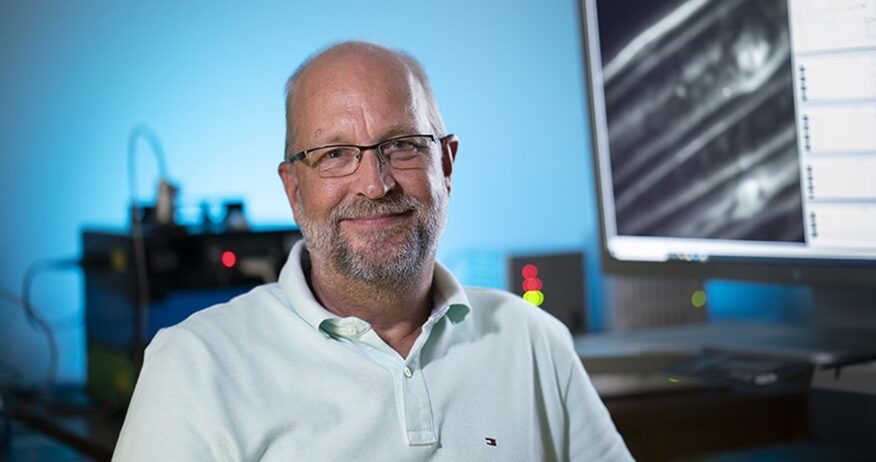
Purdue researchers found that a subset of epidermal cells in plant leaves serves as early responders to chemical cues from bacterial pathogens and communicate this information to neighbors through a local traveling wave of calcium ions. The properties of this local wave differ from those generated when epidermal cells are wounded, suggesting that distinct mechanisms are used by plants to communicate specific types of pathogen attack.
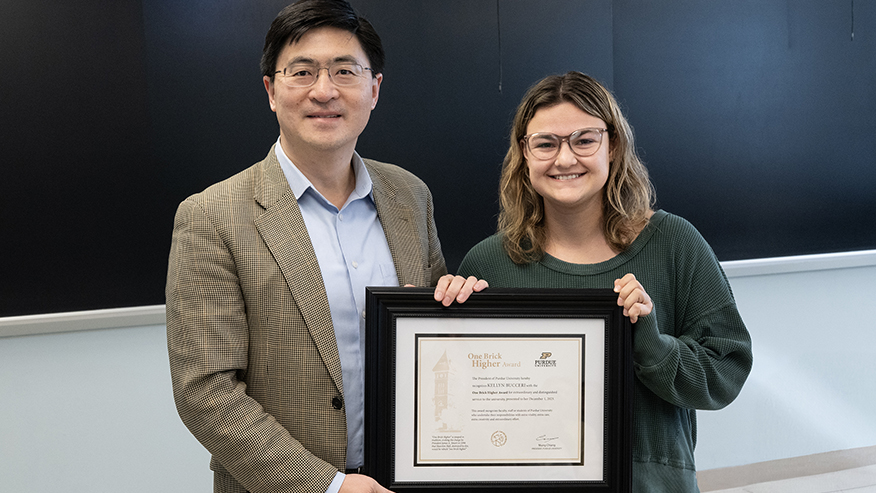
Purdue President Mung Chiang on Monday (Dec. 1) presented Kellyn Bucceri, a senior majoring in biomedical health sciences with a pre-medicine concentration in the College of Health and Human Sciences, with the One Brick Higher Award. The One Brick Higher Award is a special recognition given to Purdue faculty, staff and students who go beyond the requirements of their role and through extraordinary effort improve the lives of those around them, increase the effectiveness of the workplace, or prevent or solve problems.
Jim Brickman’s “The Gift of Christmas” blends holiday classics, heartfelt originals and a touch of humor — all delivered with Brickman’s signature piano style. Catch his performance at Loeb Playhouse at 7:30 p.m. Dec. 11. Tickets are available now.
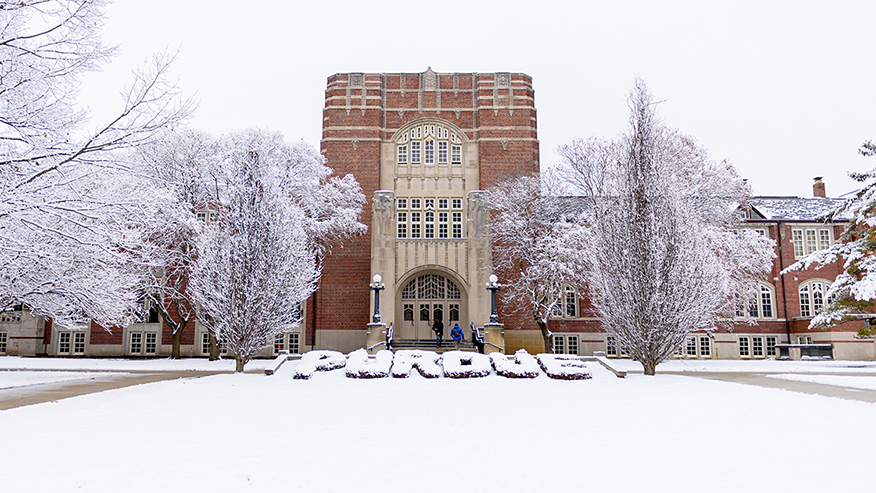
The university will be closed Dec. 24-25 and Jan. 1-2, which are university holidays, as well as Dec. 26 and Dec. 29-31, which is the 2025 winter recess. For more information on the winter recess, see the 2025 winter recess FAQs.