Bioaccumulation and effects of PFAS on largemouth bass reproduction
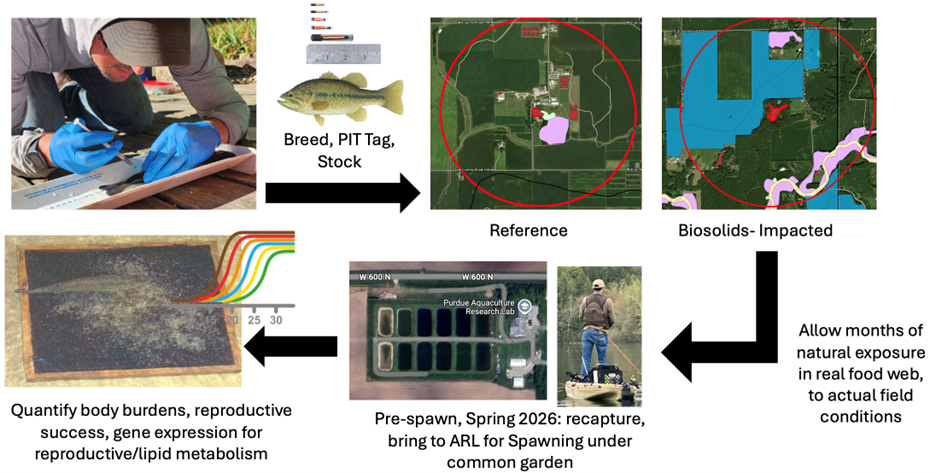
Per- and polyfluoroalkyl substances (PFAS) are persistent, bioaccumulative, and toxic contaminants that may alter reproduction. PFAS concentrate in municipal biosolids, which are routinely spread on agricultural fields. We recently sampled a pond receiving biosolid runoff and found that PFAS profiles in media were unique compared to better-studied PFAS sources and that largemouth bass (Micropterus salmoides) had very high PFAS loads compared to federal and state monitoring studies. While biosolid applications might lead to high exposures for farm pond bass and humans eating them, we need replicate sites to characterize PFAS exposures. Existing studies suggest that PFAS might disrupt reproduction in fish and provide leads toward underlying molecular mechanisms, but have generally focused on small fish exposed to single PFAS under laboratory conditions. These exposures fail to mimic field exposures to complex mixtures of PFAS, which occur chronically, via multiple routes, and against a backdrop of environmental variables that might mediate effects. Likewise, we currently lack molecular biomarkers of PFAS exposures and effects for wild fish. The central objectives of our work are to characterize PFAS profiles in media and bass tissues in ponds receiving biosolid runoff, to determine whether exposure to PFAS influences reproduction under field conditions and to elucidate any underlying molecular mechanisms, and finally, to screen and validate biomarkers of exposure and effects. We will quantify 62 targeted PFAS in fish tissues using liquid chromatography mass spectrometry (LC-MS/MS) and time of flight quadrupole mass spectrometry (QToF-MS) and will address objectives using a combination of observational fieldwork and a large-scale field experiment. This study will establish a new collaboration between USGS and Purdue scientists, builds on previous USGS work aimed at characterizing PFAS exposure and effects in gamefish, and complements ongoing USGS/Purdue collaborations aimed at understanding biotransformation of PFAS precursors and improvement of quantification in understudied media.