
Using Non-biting Midges to Model PFAS Interactions with Proteins: Predicting effects of PFAS Mixtures
Over 95% of the U.S. general population has quantifiable serum levels of PFAS, with a mean of 2 to 5 parts per billion (ppb) for perfluorooctane sulfonate (PFOS) and perfluorooctanoic acid (PFOA), respectively. The exact number and types of PFAS are unknown, but it’s estimated to be ~5,000, with >98% of them lacking bioaccumulation and toxicity data. Exposure to PFAS occurs mixtures that vary in the number of halogenated carbons and functional groups. These different PFAS classes vary in their half-lives and potency in animals. Despite that typical exposures are from mixtures, PFAS mixture toxicity data remain sparse.
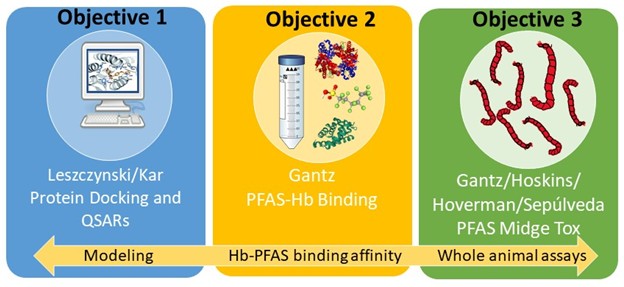
PFAS are highly proteinophilic and known to bind to circulating and structural proteins. Hemoglobins (Hbs) are key proteins responsible for transporting oxygen to tissues and there is evidence that PFAS can bind with Hbs, altering its structure, stability and potentially interfering with oxygen transport. Given their fundamental role in physiological processes and sensitivity to PFAS, Hbs could be an excellent protein target for predicting PFAS mixture toxicity. However, systematic studies examining Hb and PFAS interactions are needed to determine the utility of this approach for studying PFAS mixture toxicity.
The ultimate goal of this research is to predict the toxic potency of PFAS mixtures to help with risk assessment efforts. We are testing overarching hypothesis that binding of PFAS to Hbs is a tractable and sensitive physiological signal that can be used to predict the toxicity of PFAS mixtures. We are using a combination of in silico, in vitro, and in vivo tools using a highly sensitive invertebrate model to determine its utility for studying PFAS-Hb binding as a robust approach for ranking the toxic potency of PFAS and PFAS mixtures.