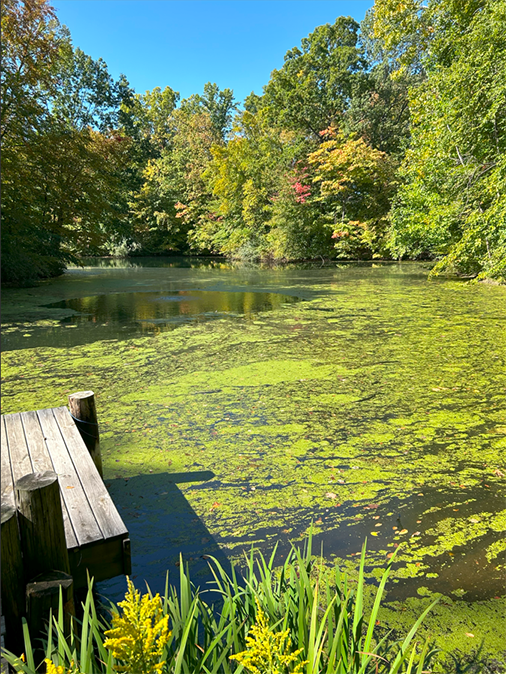
Constructed Ponds as Understudied Aquatic Ecosystems on Agricultural Landscapes
Ponds are ubiquitous aquatic habitats on agricultural landscapes, but are understudied relative to ephemeral wetlands and streams lakes and rivers. While there are many reasons for a lack of systematic studies on constructed ponds, the facts that they are often small, isolated, and located on private lands are likely to contribute. Regardless, we are interested in describing the distribution of ponds on the landscape, typical pond characteristics in terms of their surrounding land use, pond community structure, and how ponds are used by people. We are using a combination of geospatial analysis, field sampling, and experiments in aquatic mesocosms to accomplish this. We hypothesize that ponds may represent unique habitats that differ form better studied aquatic ecosystems, but that basic, descriptive data is needed to test this. Ultimately, ponds may play underappreciated roles in mediating water quality, contaminant loading, and maintenance of biodiversity in agricultural watersheds. Thus, ponds may represent a major conservation opportunity that is not currently emphasized in common approaches to conservation and management in heavily agricultural areas.