 Purdue University - Extension - Forestry and Natural Resources
Got Nature? Blog
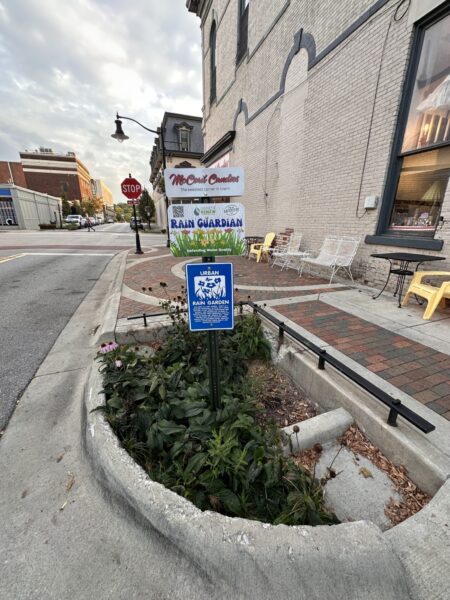
Figure 1. A rain garden in downtown Lafayette captures runoff from nearby roads and sidewalks, slowing and filtering water before it enters the stormwater system. Credit: Amy Thompson, Purdue University.
Purdue Landscape Report: Rainscaping is the practice of designing landscapes to capture, absorb, and use rainwater where it falls. Rather than sending water off-site through storm drains, the water slows down, spreads across the landscape, and soaks into the soil.
In Indiana, spring often brings intense rain events that can quickly overwhelm drainage systems, soils, and rivers. Rainscaping offers a different approach. Instead of treating rainwater as something to get rid of, it becomes a valuable resource that benefits both the landscape and the environment.
Why Rainscaping Matters
Across the Midwest, rainfall is becoming less predictable, with more intense storms delivering large amounts of water in a short period of time. Many landscapes are not designed to absorb this volume quickly. Compacted soils, large areas of turf, and paved surfaces all contribute to rapid runoff of soil, nutrients, and pollutants into nearby waterways.
With rainscaping, the goal is to keep water on-site and allow it to infiltrate slowly (Fig. 1). As the water moves through the soil, it not only irrigates the landscape, but it’s filtered, which reduces runoff, improves water quality, and eases the burden on stormwater systems.
How Rainscaping Works
The principle of rainscaping is simple: slow water down and give it time to soak in. This can be achieved in a variety of ways depending on the site conditions. The right approach depends on how water moves through your landscape.

Figure 2. Water infiltrates into a rain garden in Bloomington following an intense rain event, demonstrating how these systems manage excess runoff from the nearby parking lot. Credit: Amy Thompson, Purdue University.

Figure 3. A bioswale outside Purdue’s Horticulture building captures and directs runoff from downspouts before entering the stormwater system. Credit: John Orick, Purdue University.
The most common method for slowing runoff is with a rain garden, which is a shallow depression planted with species that can tolerate both wet and dry conditions (Fig. 2). The rain garden holds water after a storm and allows it to infiltrate within a day or two. Species that tolerate “wet feet” are planted in the bottom of the basin while drought tolerant species are planted at the top of the slope.
Other landscapes may be better suited for bioswales, particularly sloped areas where water naturally flows across the site (Fig. 3). Bioswales are shallow channels that slow and direct water, allowing it to infiltrate as it moves. As runoff passes through the soil and plant roots, sediment and pollutants are filtered out.
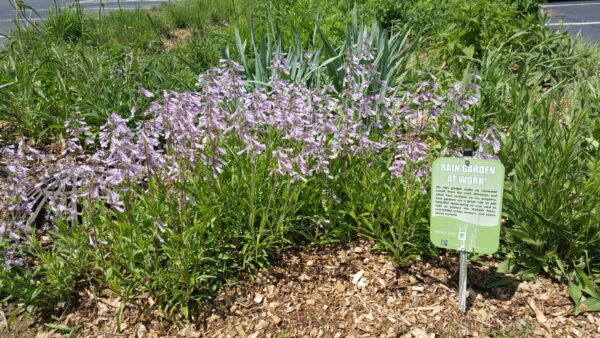
Figure 4. Rain gardens can be designed to manage water effectively while adding visual interest to the landscape. Credit: Karen Mitchell, Purdue University.
Getting Started with Rainscaping
Rainscaping does not require a complete redesign of the landscape, and the first step is simple observation. Spring is an ideal time to evaluate your site, especially during intense rain events. Observe how rainwater moves off hard surfaces, out of downspouts, across the landscape, and into storm drains. These observations will often point directly to areas for improvement and potential locations for rainscaping.
Avoid placing rain gardens in areas that remain saturated for several days after a storm, as this indicates a slow infiltration rate. Instead, focus on capturing water “upstream,” where it can soak in before reaching problem areas.
Once potential locations are identified, further site evaluation is needed. Estimate the amount of runoff entering the area and perform a simple infiltration test to determine the appropriate size and depth needed to handle larger rain events.
Plant species that tolerate both wet and dry conditions are essential, as these areas regularly cycle between extremes. Many plants native to Indiana are well adapted to these conditions, including purple coneflower, Joe-Pye weed, and prairie dropseed. By selecting species with varying heights, textures, and bloom times, these gardens can be both functional and visually appealing (Fig. 4).
Rainscaping is a practical approach to managing water in the landscape. By slowing runoff and encouraging infiltration, it reduces common problems while supporting healthier landscapes and more resilient ecosystems.
To learn more, the Purdue Rainscaping Education Program provides training and resources on planning, installation, and maintenance of rain gardens.
View the original article on the Purdue Landscape Report website: Rainscaping: Turning Water Problems into Sustainable Solutions.
Subscribe and receive the newsletter: Purdue Landscape Report Newsletter.
Resources:
What is Rainscaping? Purdue Rainscaping Education Program Video, Purdue Extension
Q&A About Drainage Water Recycling for the Midwest, The Education Store, Purdue Extension resource center
Rainscaping Playlist, Purdue Extension – Forestry and Natural Resources (FNR) YouTube Channel
Ask an Expert: Rainscaping, Purdue Extension – FNR YouTube Channel
Rain Gardens Go with the Flow, Indiana Yard and Garden, Purdue Horticulture
Become a Purdue Master Gardener, The Education Store
Master Gardeners Program
Plan Today For Tomorrow’s Flood, The Education Store
Karen Mitchell, Consumer Horticulture Extension Specialist
Purdue Horticulture & Landscape Architecture
In this edition of A Moment in the Wild, Zach Truelock introduces you to the spotted salamander, which is easily identifiable by the two rows of spots on its back. Learn more about their lives and breeding methods inside.
If you have any questions regarding wildlife, trees, forest management, wood products, natural resource planning, or other natural resource topics, feel free to contact us by using our Ask an Expert web page.
Resources
Question: Which salamander is this?, Got Nature? Blog, Purdue Extension – Forestry and Natural Resources
Salamanders of Indiana Book, The Education Store, Purdue Extension resource center
Amphibians: Frogs, Toads, and Salamanders, Purdue Nature of Teaching
The Nature of Teaching: Adaptations for Aquatic Amphibians, The Education Store, Purdue Extension resource center
Hellbender ID, Playlist, Purdue Extension – Forestry and Natural Resources YouTube Channel
A Moment in the Wild, Playlist, Purdue Extension – FNR YouTube Channel
Help the Hellbender, YouTube Playlist & Website
Zach Truelock, Hellbender Technician
Purdue University Department of Forestry and Natural Resources
Rod Williams, Assistant Provost for Engagement/Professor of Wildlife Science
Purdue University Department of Forestry and Natural Resources
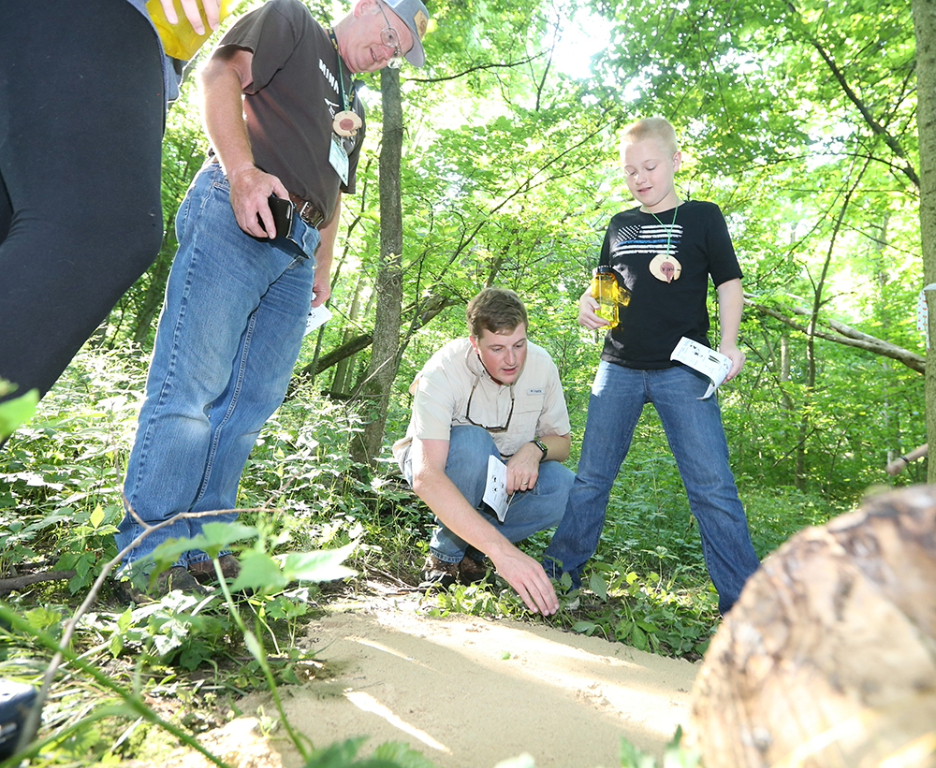 Purdue Extension wildlife specialist Jarred Brooke has been named as a recipient of the Purdue Cooperative Extension Specialists’ Association (PUCESA) Early Career Award, which recognizes an Extension specialist with less than 10 years of service.
Recipients must demonstrate Extension leadership; excellence in delivering public education programs; innovative approaches to program development and delivery; outreach efforts to county Extension educators; research that benefits Extension clientele through practical application; or through demonstrated collaboration with county educators, agencies or community leaders.
“I am truly grateful to be honored by my peers with this award, but most of my extension work would not have been possible without the wonderful people I work with both inside and outside of Purdue,” Brooke said. “I am indebted to them.”
Brooke, a 2012 wildlife science alum, returned to his alma mater in August 2016 as an Extension wildlife specialist after completing his master’s degree in wildlife management from the University of Tennessee in 2015. Over the past five years, Brooke has become a productive and effective extension specialist and has taken on multiple leadership roles, collaborated with partners in an outside of Extension, conducted applied research and worked to deliver impactful and innovative extension programming.
Brooke was honored with the PK-12 Outreach and Engagement Excellence Staff Award in April 2021 for his work with the 4H-Academy, the Wildlife Habitat Education Program and The Nature of Teaching.
Outside of Extension, Brooke helped form the Indiana Prescribed Fire Council, of which he has served as chair since 2018. He also is currently the Past President of the Indiana Chapter of the Wildlife Society, and served on the continuing education committee for the group. In these roles, Brooke collaborates with other natural resources professionals to plan and deliver natural resource-based programming to other professionals and landowners throughout Indiana.
Resources:
Jarred Brooke Receives PK-12 Council Staff Excellence Award, Got Nature? Blog, Purdue Extension-FNR
Brooke’s Prescribed Fire Videos Utilized in Global USFS Efforts, Got Nature? Blog, Purdue Extension-FNR
Pond and Wildlife Management, Purdue Extension-Forestry and Natural Resources
Natural Resources University, Deer, Fire, Pond and Habitat Podcasts
Creating a Wildlife Habitat management Plan for Landowners, Got Nature? Blog, Purdue Extension-FNR
A Template for Your Wildlife Habitat Management Plan, Got Nature? Blog, Purdue Extension-FNR
Subscribe to Purdue Extension – Forestry and Natural Resources YouTube Channel and view Jarred Brooke’s deer, fire and other wildlife videos.
Wendy Mayer, FNR Communications Coordinator
Purdue University Department of Forestry and Natural Resources
Jarred Brooke, Wildlife Extension Specialist
Purdue Forestry and Natural Resources
Join fisheries specialist Dr. Mitch Zischke and Fred Whitford from the Purdue Pesticide program as they share about pond vegetation, from what is pond vegetation and why is it useful, to how you prevent negative effects from aquatic plants and what can you do to control problem plants.
If you have any questions regarding trees, forests, wildlife, wood products or other natural resource topics, feel free to contact us by using our Ask an Expert web page.
Resources:
Aquatics & Fisheries, Playlist, Purdue Extension – Forestry and Natural Resources YouTube Channel
Ask an Expert: Pond Wildlife Management, Video, Purdue Extension – FNR YouTube Channel
Ask an Expert: Pond Management: What to Do in Winter, How to Plan for Spring, Video, Purdue Extension – FNR YouTube Channel
Aquatic Pest Management, The Education Store, Purdue Extension resource center
Pond Management: Stocking Fish in Indiana Ponds, The Education Store
Aquatic Plant Management: Identifying and Managing Aquatic Vegetation, The Education Store
Aquatic Vegetation Management, College of Agriculture – Purdue Extension
Pond and Wildlife Management, College of Agriculture – Purdue Extension
Purdue Plant and Pest Diagnostic Lab, College of Agriculture – Purdue Extension
Find your county extension educator, College of Agriculture – Purdue Extension
Purdue Pesticide Program eLearning Aquatic Pest Management Module, Purdue Pesticide Program, Purdue Extension
Part 1: Know Your Pond, Video, Purdue Extension YouTube Channel
Part 2: Selecting the Right Equipment for the Job, Video, Purdue Extension YouTube Channel
Part 3: Proper Placement of the Herbicide, Video, Purdue Extension YouTube Channel
Part 4: Stopping the Hitchhikers Boat Cleaning, Video, Purdue Extension YouTube Channel
Mitch Zischke, Clinical Assistant Professor
Purdue Department of Forestry and Natural Resources
Fred Whitford, Clinical Engagement Professor
Purdue Department of Botany and Plant Pathology
In this episode of A Moment in the Wild, Purdue Extension wildlife specialist Nick Burgmeier introduces you to the eastern newt, a salamander that has a unique relationship with both land and water and also with its fellow salamanders.
If you have any questions regarding wildlife, trees, forest management, wood products, natural resource planning, or other natural resource topics, feel free to contact us by using our Ask an Expert web page.
Resources:
A Moment in the Wild, Playlist, Purdue Extension – Forestry and Natural Resources YouTube Channel
Improving Water Quality by Protecting Sinkholes on Your Property, Video, Purdue Extension – FNR YouTube Channel
Question: Which salamander is this?, Got Nature? Blog, Purdue Extension – Forestry and Natural Resources
Is it a Hellbender or a Mudpuppy?, Got Nature? Blog
Amphibians: Frogs, Toads, and Salamanders, Purdue Nature of Teaching
Help the Hellbender, Playlist & Website
The Nature of Teaching: Adaptations for Aquatic Amphibians, The Education Store, Purdue Extension resource center
Help the Hellbender, North America’s Giant Salamander, The Education Store
Nick Burgmeier, Research Biologist and Wildlife Extension Specialist
Purdue Department of Forestry and Natural Resources
In this episode of A Moment in the Wild, Purdue Extension wildlife specialist Nick Burgmeier introduces you to mole salamanders, which live most of their lives underground. He also shares about their breeding habits and their need for ephemeral ponds and other wetlands to survive.
If you have any questions regarding wildlife, trees, forest management, wood products, natural resource planning, or other natural resource topics, feel free to contact us by using our Ask an Expert web page.
Resources
I found this in my barn. Is it a Hellbender?, Purdue Extension
Question: Which salamander is this?, Got Nature? Blog, Purdue Extension – Forestry and Natural Resources
Is it a Hellbender or a Mudpuppy?, Got Nature? Blog
Amphibians: Frogs, Toads, and Salamanders, Purdue Nature of Teaching
A Moment in the Wild, Playlist, Purdue Extension – Forestry and Natural Resources
Help the Hellbender, Playlist & Website
The Nature of Teaching: Adaptations for Aquatic Amphibians, The Education Store, Purdue Extension resource center
Help the Hellbender, North America’s Giant Salamander, The Education Store
Nick Burgmeier, Research Biologist and Wildlife Extension Specialist
Purdue Department of Forestry and Natural Resources
 Mark your calendar for four upcoming Facebook LIVE events from Purdue FNR Extension specialists.
On April 30, tune in at 3 p.m. to expand your knowledge about the Hellbender husbandry program as Dr. Rod Williams chats live with Dr. Stephen Spear from The Wilds, who is going to talk about captive rearing, different age groups of hellbenders and some of their research using EDNA to sample for hellbenders across the country. This Facebook LIVE event will take place on the Help the Hellbender page. https://www.facebook.com/HelpTheHellbender
Check back in a few hours later at 6 p.m. for a live Q&A with extension wildlife specialist Jarred Brooke. He will offering habitat help and offering tips and tricks about establishing native grasses and forbs for wildlife. Tune in on the Purdue FNR Facebook page. https://www.facebook.com/PurdueFNR/
On May 5, a host of Purdue extension specialists will be available to answer your questions on a variety of topics during a noon ET Ask the Expert session on the Purdue FNR Facebook page . Have a question about woodlands, wildlife, fish, or ponds you want to ask a Forestry and Natural Resource Specialist? We will be discussing wildlife habitat management, prescribed fire, forest management, invasive plants, wildlife conflict management, wildlife damage, amphibian and reptile identification, wildlife ecology, pond management and fish ecology. This Q&A session will put you in touch with:
- Jarred Brooke, Extension Wildlife Specialist, wildlife habitat management, prescribed fire
- Lenny Farlee, Extension Forestry Specialist, forest management, invasive plants
- Brian MacGowan, Extension Wildlife Specialist, wildlife conflict management, wildlife damage
- Rod Williams, Extension Wildlife Specialist, amphibian and reptile identification, wildlife ecology
- Mitch Zischke, Extension Fisheries Specialist, pond management and fish ecology
On May 7 at 3 p.m., in Episode 3 of our Help the Hellbenders Facebook LIVE series, Dr. Rod Williams will talk with the keepers at the Mesker Park Zoo and Botanical Gardens about their efforts to breed hellbenders in captivity. Viewers will also have a tour of the facility and see interactive exhibits.
All Facebook LIVE sessions will be archived on Facebook. Go back and watch Episode 1 of the Help the Hellbender series.
To access a Facebook live feed, go to the page at the established time. When the event is live, a LIVE icon will show up next to the word video on the left hand side of the page. Click the video link and a new page will open. The video that is live will be the first video in the list. Click that to begin watching.
Resources:
Report Invasive, Purdue Extension
Effective Firebreaks for Safe Use of Prescribed Fire, Got Nature? Blog, Purdue University Forestry and Natural Resources Extension
Renovating native warm-season grass stands for wildlife: A Land Manager’s Guide, The Education Store, Purdue Extension resource center
Invasive plants: impact on environment and people, The Education Store
Pond and Wildlife Management, Purdue Extension
Forest Improvement Handbook, The Education Store, Purdue Extension resource center
Wendy Mayer, FNR Communications Coordinator
Purdue University Department of Forestry and Natural Resources
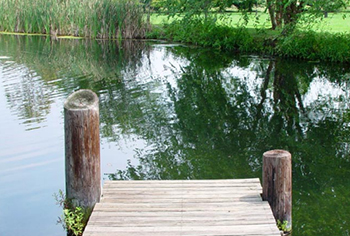
Photo credit: Dan Annarino
Hopefully no one is reading this after a catastrophic loss of their pond. This very wet summer has tested some ponds’ ability to hold and safely release excess water. I would like to quickly review the overflow structures ponds should have and also some management necessary to ensure the safety of ponds levees/dams.
For recreational ponds, there should be one or perhaps two means of releasing water from the pond. Most of these ponds are built on sloping land in order to capture rainwater to fill the pond. In this case, it is necessary to have an emergency spillway that will divert excess water once the pond is full away from the dam to prevent erosion and save the integrity of the structure. Usually they is just an earthen channel that runs around the end of the dam with an initial elevation 1-2 feet below the top of the dam. Water only runs through the spillway when the pond is full. An emergency spillway should have vegetation to prevent erosion but not to the extent that water is blocked from passing through efficiently.
A distinct advantage can be gained by having a drain structure installed through the dam when ponds are initially constructed. Drains such as this typically have a valve or swivel pipe which can regulate water level to whatever height the owner would like. With a wet summer such as we have had, the pond water level could be proactively lowered to save massive amounts of water passing through the spillway.
Additionally you can remove stagnant low oxygen water from the bottom of the pond. If a drain structure is releasing water from the bottom of the pond, it is a good idea to flush this valve two to three times per year to remove debris from around the structure which may plug it up if used infrequently. With these structures, it is a good idea to use the 6/12 rule. Water levels are kept six inches below maximum in order to catch any rain water event without overflowing. Evaporation and seepage will reduce the level back down over time. The 12 refers to the level the inches below maximum where you would add well water if you have the capacity. Generally this is only used with aquaculture ponds.
Control structures to maintain water levels will ensure the integrity of your ponds dams and levees. By controlling the amount of water flushing through a pond, the owner can also manage the productivity of the pond ecosystem by releasing/maintaining nutrients in the pond.
Resources
Commercial Greenhouse and Nursery Production: Controlling Algae in Irrigation Ponds, The Education Store, Purdue Extension Resource Center
Indiana Ponds, The Education Store
Indiana Ponds Q&A, The Education Store
Management of Ponds, Wetlands, and Other Water Reservoirs to Minimize Mosquitoes, The Education Store
Indiana Pond Management, Indiana Department of Natural Resources (IDNR), Fish & Pond Management
Ponds – Planning, Design, Construction, USDA Natural Resources Conservation Service (NRCS)
Bob Rode, Extension Aquaculture Specialist
Department of Forestry and Natural Resources, Purdue University
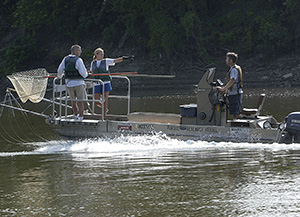
Photo credit: Tom Campbell
As boats enter and exit public bodies of water, they risk transferring aquatic plants, mussels or invertebrates that attach themselves to the bottom of the boat. While this might seem pretty harmless at first, this spreading of aquatic species runs the risk of introducing invasive species into new environments.
Invasive species cause harm to local ecosystems by reproducing exponentially when they are outside of their usual habitat and the organisms that keep their populations in check. They can then cause great damage by feeding on local species and the food they depend on. Once an invasive species is detected, it is oftentimes very expensive and difficult to control. For example, around 1991, the U.S. and Canada spent an estimated $20 million per year to control invasive sea lampreys and restore the trout populations that were damaged by them. In Indiana alone, we spend around $800,000 a year to attempt to control the growth of Eurasian watermilfoil, another nuisance invasive species.
In an attempt to avoid more cases like this in the future, the Indiana Department of Natural Resources (INDNR) is looking for help. Volunteers can sign up to record information about boats and their potential aquatic hitchhikers entering and leaving lakes during times of heavy use. The DNR Division of Fish and Wildlife can take this data and use it for public outreach and planning species management.
Those interested are highly encouraged to sign up on INDNR’s Volunteer Program page.
Resources
Aquatic Invasive Species (AIS), Indiana Department of Natural Resources
DNR Seeks Help Gathering Info on Spread of Aquatic Species, WFYI
Indiana Invasive Species Council, Purdue Entomology Extension
Invasive Plants, Purdue Agriculture Weed Science
The Education Store, Purdue Extension Resource Center (search “invasive”)
Indiana Department of Natural Resources
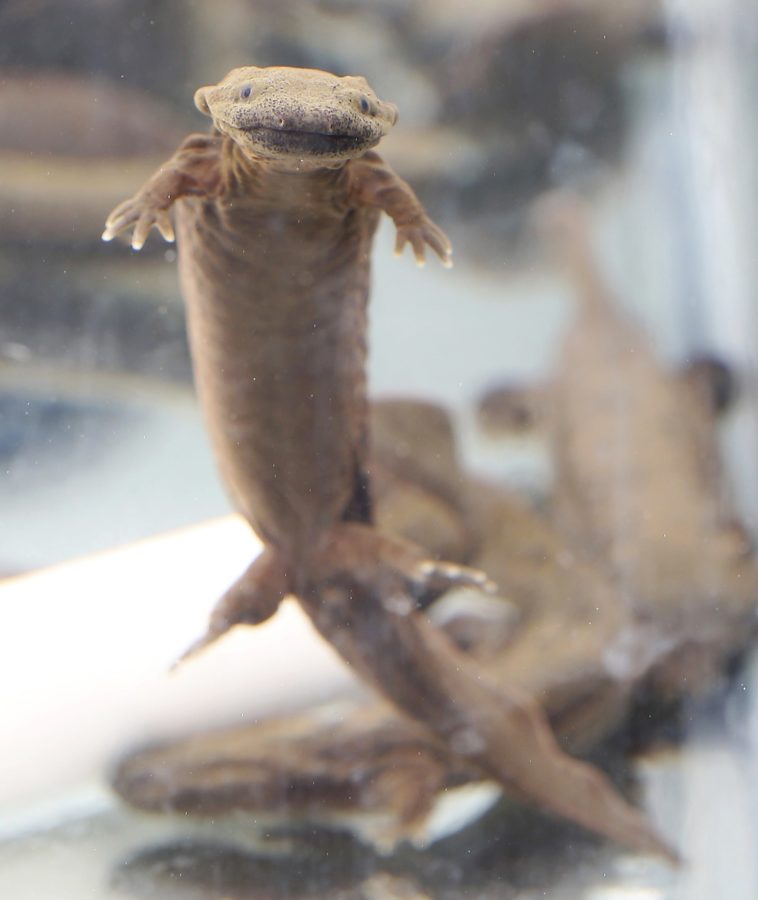 The next big step in the initiative to save the hellbenders of Indiana was completed on May 18, 2015, as three hellbenders were transferred from Purdue University’s Aquaculture Research Lab to the Columbian Park Zoo in Lafayette. This is the last of 50 hellbenders transferred from the lab to Columbian Park Zoo, Fort Wayne Children’s Zoo and Mesker Park Zoo in Evansville.
In 2013, Associate Professor of Wildlife Science Rod Williams and his team collected 300 eggs from the Blue River in Southern Indiana. These eggs grew into young hellbenders in the lab and were transferred to the three zoos to continue growing to adulthood. In the wild, hellbender mortality rate is extremely high, as high as 99%. The salamanders are at their most vulnerable state during their juvenile years, and being raised in captivity will greatly improve their chances of survival when they are released back into the wild in a couple years.
Once released, the hellbenders will be tracked via radio transmitters to monitor their movements, habitat preferences and survivorship. The last group of 18 hellbenders released into the wild had a 22.5% survival rate after one year, and Williams hopes to improve on that. A group of 80 more hellbenders will be released in 2016 with 130 in the following year. Williams’ goal of 40-50% survival rate would mark huge progress in saving the hellbenders of Indiana.
Resources
Help the Hellbender, Purdue Extension
The Nature of Teaching: Adaptations for Aquatic Amphibians, The Education Store, Purdue Extension resource center
How Our Zoos Help Hellbenders, The Education Store
Hellbenders Rock!, The Education Store
Help the Hellbender, North America’s Giant Salamander, The Education Store
How Anglers and Paddlers Can Help the Hellbender, Purdue Extension-FNR YouTube Video
Subscribe to Purdue Extension-FNR YouTube Channel
Rod Williams, Associate Professor of Wildlife Science
Purdue University Department of Forestry and Natural Resources

Recent Posts
- Spotted Lanternfly Feeds on Over 70 Plus Plant Species
Posted: May 20, 2026 in Alert, Forestry, Forests and Street Trees, Gardening, Invasive Insects, Urban Forestry, Wildlife - Painted Hickory Borer, Purdue Landscape Report
Posted: May 14, 2026 in Forestry, Invasive Insects, Wildlife - Saving Giants of the Blue River: Purdue Team Earns Statewide Recognition
Posted: in Aquaculture/Fish, Aquatic/Aquaculture Resources, Wildlife - Restoring Roots to Save the Salamanders, USDA – Natural Resources Conservation Service
Posted: May 6, 2026 in Aquaculture/Fish, Forestry, Wildlife - Spring Storms Are Coming: How to Reduce Tree Damage and Risk
Posted: May 1, 2026 in How To, Urban Forestry, Wildlife, Woodlands - Cryptocline Leaf Spot (Anthracnose) of Elm, Purdue Landscape Report
Posted: April 30, 2026 in Disease, Forestry, Woodlands - Mechanical Damage to Trees: Mowing and Maintenance Equipment
Posted: April 24, 2026 in Forestry, Forests and Street Trees, Urban Forestry - A Woodland Management Moment: Growing Quality Black Walnut in Openings
Posted: April 20, 2026 in Urban Forestry, Woodland Management Moment, Woodlands - Spring Into Bloom With ID That Tree
Posted: in Forests and Street Trees, Urban Forestry, Woodlands - Question: Have Whippoorwill Birds Declined in Numbers?
Posted: in Ask the Expert, Wildlife
Archives
Categories
- Alert
- Aquaculture/Fish
- Aquatic/Aquaculture Resources
- Ask the Expert
- Christmas Trees
- Community Development
- Disease
- Drought
- Forestry
- Forests and Street Trees
- Gardening
- Got Nature for Kids
- Great Lakes
- How To
- Invasive Animal Species
- Invasive Insects
- Invasive Plant Species
- Land Use
- Natural Resource Planning
- Nature of Teaching
- Plants
- Podcasts
- Ponds
- Publication
- Safety
- Spiders
- Timber Marketing
- Urban Forestry
- Webinar
- Wildlife
- Wood Products/Manufacturing
- Woodland Management Moment
- Woodlands