 Purdue University - Extension - Forestry and Natural Resources
Got Nature? Blog
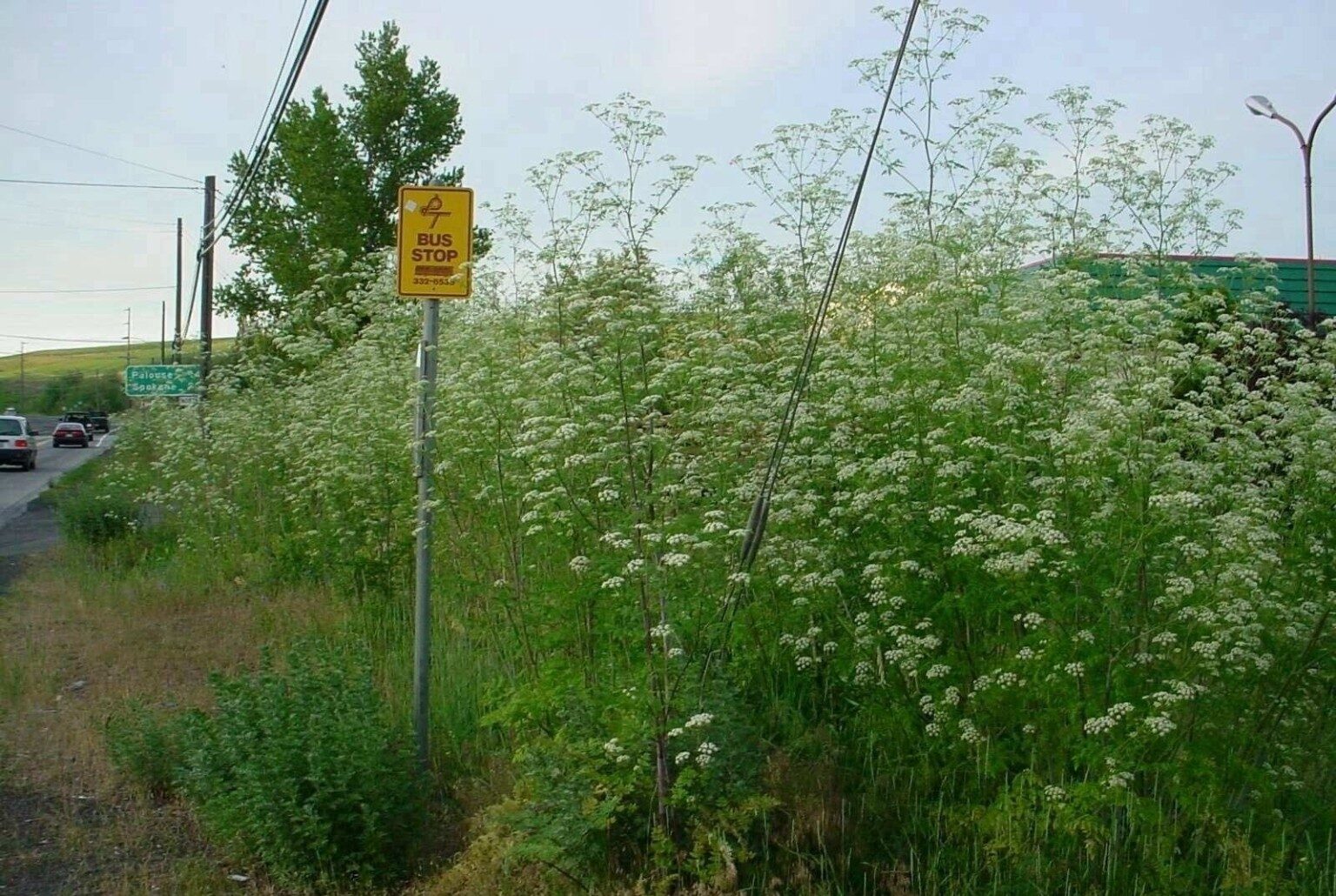
Photo by: Richard Old, XID Services, Inc., Bugwood.org.
Made infamous through the trial of Socrates, Shakespeare’s Hamlet and Macbeth, and several other works of classic literature, poison hemlock is an extremely toxic plant that will pose a risk this summer and should be handled with caution.
Poison hemlock is native to Europe. It is a biennial plant, meaning that it has a two-year lifespan. Last summer, it went through vegetative growth and largely stayed out of sight as a basal rosette. This summer, a long stem (up to 3 to 10 feet tall) will bolt and produce small white clusters of flowers. Poison hemlock is a member of the parsley family and can sometimes be confused with wild carrot. However, its distinguishing feature is its hairless hollow stalks with purple blotches.
The biggest risk with poison hemlock is ingestion. Lethal doses are fairly small, so it is important for animal owners or parents of young children to identify it in their area and remove it if possible. The toxins can also be absorbed through the skin and lungs, so be sure to wear gloves and a mask when handling these plants.
Symptoms of hemlock poisoning include dilation of the pupils, weakening or slowing pulse, blue coloration around the mouth and eventually paralysis of the central nervous system and muscles leading to death. Quick treatment can reverse the effects, so act quickly.
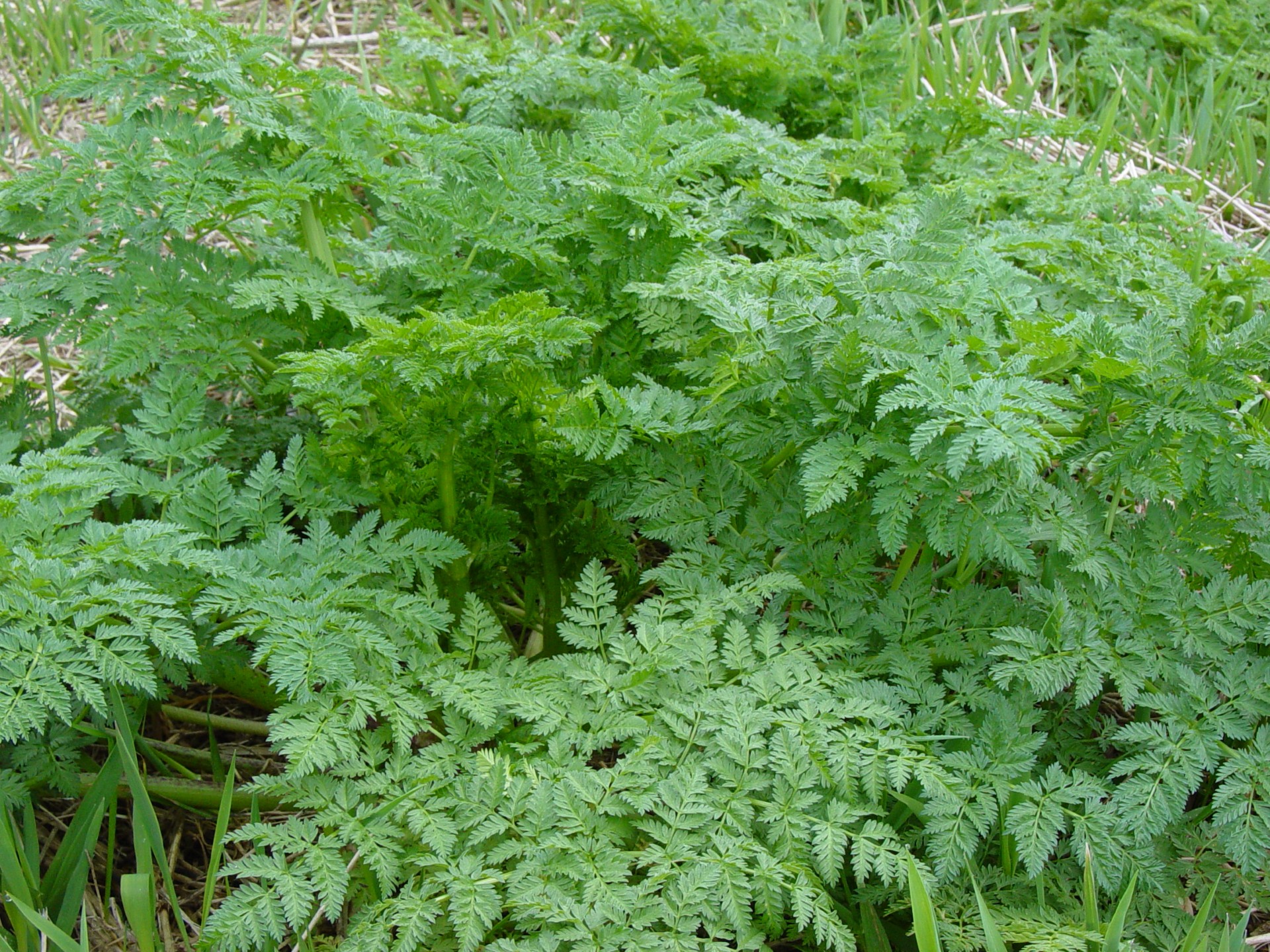 It is considered highly invasive and is listed on both Indiana’s noxious weed list and the terrestrial invasive plant rule list, Indiana General Assembly IC 14-24-12, IC 15-15, IC 15-16-7 to 10, Indiana Department of Natural Resources, Terrestrial Invasive Species – Plants. Thus, its occurrence may have legal implications for landowners. Some Indiana counties aggressively monitor and spray poison hemlock, particularly along county roads. It primarily invades disturbed and early succession sites such as roadsides, stream and ditch banks, vacant lots, and field borders. However, it can spread into pastures, hay fields, and other grassland habitats.
Its sap contains alkaloid toxins which are highly toxic to humans and animals. Although humans would not normally purposely or accidentally ingest poison hemlock (Socrates was a notable exception), care should be taken when mowing or cutting to avoid dermal and respiratory inhalation exposure. Livestock farmers should control poison hemlock in pastures, feed lots and holding pens and ensure it is not baled in hay.
Poison hemlock spreads via seed, so effective management must prevent new seed production, prevent spread of existing seed, and exhaust the existing seed supply in the soil seed bank.
Poison hemlock seed is often inadvertently spread by mowing, road maintenance or agricultural equipment. Mow infested areas along roadsides, ditch banks and field edges before seed develops. A single mowing may delay but not stop poison hemlock from growing another shoot and ultimately flowering and producing seed. Multiple mowings are likely required to prevent new seed production.
 Herbicide control should focus on the first-year basal rosette. Herbicide control can still be achieved in the early stages of flower stem development. However, as the flower stem grows so grows the amount of herbicide required to provide full coverage and thus full control. A 2% solution of glyphosate (41% active ingredient) in water with a non-ionic surfactant will provide good control of poison hemlock basal rosettes. If the poison hemlock is growing among desirable grasses, broadleaf-specific herbicides such as triclopyr and 2,4-D are also very effective on poison hemlock and will not harm the grasses. AS always, read the pesticide label for proper, safe handling and use.
For more information see Purdue Cooperative Extension Invasive Plant Fact Sheet Series FNR-437-W, Poison Hemlock. For further guidance on poison hemlock control, contact your county Purdue Cooperative Extension office.
Resources:
Noxious and Invasive Weeds and the Weed Laws in Indiana, Purdue Extension – Botany & Plant Pathology
Be Careful Around Highly Toxic Poison Hemlock Plant This Summer, Purdue Extension – Forestry and Natural Resources (FNR)
Poison Hemlock, Pest & Crop Newsletter, Purdue Extension – Entomology
Pest & Crop Newsletter, Purdue Extension
Recognizing and Managing Poison Hemlock, Purdue Landscape Report
Hemlock Woolly Adelgid: Distribution Update, Purdue Landscape Report
Poison Hemlock (Conium maculatum), United States Department of Agriculture (USDA)
Invasive plants: impact on environment and people, The Education Store, Purdue Extension’s resource center
Woodland Management Moment: Invasive Species Control Process, Video, Purdue Extension – Forestry and Natural Resources (FNR) YouTube Channel
What are Invasive Species and Why Should I Care?, Purdue Extension – Forestry and Natural Resources (FNR)
Indiana Invasive Species Council
Report INvasive, Purdue Extension & Indiana Invasive Species Council
Purdue Pest and Plant Diagnostic Lab
Ron Rathfon, Regional Extension Forester, Southern Indiana Purdue Agriculture Center (SIPAC)
Purdue Forestry and Natural Resources
Purdue Landscape Report: Poison hemlock was introduced to North America as a garden/ornamental plant. It is a native of Europe, and it is a member of the Apiaceae (parsley) family.
Purdue experts Bill Johnson and Marcelo Zimmer wrote about poison hemlock in a Purdue Pest & Crop newsletter.
They wrote that poison hemlock can be noticed very early in the spring every year, as it is typically one of the first weeds to green up, usually in late February to early March if temperatures are favorable. They said the largest threat of this weed is the toxicity of its alkaloids if ingested by livestock or humans, but it can also reduce the aesthetic value of landscapes and has been reported to creep into no-till corn and soybean fields as well.
Poison Hemlock
Purdue Extension’s fact sheet on poison hemlock states that it can also be found along roads, streams, trails, ditches, forest edges, and waste areas.
The Purdue experts said that poison hemlock is a biennial weed that exists as a low-growing herb in the first year, and bolts to three to eight feet tall in the second year, when it produces flowers and seed. It is often not noticed until the bolting and reproductive stages of the second year. Poison hemlock is often confused with wild carrot, but can be distinguished by its lack of hairs and purple blotches that occur on the stems.
The experts pointed out that poison hemlock contains five alkaloids that are toxic to humans and livestock, and it can be lethal if ingested. They warn that the plant’s alkaloids may also be absorbed through the skin, so if you find yourself hand-pulling poison hemlock, it would be a good idea to wear gloves. All parts of the plants contain the toxic alkaloids with levels being variable throughout the year. Symptoms of toxicity include nervousness, trembling, and loss of coordination followed by depression, coma, and/or death. Initial symptoms will occur within a few hours of ingestion.
For history buffs, the Greek philosopher Socrates was sentenced to death by hemlock poisoning.
Cases of poisoning due to poison hemlock ingestion are rare as the plants emit a mousy odor that makes it undesirable and unpalatable to livestock and humans. Consumption and toxicity in animals usually occur in poorly managed or overgrazed pastures where animals are forced to graze poison hemlock because desirable forage is lacking.
To view this full article and other Purdue Landscape Report articles, please visit Purdue Landscape Report.
Subscribe and receive the newsletter: Purdue Landscape Report Newsletter.
Resources:
Recognizing and Managing Poison Hemlock, Purdue Landscape Report
Purdue Pest & Crop Newsletter
Invasive Plant Species Fact Sheets: Poison Hemlock, The Education Store, Purdue Extension Resource Center
Hemlock Woolly Adelgid: Distribution Update, Purdue Landscape Report
Be Careful Around Highly Toxic Poison Hemlock Plant This Summer, Purdue Extension – Forestry and Natural Resources (FNR)
Poison Hemlock (Conium maculatum), United States Department of Agriculture (USDA)
Invasive plants: impact on environment and people, The Education Store, Purdue Extension’s resource center
Woodland Management Moment: Invasive Species Control Process, Video, Purdue Extension – Forestry and Natural Resources (FNR) YouTube Channel
Invasive Species, Playlist, Purdue Extension – FNR YouTube Channel
What are invasive species and why should I care?, Got Nature? Blog, Purdue Extension – FNR
Report Invasive, Purdue College of Agriculture – Entomology
Purdue Pest and Plant Diagnostic Lab, send in photo or sample
John Woodmansee, Extension Educator, Whitely County
Purdue Extension

Recent Posts
- Spotted Lanternfly Feeds on Over 70 Plus Plant Species
Posted: May 20, 2026 in Alert, Forestry, Forests and Street Trees, Gardening, Invasive Insects, Urban Forestry, Wildlife - Painted Hickory Borer, Purdue Landscape Report
Posted: May 14, 2026 in Forestry, Invasive Insects, Wildlife - Saving Giants of the Blue River: Purdue Team Earns Statewide Recognition
Posted: in Aquaculture/Fish, Aquatic/Aquaculture Resources, Wildlife - Restoring Roots to Save the Salamanders, USDA – Natural Resources Conservation Service
Posted: May 6, 2026 in Aquaculture/Fish, Forestry, Wildlife - Spring Storms Are Coming: How to Reduce Tree Damage and Risk
Posted: May 1, 2026 in How To, Urban Forestry, Wildlife, Woodlands - Cryptocline Leaf Spot (Anthracnose) of Elm, Purdue Landscape Report
Posted: April 30, 2026 in Disease, Forestry, Woodlands - Mechanical Damage to Trees: Mowing and Maintenance Equipment
Posted: April 24, 2026 in Forestry, Forests and Street Trees, Urban Forestry - A Woodland Management Moment: Growing Quality Black Walnut in Openings
Posted: April 20, 2026 in Urban Forestry, Woodland Management Moment, Woodlands - Spring Into Bloom With ID That Tree
Posted: in Forests and Street Trees, Urban Forestry, Woodlands - Question: Have Whippoorwill Birds Declined in Numbers?
Posted: in Ask the Expert, Wildlife
Archives
Categories
- Alert
- Aquaculture/Fish
- Aquatic/Aquaculture Resources
- Ask the Expert
- Christmas Trees
- Community Development
- Disease
- Drought
- Forestry
- Forests and Street Trees
- Gardening
- Got Nature for Kids
- Great Lakes
- How To
- Invasive Animal Species
- Invasive Insects
- Invasive Plant Species
- Land Use
- Natural Resource Planning
- Nature of Teaching
- Plants
- Podcasts
- Ponds
- Publication
- Safety
- Spiders
- Timber Marketing
- Urban Forestry
- Webinar
- Wildlife
- Wood Products/Manufacturing
- Woodland Management Moment
- Woodlands