 Purdue University - Extension - Forestry and Natural Resources
Got Nature? Blog
Explore the dual nature of goldenrods in conservation plantings. While goldenrods like tall and Canada goldenrod benefit pollinators and wildlife, their aggressive growth can outcompete other plants, reducing diversity. This guide offers insights into managing goldenrods to maintain a balanced and thriving ecosystem. It is essential reading for land managers and conservationists committed to maintaining a diverse grassland ecosystem.

Check out the Managing Conservation Plantings series which include details on how to control invasive species and other problematic plants in Conservation Reserve Program (CRP) plantings and native warm-season grass and wildflower conservation plantings.
Plant Facts
- Herbaceous broadleaf, typically 3-5 feet tall (can range from 1 to 7 feet)
- Perennial warm-season forb
- Growing period: April to October
- Flowering: late July through October
- Reproduction: by seed and rhizome
Whether you’re managing a pasture, wildlife area, or prairie restoration, this resource provides science-based strategies to control goldenrod effectively. Learn more about managing goldenrod species in grasslands and wildlife habitats, enhancing your land’s ecological health by reading the full publication: Managing Conservation Plantings: Goldenrod Control, (330kb, pdf).
This publication is part of a seven publication series The Managing Conservation Plantings Series. Publications in this series include:
- Golden Rod Control
- Thinning Native Warm-Season Grasses
- Sericea Lespedeza Control
- Woody Encroachment and Woody Invasives
- Johnson Grass Control
- Reed Canarygrass Control
- Teasel Control (Common and Cut Leaved)
- Controlling Introduced Cool-season Grasses
- Crownvetch, Sweetclover and Birdsfoot Trefoil Control
Resources:
Deer Impact Toolbox & Grassland Management, Purdue Extension Pond and Wildlife Management
Pond and Wildlife Management, Purdue Extension
Forestry for the Birds Virtual Tour and Pocket Guide, Got Nature? Blog, Purdue Extension – FNR
Frost Seeding to Establish Wildlife Food Plots and Native Grass and Forb Plantings – Purdue Extension – FNR YouTube channel
Wildlife Habitat Hint: Tips for Evaluating a First Year Native Grass and Forb Plantings, Purdue Extension – FNR YouTube Channel
Drone Seeding Native Grasses and Forbs: Project Overview & Drone Setup, Purdue Extension – FNR YouTube channel
Ask an Expert: Wildlife Food Plots, video, Purdue Extension – FNR YouTube Channel
Handling Harvested Game: Episode 1, Field Dressing, video, Purdue Extension – FNR YouTube Channel
Managing Your Woods for White-Tailed Deer, The Education Store
Forest Improvement Handbook, The Education Store
Forest Management for Reptiles and Amphibians: A Technical Guide for the Midwest, The Education Store
A Template for Your Wildlife Habitat Management Plan, The Education Store
Woodland Stewardship for Landowners, Playlist, Purdue Extension – FNR YouTube channel
Nature of Teaching Unit 1: Animal Diversity and Tracking, The Education Store
Nature of Teaching, Purdue College of Agriculture
Invasive Species Playlist, Playlist, Purdue Extension – FNR YouTube Channel
Report Invasive, Purdue Extension
Subscribe Purdue Extension – Forestry and Natural Resources YouTube Channel
Jarred Brooke, Wildlife Extension Specialist
Purdue Department of Forestry and Natural Resources
The precipitous decline in songbird numbers over the past few decades has made national news and generated calls for action to address the issues contributing to this decline. One of the contributing factors to the decline of several North American bird species is the diminishing area of suitable habitat.
 The initial assumption that many people have is this loss of habitat is forests or grasslands being converted into cropland or developments. While this does happen and is a concern in some areas, Indiana has actually been increasing our area of forest over the last several decades. An increasingly common habitat threat to several bird species is changing grassland or forest structure that occur through time in the absence of historic disturbances like fires or land management activities like thinning and harvesting.
The invasion of forests, wetlands, and grasslands by invasive plant species can also degrade or destroy habitat values for birds and other wildlife. Managing areas to reduce invasive species and introducing disturbances like prescribed fires, critical area plantings, thinning, and regeneration activities can improve habitat quality for a variety of declining birds.
The The Nature Conservancy in Indiana, partnering with birders, ornithologists, foresters, and wildlife biologists, has developed the Forestry for the Birds program, modeled from a similar program in Vermont. The goal is to provide strategies that can benefit both forest management and bird communities, facilitating and simplifying the management of bird-friendly forests. “The Birders Dozen” were selected among declining birds that Indiana residents could identify by sight or song and need conservation action through habitat management.
Learn more about Forestry for the Birds, the Birders Dozen, and what you can do to help declining birds and other wildlife in Indiana. Find the Forestry for the Birds Pocket Guide which is a free download.
Resources:
Managing Woodlands for Birds Video, Purdue Extension-Forestry and Natural Resources (FNR) YouTube Channel
Breeding Birds and Forest Management: the Hardwood Ecosystem Experiment and the Central Hardwoods Region, The Education Store
The Birders’ Dozen, Profile: Baltimore Oriole, Indiana Woodland Steward
Ask An Expert, Playlist, Purdue Extension – FNR YouTube channel
It’s For the Birds, Indiana Yard and Garden-Purdue Consumer Horticulture
Birds and Residential Window Strikes: Tips for Prevention, The Education Store, Purdue Extension resource center
No Room at the Inn: Suburban Backyards and Migratory Birds, Education Store, Purdue Extension resource center
Hardwood Ecosystem Experiment – Wildlife Responses to Timber Harvesting, The Education Store
Subscribe, Purdue Extension – FNR YouTube Channel
Lenny Farlee, Sustaining Hardwood Extension Specialist
Purdue University Department of Forestry and Natural Resources
Jessica Outcalt, Agricultural & Natural Resources Educator
Purdue University Department of Forestry and Natural Resources
The Nature Conservancy – Indiana
Just because the winter days are cold and dreary doesn’t mean the work to improve wildlife habitat on your property has to stop. In fact, now is a perfect time for a wide range of habitat projects. One such project is frost seeding native grasses and forbs. Here’s why you should brave the cold and consider sowing your seeds this winter.
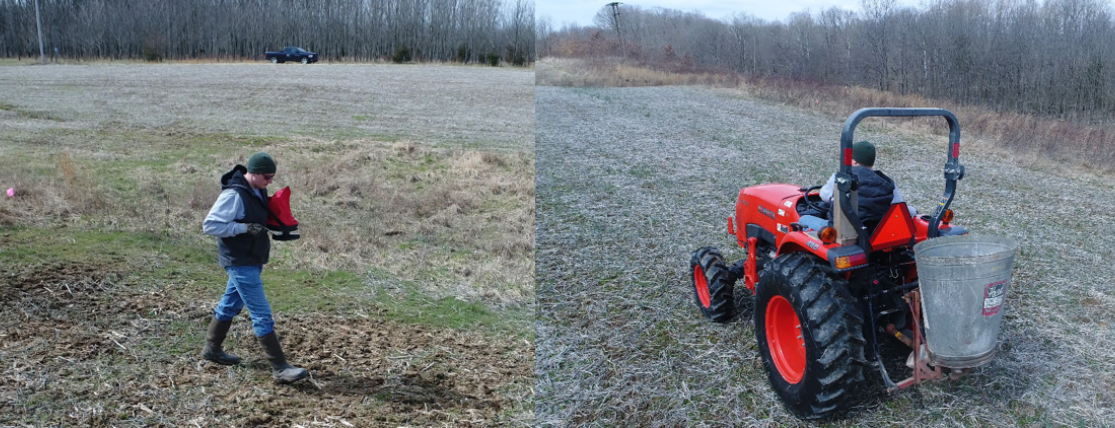
Picture 3. Smaller fields can be established with just a hand seed spreader (left), whereas an ATV or tractor-mounted spreader is better for larger fields (right).
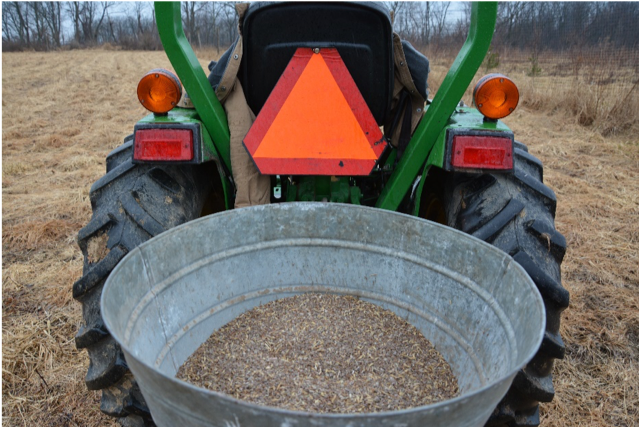
Picture 2. When broadcasting native seed, it should be mixed with a carrier (pelletized lime here) to help the seed flow through the spreader.
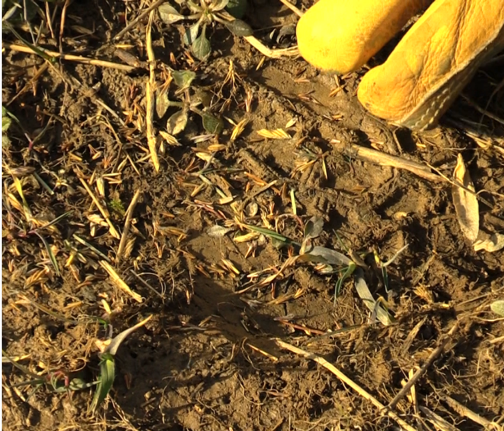
Picture 1. After frost seeding, the native grass and forb seed is visible on the ground, but the freezing and thawing of the soil will ensure good seed-to-soil contact.
Its natural
If you think about how a native prairie works, many of the seeds ripen in the late summer and early fall and drop to the ground throughout the fall and winter. So, sowing seeds from January through March or frost seeding is mimicking what would have occurred naturally. By doing such, you are taking advantage of the freezing and thawing cycles of the soil. The helps with a couple things.
First, many native plant seeds – forbs (wildflowers) especially – need that natural freezing and thawing cycles to break their dormancy. Thus, frost seeding can help increase the germination of many of these species. Second, the freezing and thawing of the soil helps to work the seed into the soil, which can improve seed-to-soil contact, an important factor in planting success (picture 1).
Less time to waste
Dormant seeding or seeding once the soil dips below a certain temperature (as early as November) is another viable option to establish a native grass and forb stand. But with frost seeding, the seed remains on the soil for less time before germination. Which may reduce the seeds’ exposure to soil pathogens, rodents, birds, or other critters that may eat the seed or reduce germination.
Minimalist-style
Frost seeding native grasses and forbs can be done will minimal equipment. All you need to frost seed is a hand or mechanical seed spreader, the seed, and a carrier (picture 2). Using a hand seed spreader works great for small fields, but you may consider using an ATV or tractor-mounted mechanical spreader for larger fields (picture 3).
Another option is to use a no-till seed drill. Of course, this will require more specialized equipment, but many Soil and Water Conservation Districts or Pheasants and Quail Forever Chapters have no-till drills that you can borrow or rent to help complete your project.
When it comes to establishing native grasses and forbs, there is more than one way to plant a field. But, frost seeding might be the option that is best suited for you and your site.
For a How-To on frost seeding, check out our Frost Seeding Video below:
Resources
Frost Seeding to Establish Wildlife Food Plots & Native Grass and Forb Plantings, video, The Education Store, Purdue Extension Resource Center
Calibrating a No-Till Drill for Conservation Plantings and Wildlife Food Plots, video, The Education Store
Renovating native warm-season grass stands for wildlife: a land manager’s guide, The Education Store
Purdue Extension Pond and Wildlife Management Website, Purdue Extension
Jarred Brooke, Wildlife Extension Specialist
Department of Forestry & Natural Resource, Purdue University

Recent Posts
- Spotted Lanternfly Feeds on Over 70 Plus Plant Species
Posted: May 20, 2026 in Alert, Forestry, Forests and Street Trees, Gardening, Invasive Insects, Urban Forestry, Wildlife - Painted Hickory Borer, Purdue Landscape Report
Posted: May 14, 2026 in Forestry, Invasive Insects, Wildlife - Saving Giants of the Blue River: Purdue Team Earns Statewide Recognition
Posted: in Aquaculture/Fish, Aquatic/Aquaculture Resources, Wildlife - Restoring Roots to Save the Salamanders, USDA – Natural Resources Conservation Service
Posted: May 6, 2026 in Aquaculture/Fish, Forestry, Wildlife - Spring Storms Are Coming: How to Reduce Tree Damage and Risk
Posted: May 1, 2026 in How To, Urban Forestry, Wildlife, Woodlands - Cryptocline Leaf Spot (Anthracnose) of Elm, Purdue Landscape Report
Posted: April 30, 2026 in Disease, Forestry, Woodlands - Mechanical Damage to Trees: Mowing and Maintenance Equipment
Posted: April 24, 2026 in Forestry, Forests and Street Trees, Urban Forestry - A Woodland Management Moment: Growing Quality Black Walnut in Openings
Posted: April 20, 2026 in Urban Forestry, Woodland Management Moment, Woodlands - Spring Into Bloom With ID That Tree
Posted: in Forests and Street Trees, Urban Forestry, Woodlands - Question: Have Whippoorwill Birds Declined in Numbers?
Posted: in Ask the Expert, Wildlife
Archives
Categories
- Alert
- Aquaculture/Fish
- Aquatic/Aquaculture Resources
- Ask the Expert
- Christmas Trees
- Community Development
- Disease
- Drought
- Forestry
- Forests and Street Trees
- Gardening
- Got Nature for Kids
- Great Lakes
- How To
- Invasive Animal Species
- Invasive Insects
- Invasive Plant Species
- Land Use
- Natural Resource Planning
- Nature of Teaching
- Plants
- Podcasts
- Ponds
- Publication
- Safety
- Spiders
- Timber Marketing
- Urban Forestry
- Webinar
- Wildlife
- Wood Products/Manufacturing
- Woodland Management Moment
- Woodlands