
Project Overview
Rationale
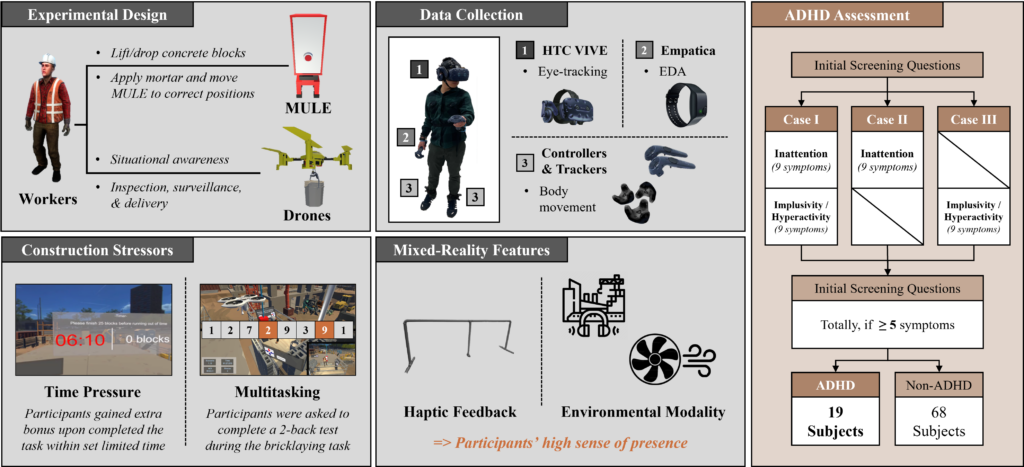
Future construction sites will increasingly rely on autonomous technologies, AI, robotics, and digital twins. While these technologies promise safer and more productive workplaces, their success depends on understanding the diverse needs of the workforce. This research investigates how neurodiverse workers, particularly individuals with ADHD, interact with autonomous teammates and navigate demanding construction environments. By uncovering their unique strengths, challenges, and behavioral patterns, we develop human-centered technologies that promote safety, productivity, well-being, and workplace inclusivity in the future of construction.
Impact
- Advance workplace inclusivity by creating construction technologies that support neurodiverse workers rather than adopting a one-size-fits-all approach.
- Identify the unique strengths of ADHD workers, including productivity, engagement in hands-on tasks, and performance under time pressure.
- Reveal critical safety and cognitive challenges, such as reduced situational awareness, multitasking difficulties, and elevated stress levels.
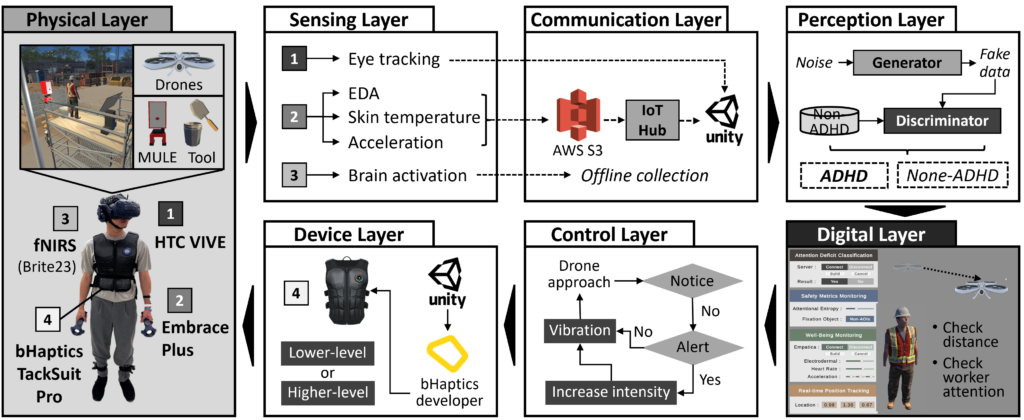
- Enable personalized human-autonomy teaming strategies that adapt support, communication, and interventions to individual worker needs.
- Establish a foundation for human digital twins that continuously understand worker states and deliver tailored assistance in real time.
Publication List
Journal Papers
- Chang, W. C., Ismael Becerra, J., Karalunas, S. L., Esmaeili, B., & Hasanzadeh, S. (2026). “How ADHD Workers Will Navigate Future Construction Sites: Safety, Task Performance, and Stress Management under Construction Stressors”. Journal of Management Engineering. (Under review).
Conference Proceedings
- Chang, W. C., Esmaeili, B., & Hasanzadeh, S. (2026). “Enhancing Early Cognitive Engagement in Human–Robot Communication Through Neurodiversity-Aware Human Digital Twins”. Neuroergonomics. Boston, Massachusetts.
- Chang, W. C., Zhou, W., & Hasanzadeh, S. (2026). “A Human Digital Twin for Real-time Safety Alerting to Support Workers with ADHD in Human–Robot Interaction”. The 23rd Smart and Sustainable Built Environment (SASBE). Cambridge, UK
- Chang, W. C., Ismael Becerra, J., Karalunas, S. L., Esmaeili, B., Yu, L. F., & Hasanzadeh, S. (2024). “Pioneering Research on a Neurodiverse ADHD Workforce in the Future Construction Industry”. Construction Research Congress 2024. Des Moines, Iowa.
Researcher

Woei-Chyi Chang
Collaborators
- Vincent Duffy, PhD, Edwardson School of Industrial Engineering, Purdue University
- Sarah Karalunas, PhD, College of Arts and Sciences, Syracuse University
- Behzad Esmaeili, PhD, Lyles School of Civil and Construction Engineering, Purdue University
Funding Source