
Project Overview
Rationale
The construction industry is entering an era in which autonomous technologies, such as drones, robots, and AI-enabled systems, are becoming integral members of the workforce. Despite rapid advances in autonomous capabilities, the success of these technologies ultimately depends on the workers who interact and collaborate with them.
Current research has largely focused on improving the technical performance of autonomous systems. Comparatively less attention has been devoted to understanding the human side of human-autonomy teaming. Construction workers continuously experience changes in attention, stress, trust, workload, and situational awareness. These factors can influence how workers perceive autonomous systems and affect overall team performance.
A major challenge is that today’s autonomous systems have limited ability to recognize and respond to workers’ cognitive and physiological states. As a result, communication breakdowns, inappropriate trust calibration, and reduced team effectiveness may occur.
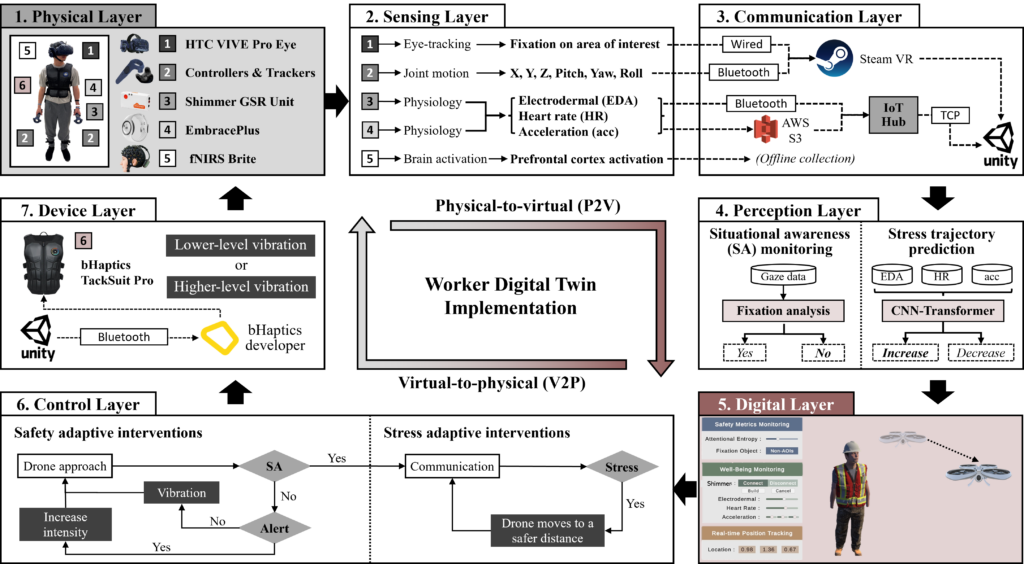
To address this gap, this research develops Human Digital Twin technologies that continuously model workers’ cognitive, physiological, and behavioral conditions in real time. By enabling autonomous systems to understand individual workers and adapt their communication and behaviors accordingly, this research seeks to establish a human-centered paradigm for future construction. The ultimate goal is to foster safer, more efficient, trustworthy, and inclusive human-autonomy teaming environments.
Impact
- Develop a system that can understand and respond to workers’ cognitive, physiological, and behavioral states in real time, creating safer and more human-aware work environments.
- Establish next-generation Human Digital Twin technologies that integrate wearable sensing, AI, and digital twins to represent and support human needs in real-world operations.
- Support personalized assistance for workers with diverse capabilities, experiences, and cognitive characteristics, promoting a more inclusive future workforce.
- Provide a foundation for transforming autonomous systems from passive tools into intelligent teammates that can continuously adapt to human conditions and preferences.
Publication List
Journal Papers
- Chang, W. C., & Hasanzadeh, S. (2025). “Mental Workload in Worker-Drone Communication in Future Construction: Considering Coexistence, Cooperation, and Collaboration Interaction Levels”. Advanced Engineering Informatics, 65(A), 103110. DOI: 10.1016/j.aei.2025.103110
- Chang, W. C., Garcia, N. F. G., Esmaeili, B., & Hasanzadeh, S. (2025). “Deep Learning–based Prediction of Human-Robot Trust Dynamics in Future Construction”. Journal of Computing in Civil Engineering, 39(4), 04025047. DOI: 10.1061/JCCEE5.CPENG-6302
- Chang, W. C., Esmaeili, B., & Hasanzadeh, S. (2025). “The Impacts of Physical and Informational Failures on Worker-Autonomy Trust in Future Construction”. Journal of Construction Engineering Management, 151(4), 04025011. DOI: 10.1061/JCEMD4/COENG-15241
- Chang, W. C., Lu, H. K., & Chen, P. H. (2025). “Application of Mixed Reality and Infrared Inspection to Examination of External Wall Tiles”. Journal of Performance of Constructed Facilities, 36(6), 04025062. DOI: 10.1061/JPCFEV.CFENG-5179
- Chang, W. C., & Hasanzadeh, S. (2024). “Toward a Framework for Trust Building between Humans and Robots in the Construction Industry: A Systematic Review of Current Research and Future Directions”. Journal of Computing in Civil Engineering, 38(3), 03124001. DOI: 10.1061/JCCEE5.CPENG-5656
Conference Proceedings
- Chang, W. C., Yu, L. F., Esmaeili, B., & Hasanzadeh, S. (2025). “Exploring Worker-Drone Interaction in Mixed Reality: Balancing Distraction and Situational Awareness”. The 32nd IEEE Conference on Virtual Reality and 3D User Interfaces. Arles, France.
- Chang, W. C., Pooladvand, S, & Hasanzadeh, S. (2025). “The Impact of Physically Demanding Human-Drone Communication on Worker Mental Stress”. The CIB World Building Congress. West Lafayette, Indiana. [Best Conference Paper Award]
- Chang, W. C., Zhou, W., & Hasanzadeh, S. (2025). “AI-Driven Assistant for Worker Safety in Future Construction: Examining Opportunity and Challenges”. Conference on Human Factors and Ergonomics Society Annual Meeting. Chicago, Illinois.
- Chang, W. C., Pooladvand, S., Esmaeili, B., & Hasanzadeh, S. (2024). “Worker-Drone Communication and Stress in Construction Workplaces under Varying Safety Conditions”. International Conference on Computing in Civil Engineering. Pittsburgh, Pennsylvania.
- Chang, W. C., Garcia, N. F. G., Esmaeili, B., & Hasanzadeh, S. (2024). “Partial Personalization for Worker-robot Trust Prediction in the Future Construction Environment”. International Symposium on Automation and Robotics in Construction (ISARC). Lille, France. [Invited for Plenary Talk]
- Chang, W. C., Ismael Becerra, J., Karalunas, S. L., Esmaeili, B., Yu, L. F., & Hasanzadeh, S. (2024). “Pioneering Research on a Neurodiverse ADHD Workforce in the Future Construction Industry”. Construction Research Congress 2024. Des Moines, Iowa.
- Chang, W. C., Ryan, S. M., Hasanzadeh, S., & Esmaeili, B. (2023). “Attributing Responsibility for Performance Failure on Worker-Robot Trust in Construction Collaborative Tasks”. 2023 European Conference on Computing in Construction (EC3). Crete, Greece. [Invited for special collection in Automation in Construction]
- Chang, W. C., Borowiak, A., & Hasanzadeh, S. (2023). “The Importance of Situational Awareness in Future Construction Work: Toward the Effects of Faulty Robots, Trust, and Time Pressure”. International Conference on Computing in Civil Engineering. Corvallis, Oregon.
Researcher



Woei-Chyi Chang
Wei Zhou
Chao-Sheng Hung
Funding Source