
Project Overview
Rationale
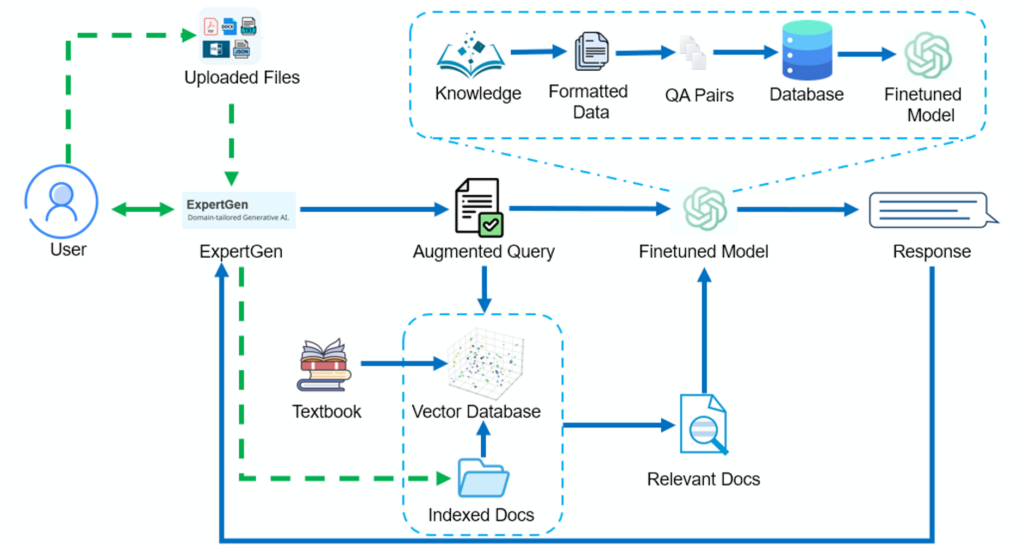
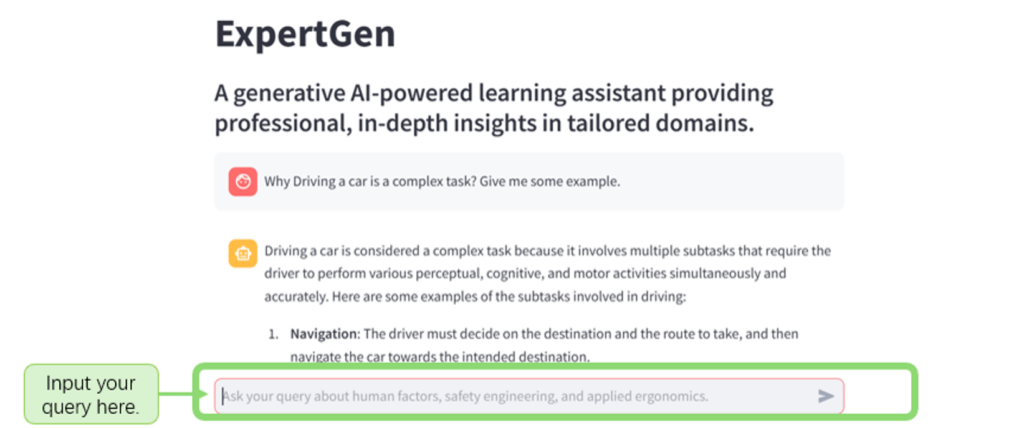
A Generative AI for Construction class because it demonstrates why general-purpose tools such as ChatGPT may not be sufficient for domain-specific learning and decision-making. The general generative AI systems can produce hallucinated or misleading responses, which weakens accountability and user trust. To address this, this research developed ExpertGen, a domain-tailored generative AI system designed to provide real-time, accurate, and context-specific support. The study compares ExpertGen with ChatGPT and traditional eBooks using learning performance, NASA-TLX cognitive workload, and user trust as evaluation metrics.
Impact
- Domain-specific AI matters: Construction AI should be trained or grounded in construction codes, safety rules, BIM, scheduling, and project documents.
- Better learning support: ExpertGen helped users perform better than traditional eBook learning and general ChatGPT.
- Lower cognitive workload: Domain-tailored AI can help students understand complex construction concepts with less mental effort.
- Higher trust: Users trusted ExpertGen more because its answers were more relevant and source-based.
- Useful evaluation model: Performance, workload, and trust can be used to evaluate GenAI tools in construction education.
Publication List
Conference Proceedings
- Jiang, N., Zhou, W., Hasanzadeh, S., & Duffy Ph D, V. G. (2025). Application of Generative AI in Civil Engineering Education: A Systematic Review of Current Research and Future Directions. In CIB Conferences (Vol. 1, No. 1, p. 306).
- Jiang, N., Zhou, W., Hasanzadeh, S., & Duffy, V. G. (2025, May). ExpertGen: A Comparative Analysis of User Performance, Cognitive Workload, and Trust in Domain-Tailored Generative AI. In International Conference on Human-Computer Interaction (pp. 178-190). Cham: Springer Nature Switzerland.
Researcher


Wei Zhou
Jae-Hyun Myung
Collaborators
- Vincent Duffy, PhD, Edwardson School of Industrial Engineering, Purdue University
- Nina Jiang, PhD, Department of Mechanical and Industrial Engineering, Louisiana State University
Funding Source