
Project Overview
Rationale
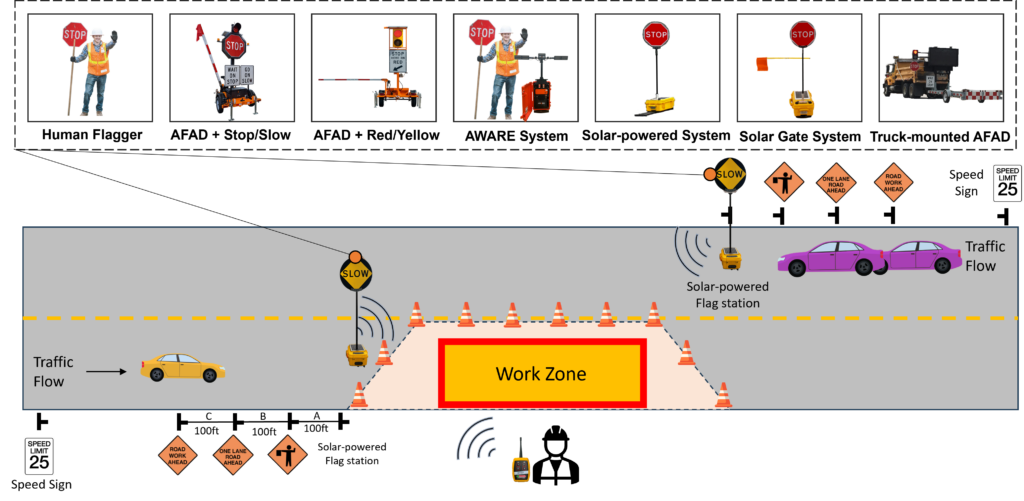
Work-zone flagging operations are critical for driver safety, but traditional human flagging can be inconsistent, difficult to notice, and risky for workers. This project evaluates multiple automated and enhanced flagging technologies using driving simulation, eye-tracking, physiological sensing, surveys, and field feedback to identify systems that improve driver attention, response, and safe stopping behavior.
Impact
- Reduce worker exposure to traffic hazards by supporting alternatives to traditional human flaggers in high-risk work-zone environments.
- Improve work-zone safety by identifying flagging technologies that help drivers detect stop conditions earlier and respond more safely.
- Support technology selection and deployment through a decision-making matrix that considers driver behavior, worker/operator feedback, and practical field implementation.
Publication List
Conference Proceedings
- Zhou, W., Zang, J., Liu, C.L., et al. (2026) “Evaluating the Impact of Warning Signals on Drivers’ Attention and Reaction: A Driving Simulation of Flagging Technology”. Construction Research Congress 2026. San Antonio, Texas.
Researcher



Chia-Ling (Gillian) Liu
Wei Zhou
Woei-Chyi Chang
Collaborators
- Brandon Pitts, PhD, Edwardson School of Industrial Engineering, Purdue University
- Behzad Esmaeili, PhD, Lyles School of Civil and Construction Engineering, Purdue University
Funding Source