
April 14, 2005
Purdue scientist making sense of scent earns research award
WEST LAFAYETTE, Ind. - Shakespeare wrote, "That which we call a rose by any other name would smell as sweet." But many popular flowers today have lost the heady bouquet they had in the days of the bard.
|
As plants have been bred to maximize color, shape and other characteristics, such as long-lasting blooms after cutting, the scents have disappeared for reasons no one knows.
Natalia Dudareva, associate professor of horticulture at Purdue University, is one of the few scientists in the world working to answer those questions. The research breakthroughs she has made have landed her the 2005 Agricultural Research Award from the Purdue College of Agriculture.
The award recognizes research excellence by a faculty member in the College of Agriculture with less than 15 years of experience beyond their doctorate and carries a $10,000 prize for the recipient's research program. Dudareva will receive the award during a ceremony at 2:15 p.m. Friday (April 15) in Whistler Hall, Room 116. The event is free and open to the public.
"Dr. Dudareva runs one of the world's leading research programs in the biology of floral scent, a field that has long perplexed agricultural scientists," said Randy Woodson, dean of Purdue Agriculture. "She is richly deserving of the Agricultural Research Award."
Edward Ashworth, head of the Department of Horticulture and Landscape Architecture, said Dudareva's insight into the science of floral scent is a major contribution to agriculture and the horticulture industry.
"Dr. Dudareva is a first-class scientist who has applied solid scientific principles to solving an important agricultural problem," Ashworth said. "Her work on floral scent has implications for improving pollination of crops and enhancing the value of flower crops in the consumer florist trade."
Improving floral scent is a goal of the $20 billion per year horticulture industry, but it also is important to agriculture. Almost three-fourths of all crops depend on insect pollinators, such as honey bees, which are attracted by floral scents.
Boosting a bouquet's bouquet would not only make flower beds more aesthetically pleasing, but also would improve the yield and quality of many crops, Ashworth said.
Dudareva's research also has important implications for researchers trying to harness plant pathways to produce essential oils, often used as flavor additives in food and medicine or as fragrance in body-care products.
"The yield of essential oils depends on the amount of materials available in the cell, and knowing how the plant produces these compounds is the place to start," she said.
Dudareva, who grew up in Soviet Russia, began her studies of floral scent in the mid-1990s. At that time, it was a completely new field of study, she said.
"Floral scent production was a field with many unanswered questions and new things to discover," she said. "That's what attracted me to this research."
Writer: Jennifer Cutraro, (765) 496-2050, jcutraro@purdue.edu
Sources: William R. Woodson, (765)494-8391, woodson@purdue.edu
Edward Ashworth, (765) 494-1306, ashworth@purdue.edu
Natalia Dudareva, (765) 494-1325, dudareva@purdue.edu
Ag Communications: (765) 494-2722;
Beth Forbes, forbes@purdue.edu
Agriculture News Page
PHOTO CAPTION:
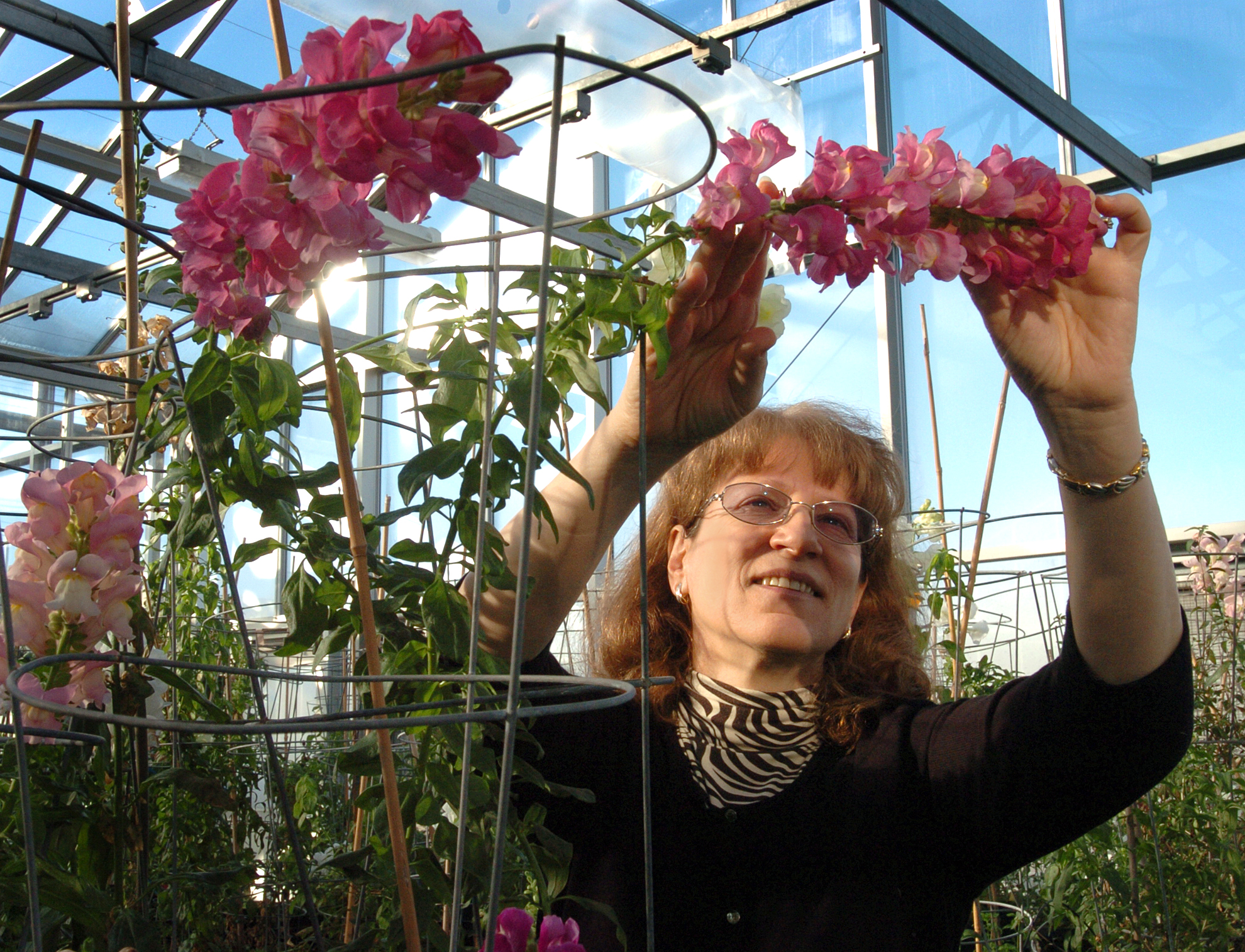
For her insights into the biology of floral scent production, Natalia Dudareva, associate professor of horticulture, will receive the 2005 Purdue Agriculture Research Award. Her research has the potential to lead to enhanced pollination of crop plants as well as the production of sweeter-smelling commercial flowers. (Purdue News Service file photo/David Umberger)
A publication-quality file photo is available at https://www.purdue.edu/uns/images/+2005/dudareva-pathway.jpg

To the News Service home page